Question about germanium transistor temperature sensitivity.

Thread Starter

Art Hall

Joined Jul 25, 2018
11
I have a few old germanium transistors that I thought it might be fun to play around with in a guitar fuzz/distortion circuit. I've often heard that one of their "problems" was their sensitivity to temperature changes, but never much more comment than that. My question is: is their problem too high of temperature, too low, or just changing temp?

If I could use them in a set temp, would it be ideal to have low temp, high temp, or just a stable temp, regardless of what temp it was?

Hope that makes sense.
Artie
 

crutschow

Joined Mar 14, 2008
38,322
The main problem is that germanium transistors have significantly more junction leakage current than silicon devices, and it goes up with temperature.
That's one of the big reason why all semiconductor devices went from germanium to silicon, which has a much lower junction leakage.
If you design the circuit to account for the Ge leakage, and don't operate at much above normal room temperature, they should work ok.
 

Thread Starter

Art Hall

Joined Jul 25, 2018
11
Thanks @crutschow. Germanium fuzz's seem to have a special place, (tonewise), in guitarist hearts. And although it may sound weird, I was toying with the idea of making a Germanium Fuzz, where the transistor was actually mounted inside a tiny environmental chamber. I would just use a miniature Peltier Affect device, in a tiny chamber, with perhaps an equally as small "boxer" fan.

I got the idea from many years working in an Air Force, or Navy, Cal Lab, where we had these giant environmental ovens to stabilize components for calibration. I just thought it might be a fun, (and crazy), project just to try.

Then again, I may be getting senile. :p
 

KeithWalker

Joined Jul 10, 2017
3,603
Germanium transistors have stable enough temperature characteristics to have been used successfully in very many transistor radios. There should be no problem using them in a fuzz box.
 

Thread Starter

Art Hall

Joined Jul 25, 2018
11
Dennis: Thanks. I've used CoPilot for several things, but I'm still not used to it being there. I get into an interesting forum, and ask there instead of what's in front of me. (Lower right corner, actually.)

Keith: Thanks also. I guess this was more of a "wretched excess" type of project. I've had a couple Germanium fuzz's that were fine. It may turn out to be more of a mental exercise. Not sure if I'll actually build this or not.
 

Ian0

Joined Aug 7, 2020
13,097
Thanks @crutschow. Germanium fuzz's seem to have a special place, (tonewise), in guitarist hearts. And although it may sound weird, I was toying with the idea of making a Germanium Fuzz, where the transistor was actually mounted inside a tiny environmental chamber. I would just use a miniature Peltier Affect device, in a tiny chamber, with perhaps an equally as small "boxer" fan.

I got the idea from many years working in an Air Force, or Navy, Cal Lab, where we had these giant environmental ovens to stabilize components for calibration. I just thought it might be a fun, (and crazy), project just to try.

Then again, I may be getting senile. :p
Vbe has the same variation with temperature as it does on a silicon transistor. As @crutschow says, it's the leakage current that is the problem.
The Dunlop Fuzz-Face is very sensitive to the Vbe value, and as Vbe values vary quite a lot in germanium transistors, every Fuzz-Face is different.
 

MisterBill2

Joined Jan 23, 2018
27,186
My recollection is that it was quite possible to design in an adequate amount of temperature compensation into a germanium transistor circuit. Much of it involved the emitter resistor calculations.
A much older transistor applications manual would be a very useful resource on that topic.
 

Ian0

Joined Aug 7, 2020
13,097
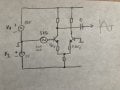
If you use a two matched transistors in differential pair there should be no problem with temp drift. Always the both Vbe changes together.
View attachment 324107
You are correct, but it was rarely used, even though the circuit existed before germanium transistors arrived on the scene.
Probably due to cost, no-one used two transistors when the job could be done with one, and the drifting DC offset removed by a capacitor.
 

MisterBill2

Joined Jan 23, 2018
27,186
Of course, with early transistors, getting a well matched pair would be a bit of a challenge. THAT is why the temperature compensation schemes were used. An extra bit of time would save a lot on a production run of thousands of assemblies.
 

Thread Starter

Art Hall

Joined Jul 25, 2018
11
I only have about half a dozen old germaniums, but I do own a really nice transistor tester, so I may measure them all to see what I have for sure.
 
Top