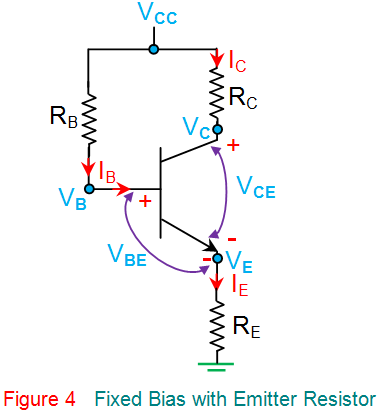
If you examine a typical transistor circuit with emitter resistor RE, the transistor begins to conduct when the voltage across the base-emitter junction VBE reaches about 0.6V.
Current flows when VBE > 0.6V in the diagram shown above.
Collector current IC and emitter current IE start to flow and increase with increasing signal VB at the base.
As IE rises, VE also rises. This has the effect of reducing VBE. This is negative feedback which, while reducing overall gain, has a stabilizing effect.
If you examine a typical transistor circuit with emitter resistor RE, the transistor begins to conduct when the voltage across the base-emitter junction VBE reaches about 0.6V.
Current flows when VBE > 0.6V in the diagram shown above.
Collector current IC and emitter current IE start to flow and increase with increasing signal VB at the base.
As IE rises, VE also rises. This has the effect of reducing VBE. This is negative feedback which, while reducing overall gain, has a stabilizing effect.
If VBE decreases, then IC and IE will also decrease. This has the effect of decreasing VE. This is has a stabilizing effect which we call negative feedback.
The opposite situation, i.e. positive feedback, also known as a "vicious circle", would cause runaway, increasing currents and overheating.
An example would be population explosion. Another example is a nuclear chain reaction.

 Facebook
 Google
 GitHub
 Linkedin