Transistor Overheating

AlbertHall

Joined Jun 4, 2014
12,623
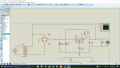
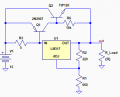
However you arrange the circuit, the transistor will be dissipating 40W so you are going to need a big heatsink. In fact the maximum dissipation of the TIP120 with the case held at 25C is only 65W. I would suggest either a higher power transistor, or multiple transistors, or a lower voltage transformer.
 

Ramussons

Joined May 3, 2013
1,567
Remove the Ground from the Common Cathode of the Bridge Rectifier.
Ground the Centre Tap of your transformer instead.
Depending on your load current, this might do the job.
 

AlbertHall

Joined Jun 4, 2014
12,623
Remove the Ground from the Common Cathode of the Bridge Rectifier.
Ground the Centre Tap of your transformer instead.
Depending on your load current, this might do the job.
Yes, assuming the real transformer has a centre tap this will dramatically reduce the transistor dissipation.
 

danadak

Joined Mar 10, 2018
4,057
More used to seeing this configuration which allows the output V to
be set to the regulators V and not subject to the pass transistor Vbe
variation. Even though you have a diode in ref leg the currents and T
each is subjected to not the same.


Regards, Dana.
 

Thread Starter

alecasavi96

Joined Feb 4, 2019
5
More used to seeing this configuration which allows the output V to
be set to the regulators V and not subject to the pass transistor Vbe
variation. Even though you have a diode in ref leg the currents and T
each is subjected to not the same.


Regards, Dana.
Hi Dana! i have trid this circuit but the Regulator is heating too much
 

danadak

Joined Mar 10, 2018
4,057
My apologies, I see the TIP2955 does not have adequate design curves for turn on.
So lets look at at TIP125. Note you can try the TIP125 calculated R on the 2955.

Lets say we want at full load, 1.47A, we want the TIP120 to take
1.2A, the regulator the rest, .27A.

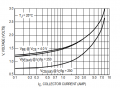
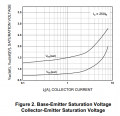
So the TIP125 Vbe must be, typical, from below, 1.5V. Then the
sense R = 1.5V / ( .27A, current flowing thru it into regulator) = ~ 5.5 ohms.

upload_2019-2-5_18-55-21.png

By the way, in your most recent test were you using a PNP Darlington ?

What is your DC input V to the regulator/transistor ? This will determine heat
sink requirements. Also you will need thermal paste for the interface transistor
case to heatsink.

http://www.ti.com/lit/an/slva462/slva462.pdf

If you have, for the sake of argument, 24 Vdc in, 5 Vdc out, 1.2 A thru transistor
then the transistor is dissipating (24 - 5) * 1.2 =~ 23W, a lot of heat to get rid of.
1W in a TO220 package is hot to the touch, no heatsink.


Regards, Dana.
 

Attachments

Last edited:

Thread Starter

alecasavi96

Joined Feb 4, 2019
5
My apologies, I see the TIP2955 does not have adequate design curves for turn on.
So lets look at at TIP125. Note you can try the TIP125 calculated R on the 2955.

Lets say we want at full load, 1.47A, we want the TIP120 to take
1.2A, the regulator the rest, .27A.

So the TIP125 Vbe must be, typical, from below, 1.5V. Then the
sense R = 1.5V / ( .27A, current flowing thru it into regulator) = ~ 5.5 ohms.

View attachment 169533

By the way, in your most recent test were you using a PNP Darlington ?

What is your DC input V to the regulator/transistor ? This will determine heat
sink requirements. Also you will need thermal paste for the interface transistor
case to heatsink.

http://www.ti.com/lit/an/slva462/slva462.pdf

If you have, for the sake of argument, 24 Vdc in, 5 Vdc out, 1.2 A thru transistor
then the transistor is dissipating (24 - 5) * 1.2 =~ 23W, a lot of heat to get rid of.
1W in a TO220 package is hot to the touch, no heatsink.


Regards, Dana.
Thank you so much! yes, i was using a NPN darlington TIP120
 

danadak

Joined Mar 10, 2018
4,057
Are you still using your original schematic ? Which I do not think is
correct. Thats why the PNP recommendation.

Keep in mind the curves are typical, so you need to margin them
for a design.


Regards, Dana.
 

danadak

Joined Mar 10, 2018
4,057
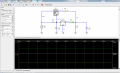
Here is a sim. Its a basic approximation. Caps are necessary. The .1 ohms
just so I could probe currents

You can see the PNP Ic ~= .10 x Ioutreg. 110 mA out of the reg, 900 mA out of
the transistor.

upload_2019-2-5_20-50-22.png


The sim tool only had that 1 PNP darlington.


Regards, Dana.
 

danadak

Joined Mar 10, 2018
4,057
The issue with the original circuit is the use of a diode in the ref leg in
a crude attempt to offset the Vbe behavior of the transistor outside the
control loop. Since the current density of the ref leg significantly different
then the emitter base of the transistor (depending on regulator Iref), and
Vt matching non existent. So degraded T performance results, as well as
load effects no longer inside control loop.

One could thermally couple the ref leg diode with the transistor, but thats
only a partial fix.

It works but not optimal.

The PNP solution keeps the regulator in direct load control. But it has
stability issues due to excess phase shift thru it. So insuring stability
requires a little more attention.

Always compromises :)


Regards, Dana.
 
Last edited:

MisterBill2

Joined Jan 23, 2018
27,258
The main problem is dropping too much voltage across the regulator and the transistor. Power dropped turns into heat. A lower input voltage will reduce the heat. And why is there a six ohm resistor across the output in the first circuit? There is no need of that.
 

crutschow

Joined Mar 14, 2008
38,388
If you want to use the NPN TIP120 as a boost but keep it inside the control loop to cancel its Vbe offset, you can add a small PNP to make it a Sziklai pair as shown below:

upload_2019-2-6_12-13-28.png
 

MisterBill2

Joined Jan 23, 2018
27,258
If you want to use the NPN TIP120 as a boost but keep it inside the control loop to cancel its Vbe offset, you can add a small PNP to make it a Sziklai pair as shown below:

View attachment 169597
OOPS!! It looks like the value of resistor R6 is too high. 1K would provide a better base pull-down function. It would not do for transistor leakage current to be increasing the output voltage.
 
Top