Transistor junctions

Thread Starter

mondo90

Joined May 16, 2025
122
Hi,

I am a bit confused by the nomenclature used in books to call transistor junctions. For instance, in NPN transistor authors say "In normal operation the emitter-base junction is forward biased" - shouldn't he rather say base-emitter junction is forward bias? To me this is incorrect because emitter-base junction is reversed bias only the opposite is true.

Thank you.
 

dl324

Joined Mar 30, 2015
18,327
Welcome to AAC!

It's a distinction without a difference. When you say the BE or EB junction is forward biased, there's only one possible interpretation.
 

MrChips

Joined Oct 2, 2009
34,812
Whether they say base-emitter or emitter-base junction, they are referring to the junction, not the direction of the bias voltage.
Hence it does not matter if it is base-emitter or emitter-base, NPN, or PNP.
They say forward bias. Hence there is no ambiguity.
 

Thread Starter

mondo90

Joined May 16, 2025
122
Thank you for the answers.
I found it confusing because when you speak of voltages between two points A and B you can not say that voltage AB = BA instead it is AB = - BA in the same way, NP junction is reverse biased while PN junction is forward bias. I think this is important, otherwise someone my say "ok, if emitter-base junction is forward bias, then I will apply positive voltage to the emitter, more negative voltage to the base and will turn it OK"
 

sparky 1

Joined Nov 3, 2018
1,218
A semiconductive material can have different conditions allowing or preventing current to flow.
When two regions with different doping levels are present in the same crystal, they form a semiconductor junction.

Setting an operating point involves a bias configuration, usually using resistors. This function can include the transistor's Beta and temperature.

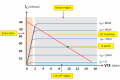
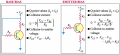
An example, an NPN transistor is found to have (VBE, IB) = (0.661V, 1mA) or (0.715V, 5mA) we can say a silicon diode has a Forward Voltage is about 0.7V
It is wise to use a V/I chart. It is with this coordinate pair that we can represent a set of operating points using this convention.

Going further using V/I chart which works for both NPN and PNP transistors that uses a necessary coordinate pair.
The Q-point is represented by ( VCE, IC ) for an NPN transistor
The Q-point is represented by ( VEC, IC ) for a PNP transistor.

1747688065661.png

1747688232600.png1747688471995.png
 
Last edited:

BobTPH

Joined Jun 5, 2013
11,515
if emitter-base junction is forward bias, then I will apply positive voltage to the emitter
No. Forward bias means the P side of the junction is more positive than the N side. It dies not matter which junction or which polarity of transistor you are talking about.

You are reading it as if it said Veb is positive. That is not what it stated.
 

Thread Starter

mondo90

Joined May 16, 2025
122
You are reading it as if it said Veb is positive. That is not what it stated.
Yes that's how I read it. Let's say I forgot how the diodes are oriented in NPN transistor, all I remember are three terminals CBE. Now if someone says "The emitter-base is forward-bias" I visualize a diode arrow oriented from emitter to the base (a forward direction) BUT this is not the case! That's why I have a problem with this way of description.

A semiconductive material can have different conditions allowing or preventing current to flow.
I think you are going into more detailed analysis of it (biasing etc). While this is only about the confusing way of referencing the junction points. Btw, I like your diagrams, where are they from?
 

MrChips

Joined Oct 2, 2009
34,812
NPN and PNP are both CBE or EBC. It doesn't matter (except when you are actually placing the transistor into the circuit).
I like how @BobTPH describes it. Forward biased means that the P-side is more positive than the N-side. It doesn't matter which type of transistor it is.
 

Lightium

Joined Jun 6, 2012
320
Has long has you don't confuse forward bias and reverse bias, your all set.

I see what your saying, but there is no rule that says you have to say B-E when forward bias and E-B when reverse bias even thou it would be easier for humans.
 

MrChips

Joined Oct 2, 2009
34,812
Has long has you don't confuse forward bias and reverse bias, your all set.

I see what your saying, but there is no rule that says you have to say B-E when forward bias and E-B when reverse bias even thou it would be easier for humans.
Going by that rule, you would have to say base-emitter is forward biased on an NPN transistor.
Likewise, you would have to say emitter-base is forward biased on a PNP transistor.

Or just say, P-N junction is forward biased.
 

Ramussons

Joined May 3, 2013
1,568
Now if someone says "The emitter-base is forward-bias" I visualize a ....
There will be no confusion if you recollect what a Forward Bias means. Forward means the applied potential aids current flow from the P to the N part of the junction. The junction can be either of the 2 in a PNP/NPN transistor, or the one in a Diode/Rectifier.
 

dl324

Joined Mar 30, 2015
18,327
Now if someone says "The emitter-base is forward-bias" I visualize a diode arrow oriented from emitter to the base (a forward direction) BUT this is not the case! That's why I have a problem with this way of description.
The problem you have is being too rigid in your thought process. When a junction is forward biased, it's forward biased; regardless of the order the terminals are mentioned or the polarity of the transistor.
 
Top