Facebook
 Google
 GitHub
 Linkedin

Hello AAC Forum,
This is pretty basic but it is written: 'The recognition of ignorance is the beginning of knowledge.'
I used to put my projects together and power it up and cross my fingers. Now I try to
test as I build to find mistakes in sub systems.
So I was checking the connections to the transistors and for the heck of it the probes
were placed at the connections to the base and the collector which I expected to have negative continuity.
I was surprised when the LED came on. I guess I thought that the function of the base is to turn on the connection
between the emitter and the collector. I did not realize, and it looks like the symbol implies, that there is a connection
between the base and the collector.
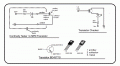
So a way of checking the transistors was imaged. I believe the Transistor Checker will work as shown in the schematic
except the plan was to put a small 1.5 volt battery at the base to allow the transistor to complete the connection to ground.
The question is how to ground the small battery. Go back to ground on the nine volt source? Or how about
putting a voltage dividing resistor between the nine volt source and the base to knock it down to a couple of volts and obviate the
second energy source?
Thanks.
Allen
This is pretty basic but it is written: 'The recognition of ignorance is the beginning of knowledge.'
I used to put my projects together and power it up and cross my fingers. Now I try to
test as I build to find mistakes in sub systems.
So I was checking the connections to the transistors and for the heck of it the probes
were placed at the connections to the base and the collector which I expected to have negative continuity.
I was surprised when the LED came on. I guess I thought that the function of the base is to turn on the connection
between the emitter and the collector. I did not realize, and it looks like the symbol implies, that there is a connection
between the base and the collector.
So a way of checking the transistors was imaged. I believe the Transistor Checker will work as shown in the schematic
except the plan was to put a small 1.5 volt battery at the base to allow the transistor to complete the connection to ground.
The question is how to ground the small battery. Go back to ground on the nine volt source? Or how about
putting a voltage dividing resistor between the nine volt source and the base to knock it down to a couple of volts and obviate the
second energy source?
Thanks.
Allen