Transimpedance Amplifier vs Voltage follower/non-inverting amp combo

Thread Starter

odm4286

Joined Sep 20, 2009
265
I'm working with a photodiode in photovoltaic mode. In order to amplify the signal I've done the following
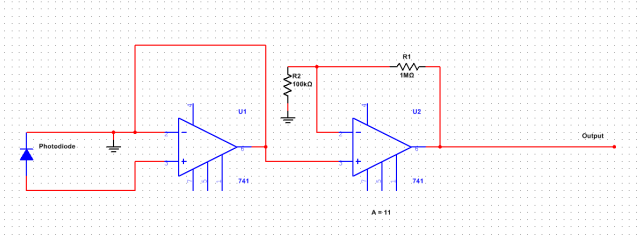

Omitted power connections purposely.​

So this works great, it eliminated all the noise I'd get when I connected the photodiode directly to the non-inverting amplifier.
My question is what advantage, if any, does a Transimpedance amplifier circuit have over this circuit? Thanks!
 

OBW0549

Joined Mar 2, 2015
3,566
One advantage a transimpedance amplifier has over your circuit is that it actually works: take a VERY close look at how you've connected U1 and the photodiode.
 

Thread Starter

odm4286

Joined Sep 20, 2009
265
One advantage a transimpedance amplifier has over your circuit is that it actually works: take a VERY close look at how you've connected U1 and the photodiode.
Hmm I'm not seeing it, as far as I could tell last night this worked fine. Roughly 300mV across my PD and about 3.3V on the output of U2. The output followed as I changed the light exposure to the diode as well. What am I'm doing wrong here?
 
Last edited:

Thread Starter

odm4286

Joined Sep 20, 2009
265
Ahh I think I've added an "extra" ground connection. Sorry, I drew this from memory. U1 inverting input should NOT be tied to ground, correct?

 
Last edited:

OBW0549

Joined Mar 2, 2015
3,566
I could, but it's something glaringly obvious-- and fundamental-- that you really should be able to see for yourself (and it has nothing to do with power supply connections).
 

Thread Starter

odm4286

Joined Sep 20, 2009
265
I could, but it's something glaringly obvious-- and fundamental-- that you really should be able to see for yourself (and it has nothing to do with power supply connections).
ahhh my diode is backwards...I think. Still learning. Cathode to the non-inverting input?

 
Last edited:

OBW0549

Joined Mar 2, 2015
3,566
Nope. Which way your diode is pointing affects only the polarity of your output, and nothing else.

Hint: what have you provided in your circuit to establish a reference potential for the inputs and output of U1? As you have it, they're undefined (i.e., floating).
 

Thread Starter

odm4286

Joined Sep 20, 2009
265
Ok, I've taken the diode out of the feedback loop. In hindsight that doesn't make much sense. How about this? Thank you for the help by the way!


OBW0549

Joined Mar 2, 2015
3,566
That's more like it!

Now take a look at the circuit and ask yourself, why is the first opamp even necessary? Why not eliminate it, and connect the anode of the photodiode directly to the (+) input of the second opamp?
 

Thread Starter

odm4286

Joined Sep 20, 2009
265
That's more like it!

Now take a look at the circuit and ask yourself, why is the first opamp even necessary? Why not eliminate it, and connect the anode of the photodiode directly to the (+) input of the second opamp?
I tried this and ended up with an extremely noisy signal. I'll give it another go tonight! So back to my original question, is there any reason NOT to do it this way? Also, I shouldn't have an issue with current flowing through my diode right? I'm wondering if I should add a series resistor to ground.
 

OBW0549

Joined Mar 2, 2015
3,566
Do you want an output that varies linearly with light level? Or do you want an output proportional to the log of the light level? As it is, your circuit will show a logarithmic response. To make it linear, you either have to shunt the photodiode with an appropriately-sized resistor, or switch to a transimpedance amplifier configuration.

Also, a voltage-mode circuit such as this will have very poor response speed, especially at low light levels; a properly-designed transimpedance amplifier will be much, MUCH faster.
 

crutschow

Joined Mar 14, 2008
38,331
Adding an amplifier adds that amplifier's noise and offset to the signal.
This will increase the amp noise by the √2 and can double the DC offset.
 

OBW0549

Joined Mar 2, 2015
3,566
I tried this and ended up with an extremely noisy signal. I'll give it another go tonight!
What kind of noise? Broadband thermal (i.e., "white") noise? RF interference? Pickup from power mains? You've got some very high impedances in this circuit, and it will be quite sensitive to any kind of interference; good shielding is a must.
 

Thread Starter

odm4286

Joined Sep 20, 2009
265
What kind of noise? Broadband thermal (i.e., "white") noise? RF interference? Pickup from power mains? You've got some very high impedances in this circuit, and it will be quite sensitive to any kind of interference; good shielding is a must.
Not sure of the type of noise, but instead of a clean DC signal i'd get something that looked sinusoidal. The output followed the input by introducing an offset, not by changing the amplitude of the "AC" output signal.
 

OBW0549

Joined Mar 2, 2015
3,566
The second Op amp does need a low Z source to work.
Ummm... why? The second opamp is operating in an ordinary non-inverting configuration and has a high-impedance input. As in all opamp circuits, the inputs must have a DC path to ground (or to some other voltage within the common-mode range of the opamp); but the input to a non-inverting amplifier such as this does NOT need to be driven from a low-impedance source.
 
Last edited:

OBW0549

Joined Mar 2, 2015
3,566
Not sure of the type of noise, but instead of a clean DC signal i'd get something that looked sinusoidal. The output followed the input by introducing an offset, not by changing the amplitude of the "AC" output signal.
Sinusoidal, but at what frequency? If it was 60 Hz, that's power-line pickup. Use more shielding.
 
Top