Transimpedance amplifier output not coming as expected.

Thread Starter

hoyyoth

Joined Mar 21, 2020
528
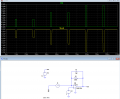
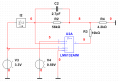
I am designing a TIA and it's circuit diagram is given below.The input is a PWL waveform.
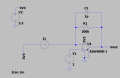
1750412672698.png

The output waveform come as very distorted.Please see below.
1750412775211.png

Is this some slew rate issue ?.
Please find my simulation file and input waveform pwl file attached.
Regards
 

Attachments

crutschow

Joined Mar 14, 2008
38,322
Is this some slew rate issue ?.
Yes, that and the gain-bandwidth.
You need a faster op amp.
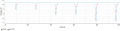
The one below has a 10MHz GBW and a 14V/µs slew-rate.
I adjusted the feedback capacitor to 0.7pF for the best pulse response.

But note that you may have difficulty dealing with a 1pF (or less) feedback capacitor in a real circuit as that is likely comparable to the circuit stray trace capacitances.
You may need to reduce the value of R1 and thus the gain of this stage (which will increase the value of the optimum feedback capacitor), and then add another stage with gain to get the desired overall gain.


1750429011205.png
 
Last edited:

crutschow

Joined Mar 14, 2008
38,322
Small feedback capacitors can be done with a "gimmick capacitor" which is just two insulated wires twisted together.
You change the tightness of the twists and the wire length to adjust the capacitance (typically about 1-2pF per inch of twist depending upon the insulation thickness), to achieve the desired output waveform.

Edit: So magnet or wire-wrap wire would have the highest capacitance per twisted unit length, since they have thin insulation.
 
Last edited:

0ri0n

Joined Jan 7, 2025
161
If you don't want to rely on small gimmick capacitors you can switch to a T-network in the feedback where smaller value resistors, combined with a now much larger feedback cap, achieve the same gain.
 

crutschow

Joined Mar 14, 2008
38,322
If you don't want to rely on small gimmick capacitors you can switch to a T-network in the feedback where smaller value resistors, combined with a now much larger feedback cap, achieve the same gain.
Due to the change in loop gain, that actually requires a smaller capacitor, not a larger, for optimum pulse response (my sim shows a drop from 0.7pF to 0.1pF for the same transimpedance gain).
 

0ri0n

Joined Jan 7, 2025
161
Due to the change in loop gain, that actually requires a smaller capacitor, not a larger, for optimum pulse response (my sim shows a drop from 0.7pF to 0.1pF for the same transimpedance gain).
That is odd. I checked and did not encounter any problems. I lowered the main feedback resistor to 56k and raised the feedback cap accordingly while retaining the original gain of 200 kV/A. The output voltages of both TIA versions are not a perfect fit to each other but nothing to complain about. The bias voltage applied to the op amp has to be adjusted because the T-network introduces gain to the bias voltage.

TIA_T-Network.png

TIA_Standard_&_T-Network.png
 

crutschow

Joined Mar 14, 2008
38,322
I checked and did not encounter any problems.
Okay, I had the capacitor connected from input to output.
I see that connecting across only the 56kΩ resistor increases the optimum size of the capacitor.

If you connect R4 to the bias voltage you don't need to change the voltage.

Why is your op amp symbol a box instead of the normal triangle?
 

Thread Starter

hoyyoth

Joined Mar 21, 2020
528
May I know while designing a TIA when to use T-netwrok in the feedback path vs a single resistor in the feedback path
 

crutschow

Joined Mar 14, 2008
38,322
That's IEC standard. Switching to ANSI would give me the more common op amp depiction but also all the other unfamiliar, old style american symbols.
Well it would seem that the "old style" triangle symbol for an op amp is more meaningful than a generic rectangular box.
 
Top