Transient RLC circuit

Thread Starter

ham3388

Joined Jul 3, 2012
97
Hi friend :)

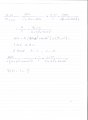
I'm just wondering if i'm on the right track for the problem. I have started analysing the circuit, but I'm really unsure of my method of analysis.

Im really lost, could some one help me here

My regards
 

Attachments

WBahn

Joined Mar 31, 2012
33,182
I can't make out much on the scanned images of your work, there just isn't enouch contrast for me to read it. Please try to get higher contrast, perhaps by going over the work with a black pen or perhaps even a fine point felt-tip marker.
 

mlog

Joined Feb 11, 2012
276
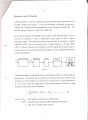
At the risk of appearing dense, what is 100 vi? Is it a voltage source or a current source that is dependent on vi, i.e. current=100 times vi?
 

mlog

Joined Feb 11, 2012
276
Based on the modules worked examples, it suppose to be voltage source...
The reason I asked is usually an arrow denotes a current source. Since the source says "100vi," I thought it could be a dependent current source based on a voltage "vi." In other words, if vi=1 millivolt, then the current source 100vi=100 milliamp. You would think the notation would be standard, but it doesn't seem to be.
 

bountyhunter

Joined Sep 7, 2009
2,512
This problem really is absurd. It asks to find the step response and at the same time correctly states that a step response from a thermocouple is IMPOSSIBLE since it measures temperature and any thing with mass can not change it's temp instantly. Idiocy.

But one point: assuming it is a voltage source that "steps", it is connected to an inductor. The current through an inductor can NOT change instantly (step) so it ramps up or down in response to the voltage steps. That is how the L-C filter works, so the steps can never appear at the resistor side.

It should also be noted that the voltage across a cap can never change in zero time so that at t+ (the instant after after the step), all the step voltage appears across the inductor and the cap voltage is unchaged from previous instant. In the following time the current ramps up through the inductor and the cap voltage gradually changes to the new steady state value.
 
Last edited:
Top