Transient Network Analysis

Thread Starter

dalam

Joined Aug 9, 2014
58
Untitled.png
I found out the voltage Vc(t) = 80-40e^(-1000t).
Voltage at t=1 msec ; Vc=80-40/e =65.28 Volts.
Using phasor I can find out Vr=√(80^2-65.28^2)=46.23 Volts.
Now I use P=Vr^2/R to find the power dissipation in resistor.
I end up getting P=21.378Watts. But this is not correct answer.
What am I doing wrong? Answer is 2.1Watts.
 

MikeML

Joined Oct 2, 2009
5,444
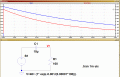
Ok. Here is what I get: V(R) = V(P) because the red trace falls perfectly on top of the green trace. V(p) is the correct equation for the voltage across the resistor.

The blue trace is the power in the resistor.

263.gif
 

MrAl

Joined Jun 17, 2014
13,702
Hi,

It's not that the u(t) is unusual, it's the whole 40+40 u(t) statement for the source. This implies that there was 40 volts present before t=0, and after t=0 there is another 40 volts present because of the step 40 u(t). The power at t=0.001 seconds therefore comes out to 2.1 watts, but that's not exact, more exact would be 2.17 watts but that's not exact either, so if you have a more exact result you can post that and we can compare (i'll post the much more exact result).

So your time expression is wrong to begin with. Perhaps you can show how you approached this problem.
 

MikeML

Joined Oct 2, 2009
5,444
Hi,

It's not that the u(t) is unusual, it's the whole 40+40 u(t) statement for the source. This implies that there was 40 volts present before t=0, and after t=0 there is another 40 volts present because of the step 40 u(t).
That is what I concluded, too...
 

MrAl

Joined Jun 17, 2014
13,702
Hi Mike,

Wow we posted at the exact same time previously :)

But anyway, the source originally 40+40 u(t) could be interpreted as a simpler source of 80 u(t) and apply the t<0 existing voltage as the capacitor initial voltage. This leads to a single term equation that is an exponential.
 

Thread Starter

dalam

Joined Aug 9, 2014
58
Hi,

The power at t=0.001 seconds therefore comes out to 2.1 watts, but that's not exact, more exact would be 2.17 watts but that's not exact either, so if you have a more exact result you can post that and we can compare (i'll post the much more exact result).

So your time expression is wrong to begin with. Perhaps you can show how you approached this problem.
The exact answer is 16e^-2.
I used equation Vc(t)=[v(0+)-v(∞)]*e^(-t/Γ)+v(∞)
Vc(0+)=40V
Vc(∞)=80V
Γ(time constant)=10^-3 sec.
 

Thread Starter

dalam

Joined Aug 9, 2014
58
Ok. Here is what I get: V(R) = V(P) because the red trace falls perfectly on top of the green trace. V(p) is the correct equation for the voltage across the resistor.

The blue trace is the power in the resistor.

View attachment 78191
Thank you for the simulation. But will you please elaborate on what am I missing in my solution?
 

ericgibbs

Joined Jan 29, 2010
21,439
hi,
Your mistake, is that the source voltage was at 40V at t<0, so after t>= 0, only 40 u[t] was applied across the series res/cap network.
ie: at t<0 the the circuit had a existing steady state voltage of 40V.

E
 

Attachments

MikeML

Joined Oct 2, 2009
5,444
...But will you please elaborate on what am I missing in my solution?
Your expression for voltage across the resistor vs time was incorrect. I was showing you the correct one V = 40e^(-t/R1C1) at the behavioral voltage source B1, which produces the same voltage at V(p) that the actual circuit produced at V(r).
 

Thread Starter

dalam

Joined Aug 9, 2014
58
Your expression for voltage across the resistor vs time was incorrect. I was showing you the correct one V = 40e^(-t/R1C1) at the behavioral voltage source B1, which produces the same voltage at V(p) that the actual circuit produced at V(r).
Thanks a lot. I got the correct answer now.
Vr(1ms)=(40*e^-1)^2/100= 2.165 Watts
 

WBahn

Joined Mar 31, 2012
32,823
View attachment 78180
I found out the voltage Vc(t) = 80-40e^(-1000t).
Voltage at t=1 msec ; Vc=80-40/e =65.28 Volts.
Using phasor I can find out Vr=√(80^2-65.28^2)=46.23 Volts.
Now I use P=Vr^2/R to find the power dissipation in resistor.
I end up getting P=21.378Watts. But this is not correct answer.
What am I doing wrong? Answer is 2.1Watts.
I don't understand where phasors are coming into play at all. Phasors are for sinusoidal signals, which this is not.
 
Top