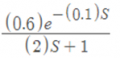
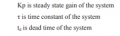
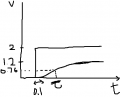
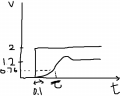
I think you should label your graph/snapshot a little more clear so we can see the voltages and times more clearly of the excitation wave and the response wave. It's unclear what they are right now.
For example, what is the amplitude of the pulse and what is the max amplitude of the response.
What is the start time of the pulse and what is the start time of the response.
What is the time of the response when the voltage reaches a value of 0.632 times the max amplitude.
These questions need to be answered and also, it does not look like Kp=1 but your answers will help clarify this.
View attachment 199563
This is what i did but im not sure how to get a time constant of 2. Also is it ok to assume the unit step has an amplitude of 2V?
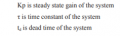
The time constant is the time where the amplitude response reaches a value of 0.632 times the max amplitude. This value 0.632 is an approximation for 1-1/e.
You only get overshoot if you have a 2nd order system or better. That more or less means that you have a power of 's' in the denominator of 2 or higher. For example, 1/(s^2+b*s+c) may have overshoot, but 1/(s+c) does not. The amount of overshoot if there is any depends on the coefficient 'b' in that first example.
So the question is, do you have a second (or higher) order system or just a first order system?
The time constant is the time where the amplitude response reaches a value of 0.632 times the max amplitude. This value 0.632 is an approximation for 1-1/e.
You only get overshoot if you have a 2nd order system or better. That more or less means that you have a power of 's' in the denominator of 2 or higher. For example, 1/(s^2+b*s+c) may have overshoot, but 1/(s+c) does not. The amount of overshoot if there is any depends on the coefficient 'b' in that first example.
So the question is, do you have a second (or higher) order system or just a first order system?
I think you should label your graph/snapshot a little more clear so we can see the voltages and times more clearly of the excitation wave and the response wave. It's unclear what they are right now.
For example, what is the amplitude of the pulse and what is the max amplitude of the response.
What is the start time of the pulse and what is the start time of the response.
What is the time of the response when the voltage reaches a value of 0.632 times the max amplitude.
These questions need to be answered and also, it does not look like Kp=1 but your answers will help clarify this.
I have mentioned everything the question gave me. These points that you have mentioned are the main reasons why i have asked for help. l'm not sure what I have to assume to draw this graph.
Well for your second question it looks like you have to do a curve fitting.
You have the graph, now fit it to the expected response in the time domain.
Do you know how to convert that expression (with 'e' in the numerator you supplied) to the time domain?
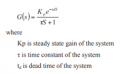
That would be the first step. In other words, convert this:
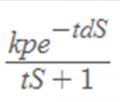
Kp*e^(-td*s)/(T*s+1)
to the time domain so you get an expression that is a function of time only.
I am assuming that you learned to do that already but if not just yell and we can do it another way.
Well for your second question it looks like you have to do a curve fitting.
You have the graph, now fit it to the expected response in the time domain.
Do you know how to convert that expression (with 'e' in the numerator you supplied) to the time domain?
That would be the first step. In other words, convert this:
Kp*e^(-td*s)/(T*s+1)
to the time domain so you get an expression that is a function of time only.
The conversion requires the Inverse Laplace Transform and you can look that up if you like but for these kinds of problems you would just use a table of Laplace Transforms and their inverses.
e^(-T*s) is just a delay by T seconds, what is sometimes called a time shift.
To find the inverse of an expression with that in the numerator you first separate that from the rest then find the inverse of the rest and then apply the time shift.
So in general you have:
F(s)*e^(-T*s)
and separate them so you just have F(s), then find the inverse of that, then apply the time shift given by T.
The function e^-Ts acts like a turn on function, that turns on the part F(s) in the time domain.
Note that if you have T=0 then e^(-T*s)=1 so you end up with:
F(s)*1
which of course is just the Laplace of f(t).
If you had T=2 then note that you dont get a '1' until t=2 seconds, so the function "turns on" at t=2 seconds.
So back to
F(s)*e^(-T*s)
if T=0 then we just find the inverse of F(s) which is f(t). But if T=2 then we still find the inverse of F(s) but now f(t) does not start until t=2 seconds, so the time function is zero until T=2 seconds and then we get the inverse time function starting up normally.
To find the expression for this time delay in the time domain, you can look up the time shift theorem. But graphically it just looks like the function f(t) is delayed by the time T seconds. You will note that the proper expression involves the unit step as well as the constant change in time t in the function f(t), but sometimes the unit step is implied so we just have the function f(t) combined with the time delay T.
So see if you can figure out the inverse transform now and then we can apply it to the problem at hand.
The conversion requires the Inverse Laplace Transform and you can look that up if you like but for these kinds of problems you would just use a table of Laplace Transforms and their inverses.
e^(-T*s) is just a delay by T seconds, what is sometimes called a time shift.
To find the inverse of an expression with that in the numerator you first separate that from the rest then find the inverse of the rest and then apply the time shift.
So in general you have:
F(s)*e^(-T*s)
and separate them so you just have F(s), then find the inverse of that, then apply the time shift given by T.
The function e^-Ts acts like a turn on function, that turns on the part F(s) in the time domain.
Note that if you have T=0 then e^(-T*s)=1 so you end up with:
F(s)*1
which of course is just the Laplace of f(t).
If you had T=2 then note that you dont get a '1' until t=2 seconds, so the function "turns on" at t=2 seconds.
So back to
F(s)*e^(-T*s)
if T=0 then we just find the inverse of F(s) which is f(t). But if T=2 then we still find the inverse of F(s) but now f(t) does not start until t=2 seconds, so the time function is zero until T=2 seconds and then we get the inverse time function starting up normally.
To find the expression for this time delay in the time domain, you can look up the time shift theorem. But graphically it just looks like the function f(t) is delayed by the time T seconds. You will note that the proper expression involves the unit step as well as the constant change in time t in the function f(t), but sometimes the unit step is implied so we just have the function f(t) combined with the time delay T.
So see if you can figure out the inverse transform now and then we can apply it to the problem at hand.
Well that is so close, but consider this in the time domain:
5*(1-e^-(t-0.2))*u(t-0.2)
and that is the inverse transform with an amplitude of 5 and delay of 0.2 seconds.
See how we only need to show the u(t) part one time?
Not only that, but if you multiply your answer out (expand it) you would end up with one factor that comes out to:
u(t-0.1)*u(t-0.1)
which looks like a unit step function being driven by another unit step.
So i would say one of them is redundant.
A side point is that the amplitude 5 only needs to be shown once also but that's not strictly required.
Does this make sense now? Only a small adjustment and i think you got it
Another side point is, would you happen to know of a circuit that would have that kind of response using only possibly some of these components:
resistor, capacitor, inductor, voltage source.

 Facebook
 Google
 GitHub
 Linkedin
 17.1 KB Views: 44