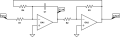
I have doubts with the following circuit, I have already obtained the transfer function to the circuit but only with resistors, now they have put a capacitor and I don't know how to proceed
The calculation procedure is as before when you replace the feedback resistor of the 1st opamp with the capacitive impedance Zc=1/jwC.
However, under real conditions the circuit will not work because of resistive positive feedback. There will be no stable DC operating point and the circuit will go into saturation.
The calculation procedure is as before when you replace the feedback resistor of the 1st opamp with the capacitive impedance Zc=1/jwC.
However, under real conditions the circuit will not work because of resistive positive feedback. There will be no stable DC operating point and the circuit will go into saturation.
No, I don`t think so. A PID controller will influence the dynamic behaviour of a circuit but it cannot fix a dc operating point.
In any case - you must avoid DC feedback with two inversions within the loop.
As a working example: The classical state variable filter (universal filter) consists of an integrator stage plus an inverting amplifier (as in your case) plus an additional integrating stage within one loop.
No, I don`t think so. A PID controller will influence the dynamic behaviour of a circuit but it cannot fix a dc operating point.
In any case - you must avoid DC feedback with two inversions within the loop.
As a working example: The classical state variable filter (universal filter) consists of an integrator stage plus an inverting amplifier (as in your case) plus an additional integrating stage within one loop.
Before I asked how to convert my plant into a circuit, since I was going to test the PID controller in a physical circuit and they gave me that circuit that has an unstable pole, so how do you recommend I model my function which is 1/ s - 2 in a circuit functional?
Before I asked how to convert my plant into a circuit, since I was going to test the PID controller in a physical circuit and they gave me that circuit that has an unstable pole, so how do you recommend I model my function which is 1/ s - 2 in a circuit functional?

 Facebook
 Google
 GitHub
 Linkedin