To get a base current from collector current in BC337.

Thread Starter

PorkChopJohn

Joined Feb 1, 2024
17
Hi all, I've been asked to calculate base current from a provided collector current which is 141mA.
BC337 is the transistor we are using in this question.
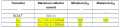
I've searched online for hFE, but got a bit confused as it has several hFE number.
1706797470223.png

my question is why there are so many hFE and what's the difference between them? How do I know which hFE should I choose.
Thank you very much for your help.
 

Ramussons

Joined May 3, 2013
1,567
Transistors do not have a particular hFE, they have a range and vary as per a lot of other parameters.
If you can measure the Collector Current and Emitter Current Very Accurately the difference is the base current. Is it Practical? :confused:
 

Thread Starter

PorkChopJohn

Joined Feb 1, 2024
17
Transistors do not have a particular hFE, they have a range and vary as per a lot of other parameters.
If you can measure the Collector Current and Emitter Current Very Accurately the difference is the base current. Is it Practical? :confused:
Consider all hFE value at 25 degree level. I think the project wants us to use the formula I_c = (hFE)(I_b) but didn't tell us much about hFE. All I know is when hFE is low, needs a high base current. When hFE is high, needs a low base current. But how to get this base current from unknown hFE if hFE always varies?
 

Papabravo

Joined Feb 24, 2006
22,058
You need to think of hFE, and indeed all transistor parameters, as if they were random variables. Random variables are normally described as having mean value and a variance. It is the variance that allows you to predict the range of the random variable, not with certainty, but with high probability. You might be tempted to ask: "how anybody can design with parts like that?" Well, the answer is that smart designers will design their circuits in such a way that they do not depend on the actual value of a parameter but will work equally well over a defined range of that parameter. That is the difference between engineering and hacking. The engineer knows how to do this, and the hacker does not have a freaking clue!

Read all about them:
Random variable - Wikipedia
 

BobTPH

Joined Jun 5, 2013
11,463
The answer is to design the circuit so that it does not matter, other than requiring a very small minimum Hfe for correct operation.

There are generally two ways a transistor is used, as a switch, or as a linear amplifier.

Let’s look at both cases.

As a switch: The collector current is limited by the load. The base current just needs to be high enough to allow that collector current with a reasonably low Vce. The datasheet will give a figure for the ratio of base to collector current for saturation. This is usually 10 or 20 to 1. So just design for a base current at that level or higher.

As a linear amplifier. The gain does depend upon beta, but it can be controlled by negative feedback such that the beta has little effect. Any well designed amplifier circuit will have the gain set by the feedback ratio.

A circuit that relies on a specific beta to set collector current is a bad circuit.
 

WBahn

Joined Mar 31, 2012
32,702
Hi all, I've been asked to calculate base current from a provided collector current which is 141mA.
BC337 is the transistor we are using in this question.
I've searched online for hFE, but got a bit confused as it has several hFE number.
View attachment 314104

my question is why there are so many hFE and what's the difference between them? How do I know which hFE should I choose.
Thank you very much for your help.
As others have stated, hFE is not some nice, fixed constant value for a given transistor part number. It varies all over the place, but within specified limits. Those limits are what the data sheet documents.

There are a number of ways that this information can be presented, and most data sheets show two or three. None of them is complete, so you have to make estimates for specific situations.

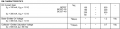
The above table gives a quick look and, if you look at the data sheet, you will probably discover that this table is specified as being at a particular junction temperature, probably 25°C.

The first line is saying that, if you take a whole bunch of these transistors, picked randomly from their production line over tiem, and put it into a circuit and adjust things to that the collector-emitter voltage is 1 V and the collector current is 100 mA, that the measured hFE should never be less than 100 nor should it ever be more than 630. Usually we only care about minimum hFE, but there are applications where too-high a gain can cause problems. Many data sheets don't specify max gains or, if they do, only do so at a few points. The second line tells you that, if the circuit is adjusted so that 200 mA of current is flowing, that the hFE should always be above 60, but they are not making any claims about what the maximum value it might be.

Many data sheets will tabulate min hFE values at four or five different collector currents (Vce=1 V is pretty common, but sometimes data at a higher voltage is also given).

Most good designs use the minimum value for design purposes, reducing it reasonably to reflect the range of Vce and Ic that the device is expected to operate at.

But sometimes you want to know what the typical values are, for instance to estimate total power consumption, on average. The data sheet may or may not list typical values.

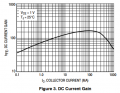
If we look at an actual data sheet for the BC337 (from On Semiconductor -- different manufactures will present different information), we see the following graph:
1706815467493.png
This gives the typical hFE, again at that Vce = 1 V and junction temp of 25°C operating point. Here you can see that the typical hFE peaks at about 225 at about 100 mA, dropping steadily for lower currents and quite quickly for higher currents. You can also see that at very low currents the hFE can be less than any of the minimums listed in the table, so if you are going to be operating the device well away from the test conditions in the table, it's worth looking closely at the data sheet to see if you can get a better picture of the behavior.

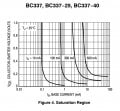
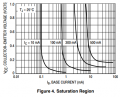
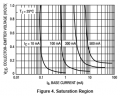
Another graph that some, but not many, data sheets provide is the following one:

1706816188006.png
Again, these are typical values at 25°C.

Here you can get a feel for what kind of Vce voltage you can expect (on average -- don't ever loose sight of the fact that a given transistor will pretty much never be average) when you are trying to use it as a switch. The bottom end of each curve is for an hFE of 10 (the 500 mA curve goes down a bit more than that).

You might be wondering how the parameters change at different temperatures. Most data sheets are very thin on this information (this one has essentially no such information), so you are left searching for data sheets that do and then making assumptions about how the trends shown for that device can be applied to this device, or looking for general behaviors verses temperature for these types of devices.

Usually, if you need that information bad enough to go to this effort, you are probably in the realm where you really need to consider taking your own measurements to get the data you need that is germane to your specific needs.

Now, having said all that, how do you go about answering the question asked on your homework?

There isn't going to be a single, correct answer (and if your instructor thinks there is, then it is highly likely that they have never actually designed a transistor-circuit in the real world). Your best answer is going to be a range, and will be backed up by a description of the assumptions you are making to come up with it.
 

Thread Starter

PorkChopJohn

Joined Feb 1, 2024
17
Welcome to AAC!
Is the question for a specific transistor, or BC337 in general?

hFE isn't a constant value. Do you know what parameters affect it?
Thank you.
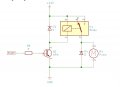
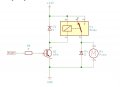
Initially we’ve been asked to find a current value from the diagram below
1706830722830.jpeg
given R_coil=85Ω and V_coil=12V from relay. I got the current flow through relay and collector which is 12V/85Ω=141mA. Then we need to choose a transistor from bunch of they provided ones (I chose BC337 as 141mA in the range) asked to find base current from previous calculations. But I’m not sure which hFE to use.

and yes I know hFE is not a constant value and all the parameters affect it that’s why I got confused
 

Thread Starter

PorkChopJohn

Joined Feb 1, 2024
17
That's an oddly specific current value.
Is the transistor being used as a switch?
Yes it is being used as a switch. Here is the diagram
1706831548021.jpeg
Initially we’ve been asked to find a current value from given R_coil=85Ω and V_coil=12V from relay. I got the current flow through relay and collector which is 12V/85Ω=141mA (I might be wrong though). Then we need to choose a transistor from bunch of they provided ones (I chose BC337 as 141mA in the range) asked to find base current from previous calculations. That’s where I got stuck as I don’t know which hFE to use to get the base current. There are following questions that I need to use this base current value to do further calculations. So I kinda need a specific base value.
 

panic mode

Joined Oct 10, 2011
4,864
what does the PUMP terminal connect to? that will have a major impact on sizing the base resistor...
as for hfe, since transistor is used as a switch, you do not need precision, it is ok to exaggerate. for example you could just assume the worst case scenario (lowest hfe avialble) and then your know that any single transistor from the batch will still work. higher gain means Ic can be larger but... this is limited by the resistance of the load.
 

panic mode

Joined Oct 10, 2011
4,864
you see that supply is 12V and load (for transistor) is the relay coil. so you need to see current drawn by relay. then knowing the worst case transistor gain, you can calculate base current. from that (and what ever is driving it) you can derive base resistor value. and don't be shy to use some decent margins. don't live on the edge...
 

BobTPH

Joined Jun 5, 2013
11,463
The rule of thumb is that you use 10 as the Hfe for a saturated switch. Design for a base current of 14 mA and you are safe. Seriously, that is all you need to do.

Edited: Fixed my stupid math.
 
Last edited:

crutschow

Joined Mar 14, 2008
38,316
The hFE value in the data sheet is for linear operation of the transistor (note that it is given for a Vce of 1V, not when the transistor is saturated fully on).
It's a common mistake to use that value for calculating base current for switching transistors.

Notice that when used as a switch, where Vce(sat) is measured, they use a base current of 1/10th the collector current.
That's why a (forced) hFE value of 10 is used when the transistor is operating as a switch to give the minimum ON voltage.
 

WBahn

Joined Mar 31, 2012
32,702
The rule of thumb is that you use 10 as the Hfe for a saturated switch. Design for a base current of 1.4 mA and you are safe. Seriously, that is all you need to do.
Wouldn't it be better to design for a base current of 14 mA?
 

WBahn

Joined Mar 31, 2012
32,702
what does the PUMP terminal connect to? that will have a major impact on sizing the base resistor...
as for hfe, since transistor is used as a switch, you do not need precision, it is ok to exaggerate. for example you could just assume the worst case scenario (lowest hfe avialble) and then your know that any single transistor from the batch will still work. higher gain means Ic can be larger but... this is limited by the resistance of the load.
Since it's being used as a switch, the hFE's shown in the data sheet are irrelevant since they are for operation in the linear (active) region and switches should be operated in saturation.
 

WBahn

Joined Mar 31, 2012
32,702
Thank you.
Initially we’ve been asked to find a current value from the diagram below
View attachment 314144
given R_coil=85Ω and V_coil=12V from relay. I got the current flow through relay and collector which is 12V/85Ω=141mA. Then we need to choose a transistor from bunch of they provided ones (I chose BC337 as 141mA in the range) asked to find base current from previous calculations. But I’m not sure which hFE to use.

and yes I know hFE is not a constant value and all the parameters affect it that’s why I got confused
You are using the transistor as a switch, so the hFE is pretty much irrelevant because they are for the linear region and you aren't trying to operate there -- you are trying to operate as far away from there as you can.

Most small switching transistors are considered to be in hard saturation with a beta of 10. There's nothing magical about this number -- it's used for comparison purposes and became a defacto operating point decades ago. With modern transistors, you can usually get by with higher beta values and still be in acceptably hard saturation. Look at Figure 4 in the data sheet to get an idea of how low you can go in base current for a "typical" transistor, and then build in some margin. Or just start with a beta of 10 and see if that base current raises any issues as far as what is providing the current and what your total current/power budget is.
 
Top