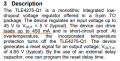
TLE4275 Question

Thread Starter

bwilliams60

Joined Nov 18, 2012
1,450
Good day to all. I have a couple of questions regarding this LDO. My first question is, in laymans terms, how does this regulator work. I kind of get the basics of it but not 100% sure I grasp the whole concept.
Secondly, I have one here that is connected such that pin 1 = Vin = 14V, pin 2 = 4.65V and is tied into a microcontroller through a 4.7K resistor, pin 3 = GND, pin 4 goes to a capacitor and pin 5 = VREF at 5V.
What part does the microcontroller play?
How does this type of regulator turn on? Vin seems to be live all the time so I am assuming that the micro must play a part in this?
 

Attachments

ronsimpson

Joined Oct 7, 2019
4,690
I have not used this part but, let me say things that might be wring. lol
It appears that "reset" is a output of the regulator and a input to the micro. Many micros do not work if the supply voltage is too low. They might get stuck (not working) if the supply voltage goes up/down several times at turn on. So the power supply holds the micro in reset until the supply is at a good voltage for a while. Then the regulator tells the micro, "go" we have good stable power.
 

Thread Starter

bwilliams60

Joined Nov 18, 2012
1,450
Okay that makes a little sense. The LDO gets extremely hot, the micro gets warm and my voltages change and nothing else on the board works.
Vin = same
Delay = 0.2
Reset = 0.1
VREF - 3.73

LDO is shorted?????
How does this turn on? Or does it always remain on? Vin is 12.6-14V constant supply.
 
Last edited:

AlbertHall

Joined Jun 4, 2014
12,625
In post #1 you say that reset is 4.65V. I hope you did not connect a 4.65V power supply to this pin as that could have damaged it. This pin should be connected by a pullup resistor to the regulator 5V output and the uC reset pin.

In post #3 you have the reset pin at 0.1V which would indicate that the regulator output is not correct and indeed the output at 3.73V is incorrect. That may be either because the 5V output is overloaded (unlikely) or the regulator is damaged.
 

ronsimpson

Joined Oct 7, 2019
4,690
Vin = 14V - Vout = 5V = Delta 9V
How much current are you using? Lets say 200mA.
9V X .2A = 1.8 watts
Depending on which part you have, the temperature increase is 30 to 40C/watt. Lets say the small package so 1.8W X 40C = 72C rise + 25C room temp = 97C internal temperature. (150C max) This gives me the idea the part will overheat and shutdown near 300mA.

I do not know why the part is not working. Try removing the load and see what happens.
 

Thread Starter

bwilliams60

Joined Nov 18, 2012
1,450
Okay I may be going about this wrong but to answer a few questions first:
This problem is on an automotive instrument cluster and it has a draw of 770mA. At first it was intermittent and everything worked fine, motors etc. Now the draw is still there and only one small LED lights up all the time. I doubt that is my draw.
1) I did not apply any voltages to the regulator. One minute everything is working, next minute it is not.
2) I removed the regulator and obviously the draw is gone. With an ohmmeter, I measured each of the pads to ground. Everything read close to zero, except for VREF which read 3.9 ohms. I am thinking this is fairly high.

Should I put the regulator back on and lift the VREF leg and then look for a short in the output circuit?
How can I tell if the micro is still okay?
 

Ian0

Joined Aug 7, 2020
13,131
Micros don’t get warm.
If your microcontroller is warm, it is dead.

The TLE4275 seems like a very ordinary 5V regulator. It only differs from good old 7805 in it has an output which can reset a microcontroller if the regulator output voltage is too low.
 

AlbertHall

Joined Jun 4, 2014
12,625
The TLE4275 seems like a very ordinary 5V regulator. It only differs from good old 7805 in it has an output which can reset a microcontroller if the regulator output voltage is too low.
And it has a much lower dropout voltage - 0.5V - compared to the 7805's 2V.
 

Thread Starter

bwilliams60

Joined Nov 18, 2012
1,450
View attachment 262455
The part will get too hot and shutdown even if it can supply 770mA.
I saw that but the part about the microcontroller getting warm is where I am bothered. It makes sense that if the regulator is getting super hot, that it is trying to move too much current but is it from the micro or something else. that is where I am stuck. If I power up VREF with the regulator off, and my battery voltage on input, would my micro power up if it was working.
 

Ian0

Joined Aug 7, 2020
13,131
The pin you have called VREF is the regulator output. If you connect 5V to the regulator output it just bypasses the regulator, and anything connected to its output should power up.
 

Thread Starter

bwilliams60

Joined Nov 18, 2012
1,450
So neither of the other two pins, delay and reset will have no bearing on anything to do with the microcontroller? I believe if I understand this correctly, the reset pin sends 4.65V to the microcontroller. Not clear on the delay function but it doesn't look like it has anything to do with the microcontroller.
 

ronsimpson

Joined Oct 7, 2019
4,690
Not clear on the delay function but it doesn't look like it has anything to do with the microcontroller.
I think the delay is the time from "good power" to when the micro is brought out of reset.
----edited-----
When I was doing auto design back in the dark ages;
When the starter cranks the engine the battery voltage drips greatly during the compression stroke of the engine. Then when the engine "goes over top" the compressed air pushes back into the starter. You can not see this with a meter but with a scope you can see the voltage go from 6V to 14V as each piston goes through its cycle. We were not using "LDO" regulators. The micro would reset and restart many many time as the engine cranked. If the delay was set to 0.5 second it probably would hold the micro in reset for the entire crank time.
 
Last edited:

Thread Starter

bwilliams60

Joined Nov 18, 2012
1,450
Perfect analogy. Thank you for that. Some days I wish the literature(datasheets) was not so lawyer like and more in laymans terms for those of us that didn't go through electronics engineering schools. I guess that is why you guys get the big bucks. It would be good to have an electronics book in laymans terms. it would probably sell a lot. I always stop when the ton of math comes in. I think a lot of people get caught there. I am good at math but have no interest at my age. Simple explanations work best. Thanks for the help. Much appreciated.
 

Ian0

Joined Aug 7, 2020
13,131
Some days I wish the literature(datasheets) was not so lawyer like and more in laymans terms for those of us that didn't go through electronics engineering schools.
They are all written in exactly the same way, once you have learned how to read one, you can read them all.
(It’s the same with patents.)

First, there’s the Absolute Maximum ratings - if you exceed them it will blow up.
Then there’s the normal operating Conditions. Design it to work within these. if you exceed them, it won’t blow up, but it might not work right.
Then there’s the minimum, typical and maximum for various parameters.

if you want a good, general purpose electronics handbook, that’s easy to read, get Horowitz& Hill The Art of Electronics.
 

Thread Starter

bwilliams60

Joined Nov 18, 2012
1,450
They are all written in exactly the same way, once you have learned how to read one, you can read them all.
(It’s the same with patents.)

First, there’s the Absolute Maximum ratings - if you exceed them it will blow up.
Then there’s the normal operating Conditions. Design it to work within these. if you exceed them, it won’t blow up, but it might not work right.
Then there’s the minimum, typical and maximum for various parameters.

if you want a good, general purpose electronics handbook, that’s easy to read, get Horowitz& Hill The Art of Electronics.
Words of wisdom for sure. I have the Art of Electronics. I just need to find enough time to read and understand it. As retirement age gets closer, so too does the thought of having time to finally read it. As long as my eyes hold out that long :)
 

Thread Starter

bwilliams60

Joined Nov 18, 2012
1,450
Update - Well I tried something unconventional after learning that this is similar to a 7805 and installed a 7805 in place of the TLE4275 and lo and behold, some interesting insight.
Pad 1 = input = 14.01V
Pad 2 = reset - 4.65V There is no connection to this currently so this is coming from the microcontroller
Pad 3 = ground = 0.01V Good
Pad 4 = delay = 1.5-3.5V varying Not sure where this is coming from
Pad 5 = output = 5.01V VREF as it should be

My stepper motors are now cycling again and I have at least one more LED flashing than I did before so partial functionality has been restored. I am hopeful that the micro still lives and I have other smaller fish to fry. I am also hopeful that perhaps the 4275 was in fact cooked and part of my original drain problem.
 

Thread Starter

bwilliams60

Joined Nov 18, 2012
1,450
Nothing has changed. Is it possible that I have damage to only part of my microcontroller? Is it possible that something has shorted and taken the LED control and display control down and left the motor control operational? How would I go about sorting that out?
 
Top