Tiny Switchy

Status
Not open for further replies.

Thread Starter

Ascendthestair

Joined Apr 11, 2025
2
This little thing looks like a great project for a club I'm running. I'd guess the insides aren't terribly complicated and I'd love to see if someone could help me put together a design that I can use for a group of teens that are working on adapted toys and the like.

Tinyswitchy.com - Just looks like it turns a NO to a NC or timer. I assume there is just a 555 in there doing its thing, but I'm not experienced enough to get a design together.

I appreciate your thoughts on!
 

MrChips

Joined Oct 2, 2009
34,629
This little thing looks like a great project for a club I'm running. I'd guess the insides aren't terribly complicated and I'd love to see if someone could help me put together a design that I can use for a group of teens that are working on adapted toys and the like.

Tinyswitchy.com - Just looks like it turns a NO to a NC or timer. I assume there is just a 555 in there doing its thing, but I'm not experienced enough to get a design together.

I appreciate your thoughts on!
This is an easy project for anyone having the know-how.
Instead of focusing on this particular gadget, tell us what problem you are wanting to solve. Then we can take it from there.
 

Tonyr1084

Joined Sep 24, 2015
9,744
This little thing looks like a great project for a club I'm running. I'd guess the insides aren't terribly complicated and I'd love to see if someone could help me put together a design that I can use for a group of teens that are working on adapted toys and the like.
If you watched the video - at 3:04 minutes you see the insides of the device. While there's not enough seen to be able to fully understand what it's doing, it offers a couple features it seems you're after.

[edit as of November 12, 2025] there may have been an attached video but it appears to have been removed.
 
Last edited:

MisterBill2

Joined Jan 23, 2018
27,186
If you watched the video - at 3:04 minutes you see the insides of the device. While there's not enough seen to be able to fully understand what it's doing, it offers a couple features it seems you're after.
My questions are first: just exactly WHAT DOES IT DO?? I am not going to watch some video on the cartoon channel, I want to read the words that the TS will use to describe what it does. THAT will avoid any conflict based on interpretations of what is shown. And for those who see "a couple features it seems you're after." it would be rather decent of you to describe them in your own words. Consider that I might think of something as a useless gimmick while others think it is super-cool.
 

MisterBill2

Joined Jan 23, 2018
27,186
I do my best to avoid the youtube cartoon channel stuff.
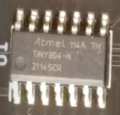
Many thanks to "The Futurist" for being able to produce an in focus screen grab.
It seems that BB in post#3 called it correctly.
And it seems to me, also, that it smells like a solution in search of a problem. The difficulty being that such solutions often have so many features: " a couple features it seems you're after." that they are miserable to use.

OR, like I mention sometimes, "When one size fits all, it does not fit any of them very well."
 

Thread Starter

Ascendthestair

Joined Apr 11, 2025
2
This is an easy project for anyone having the know-how.
Instead of focusing on this particular gadget, tell us what problem you are wanting to solve. Then we can take it from there.
Sorry for the delayed response.

Our goal as a group is to be able to adapt toys for use by all abilities. Currently we are wiring buttons to 3.5mm mono cables and to sensitive 3 or 5" buttons that are easily pressed. Some toys however would be better used as a toggle (which requires more dexterity to press and prevents us using a single button model) or a timer (which is just more complicated in general)
This gadget seems to solve those problems.

The things we need to solve are
-Different toys require different button styles
-The same toy used by different kids with different needs may require either Momentary, Toggle, or timer buttons
-Our kids are just learning to do this so I prefer to give clear repeatable instructions. Just making the buttons with a Momentary
-keyboard switch in a 3d printed frame is what we are doing now. I think we need to keep that.
-This should be a discrete project for our teens that show some troubleshooting knowhow. Allowing us to step up the engineering talents but still maintain the mission of adapting toys
 

MrChips

Joined Oct 2, 2009
34,629
I prefer to take an engineering approach to problem solving.

The Tiny Switchy is an admirable solution because it is like the Swiss Army Knife. It will work in any situation.
The things we need to solve are
-Different toys require different button styles
-The same toy used by different kids with different needs may require either Momentary, Toggle, or timer buttons
I would prefer to use three separate solutions in order to keep it simple.

At the very least, each unit should have options for NO and NC contacts.
There are two ways to accomplish this:
1) have a miniature slide switch to choose from NO and NC output,
2) have both outputs available on the board.

All buttons must be debounced with a 50-ms delay or filter.

If you still desire to have all three functions on the same unit, then using a microcontroller (MCU) would be my first choice for a solution. I would prefer to have a selector switch which can be on the outside or inside the box. To select the time-delay I would use a rotary knob so that one can instantly see the set time. Again, the control can be placed inside the box, or accessible with a screwdriver through a hole on the box. Presumably, you only need to select the function and time one time for a specific application.
 

dgrover

Joined Oct 10, 2021
1
Just saw this post, and can offer a few details. I designed and manufacture the Tiny Switchy. It does indeed use a microcontroller (the ATTiny804), a pair of MOSFETs for the output, and not a whole lot else. The goal was to drop the BOM drastically from a traditional switch modifier design that would use potentiometers, relays, and other costly components. The microcontroller and pushbuttons go a long ways towards that. Designing for low power (about 4 uA I think) means it doesn't need an on-off switch, another savings, and runs for years on a CR2032. A lot of interconnected design decisions to get to a retail price (and reasonable wholesale) that I think make it a good value. It also does not include a few features (momentary output for some electronic devices that use pushbuttons for on & off, for example) that some other switch modifiers have, but it does try to cover many use cases without getting too complicated or expensive. Manufactured in-house on a pick-and-place and reflow oven. Case is injection molded in-house (a small 16-ton vertical machine) using a mold also made in-house (aluminum).

See Makers Making Change for some examples of folks making switch modifiers using off-the-shelf Arduinos and similar. That approach would certainly offer opportunities for customization to address many other situations.

--Dale
Dale Grover
Little Lake Technology, Inc.
 
Status
Not open for further replies.
Top