Facebook
 Google
 GitHub
 Linkedin
Hello crew,
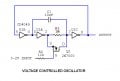
Withing the more general scope of making electronic music, I am trying to build this oscillator based on a 4049 chip:
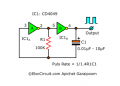
I know it's crap, but it's simple, which is good for learning I have breadboarded it successfully, I'm using a 12V supply and playing with the RC values I can adjust the frequency. Yay!
Now I am trying to add voltage control to the thing. I have found another schematic with an added 1M resistor at pin 3 that says to connect CV there. So I did just that and hooked a pot (10K) wired as a voltage divider there to be able to sweep between 0V and 12V but I only get about a semitone range. This is what it looks like now:
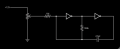
I can increase that up to about an octave and a half by changing the 1M resistor for a 20K (if I remember well) but I'd really like to get at least twice that range. Sadly, with smaller resistor values the oscillator starts to behave quite erratically.
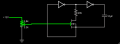
I know that for the thing to be used for music I will end up having to add an expo converter but I feel like I should be able to get the range using a pot first. I've tried to simulate the circuit on the falstad applet to "see" how the electrons move around but the simulation fails when I start playing with the control voltage.
Anyway, so many words to ask how I can increase the range of this thing, if it's at all possible.
Thank you for your time!
Withing the more general scope of making electronic music, I am trying to build this oscillator based on a 4049 chip:
I know it's crap, but it's simple, which is good for learning
I have breadboarded it successfully, I'm using a 12V supply and playing with the RC values I can adjust the frequency. Yay!Now I am trying to add voltage control to the thing. I have found another schematic with an added 1M resistor at pin 3 that says to connect CV there. So I did just that and hooked a pot (10K) wired as a voltage divider there to be able to sweep between 0V and 12V but I only get about a semitone range. This is what it looks like now:
I can increase that up to about an octave and a half by changing the 1M resistor for a 20K (if I remember well) but I'd really like to get at least twice that range. Sadly, with smaller resistor values the oscillator starts to behave quite erratically.
I know that for the thing to be used for music I will end up having to add an expo converter but I feel like I should be able to get the range using a pot first. I've tried to simulate the circuit on the falstad applet to "see" how the electrons move around but the simulation fails when I start playing with the control voltage.
Anyway, so many words to ask how I can increase the range of this thing, if it's at all possible.
Thank you for your time!