Facebook
 Google
 GitHub
 Linkedin
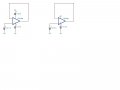
..generate the most heated debates. Trick question, what is the common mode voltage of the op-amp buffers in the attachment?
1) Most op-amp literature tells you the common mode voltage is the average of the algebraic sum of V+ and V-. This is the same as saying the common mode voltage is the voltage on the V+ pin. Using this definition, the common mode voltage for both buffers is 7.5V.
2) If I told you the common mode voltage is referenced to (Vcc+Vee)/2 or otherwise the mid-point between the supplies, then the left buffer's common mode voltage is 7.5V since the mid-point is 0V and the right buffer's common mode voltage is 0V.
3) If I told you the common mode voltage is referenced to Vee then the left buffer's common mode voltage is 22.5V and the right buffer's common mode voltage is 7.5V.
I have used the first definition almost exclusively until I entered the semiconductor field. Many test and evaluation engineers (ATE/Bench) have used the second or third definition.
Do you agree or disagree?
1) Most op-amp literature tells you the common mode voltage is the average of the algebraic sum of V+ and V-. This is the same as saying the common mode voltage is the voltage on the V+ pin. Using this definition, the common mode voltage for both buffers is 7.5V.
2) If I told you the common mode voltage is referenced to (Vcc+Vee)/2 or otherwise the mid-point between the supplies, then the left buffer's common mode voltage is 7.5V since the mid-point is 0V and the right buffer's common mode voltage is 0V.
3) If I told you the common mode voltage is referenced to Vee then the left buffer's common mode voltage is 22.5V and the right buffer's common mode voltage is 7.5V.
I have used the first definition almost exclusively until I entered the semiconductor field. Many test and evaluation engineers (ATE/Bench) have used the second or third definition.
Do you agree or disagree?
Attachments
-
 35.3 KB Views: 33