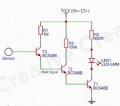
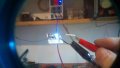
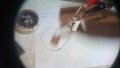
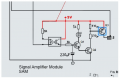
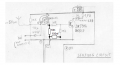
I made a simple AC detector, that doesnt work on my wall, but only on my table. I think it's sensing my grounded table. If I lift it in air, its led is lit for a considerable distance from table, from about 20 cm and forward.
Is working somehow, but not really sensing what I need.
Here is in the air(led is on):______________Here is near the table (and led is off): ______________
@dl324 today I received my DSO138 Digital Oscilloscope I ordered in my past life. It come of course without the acrylic case, but I can make one myself from cardboard. I wished I didnt had to make it. But the price was excellent.
If you have the pleasure sometime, to introduce me to some quick and dirty basics with it. Yes I can watch some youtube videos, and I already watched a lot in the years, but other thing is when the information comes from you and is interactive.
Please respond to this new thread I made here: https://forum.allaboutcircuits.com/...ng-with-a-digital-oscilloscope-dso138.176267/
I dont want to extend this thread that is already too much as it is.
Thank you !
I also received the IR leds and their dark photo diodes (50 pairs = for a lifetime).
The first thing I did with my oscilloscope was to feed stereo music to it. Left channel to vertical input and right channel to horizontal channel input. The trace makes a bouncing tangle when stereo has different sounds on each channel.
The first thing I did with my oscilloscope was to feed stereo music to it. Left channel to vertical input and right channel to horizontal channel input. The trace makes a bouncing tangle when stereo has different sounds on each channel.
New problem. Relay1 is not commanded anymore.
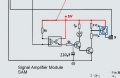
What I did so far. I only changed the sensing circuit with a 10K potentiometer. And it worked excelent. In this way, I could test the board if is reacting to the mains fv and it was not. Now I put back the sensing circuit and is not commanding relay1 anymore. I checked SAM signal transistor (marked with blue square) Emitter-Collector voltage and is 1.6V all the time.
But when led10 is activated, that Emitter-Collector turns to 0V. I changed this particular transistor with a new one, and is still exact the same result. Then I checked every transistor in the entire board, B-C B-E with my DMM set on diode, to check if they are burned/non-conducting, and all are just fine. None are damaged or burned.
Then I separated the entire latching circuit (the one with 555 in it) and that also interrupted both relays as well. I checked again that Emitter -Collector voltage and is 1.6V all the time.
Then I manually powered the relay itself with 5V and then its little command module with the leds on them, and all are fine.
- The idea was, to have 5V to relay1 (or to the command module for relay1) to manage to command it. This circuit with the PNP in it, it does not have any sense for me. It should have been working with only NPN's. Remember that first SAM I built? with a single darlington transistor in it that was getting burned after awhile of use? That was NPN. Why the hell is stopped now? Why the hell was working with PNP?
My impression again, this SAM is faulty.
I am thinking to build another SAM but this time with superior more powerful transistors in it, and I will use NPN ones and in a darlington configuration. I will use the powerful BD139, since I have 100 of them. And if these are getting burned... then I will add a heatsink as well.
Now that I have the osciloscope, and I believe you when you say its an indispensable tool, but I really have no idea how to debug anything with it at this fresh moment. I think I should use it somehow. But how and where? I sincerely dont know. How are you doing if you were in my case?
As always, I will do exactly what you are telling me to do. So guide my ass, please.
My question for you is, how to discover the real cause of these interruptions or malfunctions, and why does that darlington transistor from the first SAM was burning so easy? I like that circuit more, because of its simplicity and fast debugging. Now with this new one... that is also faulty its just crazy.
Tell me your impressions and your thoughts.
Let's make another more serious SAM. More resilient and that will output a true 5V without any bullshit.
Thank you.
Open this image first:
(this image is HiDef and you can read the smallest text in it, but you must open it properly, either download it, or in browser 1click to enlarge it and then rightclick on it and choose "view image") View attachment 215289
I have 3 important problems to resolve:
probl 1: (!!!!!Very important!!!!!)
The area of the light is too small and the LM3914 circuit will create an On/OFF state for all leds, when interupting the beam. It will interupt suddenly.
Its not the circuit fault but exclusivly the light and LDR fault. Their dimentions are too narow and my finger is too wide for the circuit to sense it slowly. I need a way of enlarging the LDR surface that will allow penumbra to play its role on the lm3914 circuit and the leds to behave corectly. I have to evectively get into the beam light and interupt it right now, so it is no room for penumbra to leave the sensor to sense anything. Its too fast for the ldr to be able to cath other little diferences in shadow, other penumbras diferences. I need to enlarge the shadow area of the LDR. I dont know how to say it better than this. The shadow area right now is 0.5cm (or 5mm) (or 1/5 of 1 inch)
I wish I can enlarge the shadow area to about 5cm (or 2 inch) around LDR sensing area. When this area is so large, the ldr have the time and space to dim the leds 1 by 1 more elegant. Right now is too abrupt, too brutal, too fast, too narrow. You get me? If not, ask me, and ill add more details on this matter and drawings if needed.
probl 2: (not very important at the moment, is working as it is)
The new Laser diode, I inserted for the very large distance i can separate the triger elements. But, the Laser is too dim at 3V and im afraid to push it over 3V ( i can, i test it already and is brighter) but it will overheat and burn in a short period of functionality. Im not very sure how stable will be as it is at it's normal parameters.
My thought is to amplify the LDR signal to pin 5 trough a transistor because of this small laser signal. It is good light right now and working ok but not very bright and leaves other external lights to interfere. Of course ill have to make a new case for the ldr to defend it from external lights and concentrate only my beam on it.
probl 3: (important, but it can wait until the end)
All this trigger part, (laser diode + ldr module to pin 5) will have to be integrated with another pre-existing circuit. I'll have to change ldr module to that one, and adapt this one to do a double function: to action on pin 5 as it is now, and also to triger a relay from the other circuit. What a complication. I hope i can split the signal in 2, one for the pin4 and other for a transistor that will drive the relay. Ill have to test it and keep you in touch.
Just as an observation from one point: Don't use an LDR- they won't be good for this. Instead use a photo-diode that is specifically responsive to your laser's peak wavelength.
Just as an observation from one point: Don't use an LDR- they won't be good for this. Instead use a photo-diode that is specifically responsive to your laser's peak wavelength.
You say the LM3914 LEDs are very dim:
1) The missing resistor to ground on pin 7 sets the LEDs current.
2) The missing ground on pin 8 sets the pin 7 voltage.
I will check that also, mister @Audioguru again . It would be nice to make them full brightness. But I have a bigger problem now, with the relay1 not being commanded anymore and I am waiting for mister @sghioto to help me resolve it... if he is willing anymore.
- Problem solved and thanks to mister @sghioto. It was a loose wire, but is weird because it was soldered but it didnt made contact and on continuity tester is showed ok as connectivity. It looked ok. Anyway, dragging with my tweezers the wires around, 1 got loose and resoldering it with a good solder flow, did connected the command module for the relay and everything is now as before, working. Embarrassing for me, but it was hiding in plain sight. The wonderful logic of mister @sghioto saved my circuit once again. Stuff happens.
On other side of the problem, the interference problem, here are my latest conclusions:
- The summary of this circuit is simple. Is working at 5V for all modules, for the entire board circuits. It is working perfectly on the working table. It is messed up on the wall, Near the 240V AC, 50Hz inside the wall. If I put a metal shield in the back of my board, and ground it, again, is working perfectly. BUT if I connect the relay to actually switch the 220, either by inserting the relay in the hole, or by dragging some wires from relay to the live wires in the hole socket, it is terrible messed up. This is the summary.
- I think the relay is so small and cute, that 50Hz getting through its metal contacts are reverberating through all the minimalist isolation he has in it, and the vibration from the 50Hz travels on it's (5V) power wires, to the board, to the entire thing, bypassing the grounded metal shield and affecting the sensing circuit. It's like water, getting on a thread to the other side of the board.
Basically, the entire board and its circuits are "vibrating" at 50Hz when is the physical connection to the live wires.
Because with the grounded metal shield in the back of the board is working perfectly, when is not connected to the live wires. BUT if I connect the relay to actually switch the 220, THEN it is behaving erratically. You see it now ?
I very much think that the relay should be shielded and filtered and protected to not transmit further the frequency.
What do you say?
My solution :
- I think 1 or 2 diodes put on the 5V power wires to the relay itself, will restore the smooth continuity of the track , and stop any reverberation from the live wires get past the diodes. Hopefully. And also a 100nF capacitor on top of those diodes, to hopefully filter further.
I will do the tests and let's hope for the best.

 Facebook
 Google
 GitHub
 Linkedin