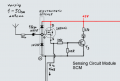
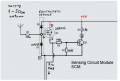
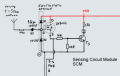
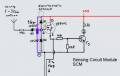
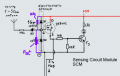
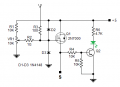
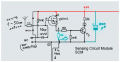
The LED's Wings Project and sensing circuit.

Thread Starter

q12x

Joined Sep 25, 2015
2,227
Do you mean as far as using a different type of sensor?
Yes and no.
Yes, as mention before, how can I replace it? Beside sound.
No, the same sensor, how can I avoid burning them? What are the safe rules in this situation? I want to push it further because we reach this far with it and I still don't give up. I understood from the begining it is difficult, not THIS difficult, but I had it in my mind. It's weird because the long antena I used it before, and even the dude in the tutorial is also using a long antena. And now... is getting damaged every time I touch the little antena or burned completly every time I touch the long antena.
 

Thread Starter

q12x

Joined Sep 25, 2015
2,227
Ok, so I'm thinking to new approach, new tactics.
1- There are no anti-static electricity circuits? Already made? That I can copy and apply to my problem here?
Protection for static electricity, of any kind and any shape, not just electronic circuits, but materials perhaps?
2- Can't we invent such an anti-static electricity circuit? I imagine it should be with a rezistor and a zenner diode. I remember a zener diode needs a resistor, like a led, to limit current through it, or else will get burned. I think it was an article here on AAC. I dont usually use in practice very often the zeners, but I have a general idea about them and also I have a collection of them in my arsenal, all brand new and with many voltage values. I bought a set on ebay long time ago, just in case.
- If not with a zener, then with a voltage limiter, but it must be in form of "if voltage equal or greater than 15V, then limit it to this maximum of 15V".
3- Before breaking any more sensitive 2N7000 transistors, I would very much like to make a test circuit for this electrostatic problem. Something simple I imagine, with a couple of normal npn bc546 transistors and a led or multiple leds, to signal me when and how hard the electrostatic is occurring.
I dont have any circuit designed yet, I only have the ideas. Here I am asking for the circuit designs from you.
Or, if is too scify what I am imagining, then please explain it to me since its a new subject to me. I mean, its not new but I seriously treated now, than before.
Thank you !
PS> I got these ideas after you (@sghioto) mentioned " The maximum gate voltage on 2N7000 series is only 20 volts. " So in this context, it might be a chance.
 
Last edited:

Thread Starter

q12x

Joined Sep 25, 2015
2,227
Thank you!
In some degree, I understand why diode from G to + and the 100ohm are for. But i dont get why diode from - to G.
Please explain. Static electricity gather on the [-] track as well? Kind of reverse biased inside the transistor? Im trying to guess here.
Diode from G to + is indeed very smart, and I love the idea. Basically redirects all the voltage (if present) from the antenna wire to the + rail. It will not overcharge the + rail? Just curious ipotetical.
And the 100ohm will limit the current but not the voltage. Right? The current is already very small from antenna to G. That's why I mentioned the zenner. Or an opamp + zenner, Ive seen this configuration somewhere in my opamps researches. If I even remember right. I think it was inside a voltage regulator circuit diagram, if I remember right. Or probably Im over complicate it but Im happy to add anything as long as it will resolve the problem.
 
Last edited:

sghioto

Joined Dec 31, 2017
8,643
Edited schematic, see placement of 100 ohm resistor. Also corrected the symbol for the 2N7000
ESD can be negative, to answer your question why the diode from gate to ground
 
Last edited:

sghioto

Joined Dec 31, 2017
8,643
Then you probably don't need the 1N4148 in series with the 100 ohm resistor.
Suggestion. It's always a good idea to label the components. Saves a lot of time by not having to describe a part in the schematic as I did above.
1613331889031.png
 

Thread Starter

q12x

Joined Sep 25, 2015
2,227
I screenshoted that before I've added more details to it. It is updated in my artpage as mentioned.
1613332977937.png
D3 that you took it out, is an essential component there. It is playing the role of a 1G ohm resistor that is helping the sensing gate.
If I'm making the antenna straight and not round as it is now, it will increase the sensitivity.
I think the calibration can be made from a potentiometer, if Im hiper sensitizing the gate(by stretching the antenna). Is what Im thinking to do (probably) next. That 10k is part of this calibration. But it was doing nothing. For some reason, if I was adding another resistor from G to 0V, nothing was working.But I had very strange errors all the way. Only the pot will have sense there.
So my plan is to add in parallel to the 2 diodes, a pot. Like the violet thing i draw there. It is linked to the G with its middle pin and also to D3.
1613333476608.png
And like this was in the original circuit from the movie:
1613333688264.png
 
Last edited:

Thread Starter

q12x

Joined Sep 25, 2015
2,227
I tried your correct circuit and is not working. So what I built so far is working perfectly without any way of fine tuning (excepting the antenna) and is fine as it is. We will put aside this problem for the moment and concentrate on other more important modules to make.
I start to make the Remote Control test and with a little success.
I made a short movie(6min) in which I present what I did so far:
 

BobaMosfet

Joined Jul 1, 2009
2,211
I screenshoted that before I've added more details to it. It is updated in my artpage as mentioned.
View attachment 230403
D3 that you took it out, is an essential component there. It is playing the role of a 1G ohm resistor that is helping the sensing gate.
If I'm making the antenna straight and not round as it is now, it will increase the sensitivity.
I think the calibration can be made from a potentiometer, if Im hiper sensitizing the gate(by stretching the antenna). Is what Im thinking to do (probably) next. That 10k is part of this calibration. But it was doing nothing. For some reason, if I was adding another resistor from G to 0V, nothing was working.But I had very strange errors all the way. Only the pot will have sense there.
So my plan is to add in parallel to the 2 diodes, a pot. Like the violet thing i draw there. It is linked to the G with its middle pin and also to D3.
View attachment 230404
And like this was in the original circuit from the movie:
View attachment 230405
@q12x I watched your video- fantastic job- very cool!!!

To help you do schematics here is a free product for both schematics and pcbs. Their PCB services is (in my opinion way too expensive), but for free use the software is far better than what you are doing (far easier, too):

https://www.expresspcb.com/
 

Thread Starter

q12x

Joined Sep 25, 2015
2,227
Thank you for the software mister @BobaMosfet . I already download it and now im looking through it.
Very interesting indeed that you find with 6 layers, but I need 10!!! or more, who knows. But I get it.
I will look in it to see if I can combine somehow to make more than 6 layers inside 1 file or 2 files with split circuit boards.
What Im very interested is a price for a board with 10 layers on it, and quite big dimensions that I just measured now and is exactly 50cm x 15cm, the entire metal shield that the board sits on it. I just realized that I also will need a layer for the back of the fiberglass board full of copper for the shield itself. So it will be more than 10 layers. I didnt number them yet, im speaking from my ass_imov right now but im pretty sure im over 10layers. Is there such technology to print on 12 layers for example? My real problem is money and cost. That, I dont think I could afford it. But is a good thing to have an idea about the price, nevertheless. If you can help me with that... it wil be awesome. The more information I have, the better.
I still, have a bit more circuits to add to this board. It's not finished yet, not completely.
 

BobaMosfet

Joined Jul 1, 2009
2,211
@q12x - Why on Earth do you need 10 or more layers? Yes, there are packages that will do that- I use DipTrace (and you can try their trial software free for 30 days).

Here's the thing- let's see a whole, clean schematic, and then we all (here) can evaluate how many layers you actually need, and a possible avenue to achieve that affordably. Most PCBs are priced based on holes drilled, not on dimensions, but that depends on the PCB outfit.

Normally, there are specific reasons for layers, and you only add a layer if you have no other way, or it serves a required purpose.
 

Thread Starter

q12x

Joined Sep 25, 2015
2,227
Why on Earth do you need 10 or more layers?
here is why:
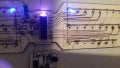
20210222_194547.jpg
Do you see all those intersections? And UNDER the IC module all those wires are going?
Those intersections are possible because the wire is enameled and I was counting on it when I first build it.
Because I have 10 rows of leds I guess is only 10 layers. But Is more than those leds. Its the back metal plate, some more stuff on the IC, and probably more that I cant see it now but only in a clean design and possibly a testing program.
Im actually thinking on doing it on paper on a glass with strong light under it. I have to build a glass table like that and is in plan for many years. I will do it in the end. But now Im not at that stage yet.
 
Last edited:

BobaMosfet

Joined Jul 1, 2009
2,211
here is why:
View attachment 231200
Do you see all those intersections? And UNDER the IC module all those wires are going?
Those intersections are possible because the wire is enameled and I was counting on it when I first build it.
Because I have 10 rows of leds I guess is only 10 layers. But Is more than those leds. Its the back metal plate, some more stuff on the IC, and probably more that I cant see it now but only in a clean design and possibly a testing program.
Im actually thinking on doing it on paper on a glass with strong light under it. I have to build a glass table like that and is in plan for many years. I will do it in the end. But now Im not at that stage yet.
Hi- no, no... you don't need all those layers. Your entire project can be done on 2-4 layers. Seriously. I have lots of experience with PCB design. I have PCBs far more complicated in less space than what you have, using just 2 layers.
 
Top