Facebook
 Google
 GitHub
 Linkedin

Sometimes I was wondering if a Joule Thief could be built without a resistor.
Or without a transformer, just a coil (or two). However this circuit needs extra parts and usually, 2 Transistors.
How about reducing the parts count even further? And using a ready-made potcore inductor.
Such as a Panasonic 10mH component.
One extra winding is added, and this becomes the main winding for the LED current.
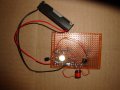
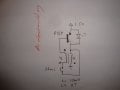
A regular 2n3906 PNP Transistor and a 1.5v AAA Battery and a 1W white LED are used as component.
Now, the base is connected to one pin of the 10mH coil.
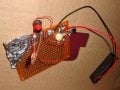
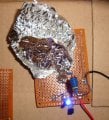
The other is just left free! A piece of tin foil is attached to the corner of the proto board, so it just covers the other pin of the 10mH Inductor.
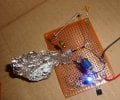
By rubbing the tin foil, the Joule Thief actually starts!
Explanation: The tin foil works as Antenna, so the electron holes can flow out from the transistor base into free air.
I used just one connection at first, but brightness wasnt great. I had to use a start button, and though this isnt a resistor, component count isnt reduced. Also the wire arrangement was sensible very much.
The tin foil does not need to be stretched out, it is just right like it is, but it is important it has good coupling to the 10mH inductor (here done with a solder blob).
When the tin foil is lifted a little, brightness goes down!
I think before of adding the foil, energy was flowing via capacitive coupling between the windings. I explain that by when compressing the windings, brightness would increase.
It starts up easily (but not by itself).
Only 3 components: LED, Transistor, and Inductor (with added winding actually just a few turns).
The feedback winding has more turns than the main winding.
Interesting circuit, or is it?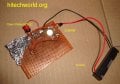
Or without a transformer, just a coil (or two). However this circuit needs extra parts and usually, 2 Transistors.
How about reducing the parts count even further? And using a ready-made potcore inductor.
Such as a Panasonic 10mH component.
One extra winding is added, and this becomes the main winding for the LED current.
A regular 2n3906 PNP Transistor and a 1.5v AAA Battery and a 1W white LED are used as component.
Now, the base is connected to one pin of the 10mH coil.
The other is just left free! A piece of tin foil is attached to the corner of the proto board, so it just covers the other pin of the 10mH Inductor.
By rubbing the tin foil, the Joule Thief actually starts!
Explanation: The tin foil works as Antenna, so the electron holes can flow out from the transistor base into free air.
I used just one connection at first, but brightness wasnt great. I had to use a start button, and though this isnt a resistor, component count isnt reduced. Also the wire arrangement was sensible very much.
The tin foil does not need to be stretched out, it is just right like it is, but it is important it has good coupling to the 10mH inductor (here done with a solder blob).
When the tin foil is lifted a little, brightness goes down!
I think before of adding the foil, energy was flowing via capacitive coupling between the windings. I explain that by when compressing the windings, brightness would increase.
It starts up easily (but not by itself).
Only 3 components: LED, Transistor, and Inductor (with added winding actually just a few turns).
The feedback winding has more turns than the main winding.
Interesting circuit, or is it?



 Sort of a "blocking oscillator"