Facebook
 Google
 GitHub
 Linkedin
Hi friends. i have recently made an LDR circuit that turns a LED on when dark. I used a joule thief approach with a transistor as to try an use 'dead'' AA batteries. everyone has those..but to be able to set the threshold to what intensity of light it turns on i added a potentiometer... now my first circuit looked like this:
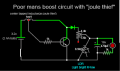
As you can see the sensor was afterwards.
this worked very well. problem was the transistor was always on and batteries didnt even last a night as power flows even if light is off...
Then i decided to add the 'sensor' at the base of transistor(2n2222)
like so:
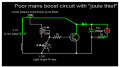
This also worked, but i struggled to set the threshold... then i made a small adjustment to the connection with the sensor like so:
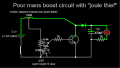
This works as desired but the settings are waaaaay to sensitive on or off at spicific light, can't set the desired action anymore. am i missing capacitors or zeners or what.
My question is:
Is there a way to make it more proficient witout adding any other components like 555 which will just complicate things. If i have to add another or a few extra transistors then i can do that.But how can i make it better and better at adjusting light threshold? must i swop the ldr and potentiometer or what?
As you can see the sensor was afterwards.
this worked very well. problem was the transistor was always on and batteries didnt even last a night as power flows even if light is off...
Then i decided to add the 'sensor' at the base of transistor(2n2222)
like so:
This also worked, but i struggled to set the threshold... then i made a small adjustment to the connection with the sensor like so:
This works as desired but the settings are waaaaay to sensitive on or off at spicific light, can't set the desired action anymore. am i missing capacitors or zeners or what.
My question is:
Is there a way to make it more proficient witout adding any other components like 555 which will just complicate things. If i have to add another or a few extra transistors then i can do that.But how can i make it better and better at adjusting light threshold? must i swop the ldr and potentiometer or what?