The Analog Gods Hate Me

Thread Starter

royaaron

Joined Feb 19, 2024
108
I’ve attached a schematic with which I’ve had excellent assistance from Mooly on diyaudio.
He concluded that I am not breaking any rules and could not see any obvious electrical issues that would prevent it from working.
But it is not working. And I’ve triple-checked my wiring, checked continuity and discontinuity (what should be connected is and what should not be is not).

The aim of the device is mainly to produce three mono outputs from a stereo source:
1. a center channel (mono) output
2. an output consisting of what is unique to either of the stereo channel inputs
and
3. an output consisting of what is common to the stereo channel inputs

In addition, there is a switchable low-pass circuit that can be employed.

Function 1 is simple enough.
Function 2 should contain the sum of one of the stereo channels and the inverted other channel.
The input to this portion is regulated by a linear 2-gang potentiometer acting as a balance allowing the user to pan between the left and right.
For function 3 the outputs of 1 and 2 are combined in a differential circuit (much like done for function 2), essentially producing the opposite of function 2.
The (likely) source unit output is stated as 0.5 volts at 2.2K ohms.

What happens is:
1. The volume seems to be greatly reduced.
2. Neither function 2 nor 3 appears different from the input at all; it’s as if there was no circuitry in place.
3. The low-pass circuit does appear to have some effect.
4. SW2 is a “Break/Make” rotary switch. When I switch between any two positions slowly, thus not making the next connection there is a large squeal. Could someone explain? I didn’t think that an open connection would drive anything nuts.

The schematic and LF353P spec sheet are attached.
 

Attachments

Ian0

Joined Aug 7, 2020
13,097
Try it with two signal of different frequencies from a signal generator (or two), one on each channel. Then it will be really clear what is happening.
 

MisterBill2

Joined Jan 23, 2018
27,159
The flaw that I observe is that the resistors R4 and R5 are coupling the two inputs together so that there is not much difference.
The solution is to have a buffer amplifier before the summing connection.

The loud squeal that happens as the switch is moved is an oscillation that happens when the amplifier input circuit is momentarily opened.
AND this is a variation of the same project that we saw a few months ago. My opinion is that the total scheme is too complex.
 

Thread Starter

royaaron

Joined Feb 19, 2024
108
The flaw that I observe is that the resistors R4 and R5 are coupling the two inputs together so that there is not much difference.
The solution is to have a buffer amplifier before the summing connection.

The loud squeal that happens as the switch is moved is an oscillation that happens when the amplifier input circuit is momentarily opened.
AND this is a variation of the same project that we saw a few months ago. My opinion is that the total scheme is too complex.
I do not understand "so that there is not much difference." The object is to create a mono signal consisting of the left and right channels.
What values would you suggest for R4 and R5?
And while I understand that you think the "center channel" (mono) portion should be implemented differently why can't I just short left and right using resistors?
I've seen it in various but similar fashions on the net a dozen times?
Could you suggest how to implement a buffer amplifier?

And, yes, this one is an even more complex (and bothersome) version of what I posted months ago.

While not terribly important (since SW2 is switched quickly) is there a solution to "oscillation that happens when the amplifier input circuit is momentarily opened?"
 

MisterBill2

Joined Jan 23, 2018
27,159
I do not understand "so that there is not much difference." The object is to create a mono signal consisting of the left and right channels.
What values would you suggest for R4 and R5?
And while I understand that you think the "center channel" (mono) portion should be implemented differently why can't I just short left and right using resistors?
I've seen it in various but similar fashions on the net a dozen times?
Could you suggest how to implement a buffer amplifier?

And, yes, this one is an even more complex (and bothersome) version of what I posted months ago.

While not terribly important (since SW2 is switched quickly) is there a solution to "oscillation that happens when the amplifier input circuit is momentarily opened?"
The reality is that to avoid combining the signals sent to sections that require them to be separate, you must have an isolation amplifier to maintain the separation.of the two signals. Perhaps another can explain it more clearly.
 

Ian0

Joined Aug 7, 2020
13,097
The problem with R4 and R5 is that they are too small in comparison with the source impedance at that point, which is about 17k from the various variable resistors. If you buffer the signal from the variable resistors you might stand a chance. . .
 

Thread Starter

royaaron

Joined Feb 19, 2024
108
The reality is that to avoid combining the signals sent to sections that require them to be separate, you must have an isolation amplifier to maintain the separation.of the two signals. Perhaps another can explain it more clearly.
So the best why to implement "center channel" is through an amp rather than by shorting the signals albeit through resistors . . .
OK, I'm onboard. The LF353P is a dual opamp. So I suppose I could connect each channel to separate unity gain amps
I think you a resistor from the junction to ground.
The junction is the mono output, no?
 

MisterBill2

Joined Jan 23, 2018
27,159
Connecting a resistance between the channels will tend to combine them, because without isolation the signals flow in both directions.
The TS has a lot of op-amps and so isolation buffering would be simple.
My comment IS NOT about obtaining the center channel, it is about not maintaining the isolation for creating the difference between the channels. I was looking at the whole system, not at just the one part of it. What you combine at one point becomes combined at the other points.
What is done in one section will affect the other sections.
If you do not want any advice, you can ignore it until someone else explains it again.
 

Thread Starter

royaaron

Joined Feb 19, 2024
108
The solution is to have a buffer amplifier before the summing connection.

MisterBill,
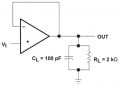
How's this? (I believe the RC circuit serves to reduce RF interference.)


Unit Gain Op Amp.jpg

So I can feed both left and right channels into the two LF353P inputs thus isolating them from the source.
But do I then short the ouputs from the op amp? Or do I have to add something?
And what if I did want a small gain?

And I do want your advice. I just do not understand things fully all of the time.
 

MisterBill2

Joined Jan 23, 2018
27,159
IF you added two of these buffers in series with the connections shown feeding R4 and R5, then the L and R signals will remain separated to where they feed the separate inputs to IC1B, pins 5 and 6. THAT is all it would take to be able to get the desired difference signal.
 

Thread Starter

royaaron

Joined Feb 19, 2024
108
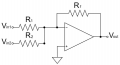
Look up "Summing Amplifier " or "Virtual Earth Mixer"
I have and found this:
1752005643968.png

But I still have to supply R1 and R2. What values would those be? And would Rf be of the same value?

Aside from C1 and the R6 pot, IC1a is, I suppose, a non-inverting summing amp. Perhaps that is my mistake.
 

Thread Starter

royaaron

Joined Feb 19, 2024
108
IF you added two of these buffers in series with the connections shown feeding R4 and R5, then the L and R signals will remain separated to where they feed the separate inputs to IC1B, pins 5 and 6. THAT is all it would take to be able to get the desired difference signal.
1. Using the dual-amp LF353 I ahould be able to do that with one IC.
2. But then there's that mono output I'm looking for. I figure I would use another LF353 in a similar fashion. But can I then just short the outputs (Pins 1 and 7)?
3. And what if I did want a small gain?
 

Ian0

Joined Aug 7, 2020
13,097
1. Using the dual-amp LF353 I ahould be able to do that with one IC.
2. But then there's that mono output I'm looking for. I figure I would use another LF353 in a similar fashion. But can I then just short the outputs (Pins 1 and 7)?
3. And what if I did want a small gain?
Shorting the outputs together will give you nothing apart from distortion.
If you want a small gain, make Rf slightly larger than the input resistors.
 

Thread Starter

royaaron

Joined Feb 19, 2024
108
All the same value, and large (ten times as big) as the source impedance.
Okeedoke . . .

17K seems about right:
The purpose of resistors R1 and R2 is to compensate for any difference between the two ganged pots of R3, the general volume control.
(I'll probably lose the ground and make them rheostats.)
So one of them will be 0 ohms and the other just a few. R3 (also a logarithmic pot) will typically point to noon and so will likely equate to a 17K resistor.
But how that translates to impedance is Greek to me.
What if instead of 170K (or 200K) resistors I used 100K resistors? What effect would that have?
 

Ian0

Joined Aug 7, 2020
13,097
So how do I get a mono signal from the left and right?
You get L+R by using the summing amplifier.

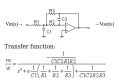
If you really want to minimise the number of op-amps, you can do the mixing and filtering in one stage with a MFB filter:
Screenshot from 2025-07-09 06-20-18.pngby duplicating R1, one for each channel.
This utility calculates the component values for you.
 
Top