Testing LED's ( Back Light on a TV )

Thread Starter

spike1947

Joined Feb 4, 2016
537
Hi
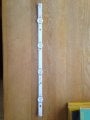
I am trying to replace some dead LED's on a couple of strips from a LED TV, tested a row of 4 using 12.2 v dc and it shows 2 working, now I am trying test a single LED using 3.23 v dc ( 2xAAA Bats ) , but even the good ones are not lighting with that voltage, what am I doing wrong here !.
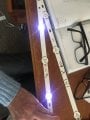
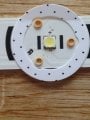
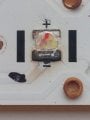
attached pics showing 2 LED's lit with a supply to the strip of 12.2 v dc.

ps: I also don't know what the voltage is of these !.
Cheers
Spike
 

Attachments

Ya’akov

Joined Jan 27, 2019
10,226
The individual components can contain multiple LED chips in series. If you lit 2 with 12V that suggests they could need 6 volts to forward bias. You might try, though, doing the test in a darkened room. LEDs glow before they light brightly and they may be glowing at the lower voltage.

The best way to test them would be with a current limited supply, that way you can turn up the voltage without fear of exceeding the power they can handle.
 

dendad

Joined Feb 20, 2016
4,636
You could try measuring each LED with a multi meter set on the diode test.
That will be quite safe and should tell you if the LED is ok.
 

Ya’akov

Joined Jan 27, 2019
10,226
You could try measuring each LED with a multi meter set on the diode test.
That will be quite safe and should tell you if the LED is ok.
This is correct with a caveat. Depending on the meter, some LEDs may not test properly because their forward voltage will exceed the diode test voltage. This includes some white LEDs and certainly those with multiple chips in one case.
 

Thread Starter

spike1947

Joined Feb 4, 2016
537
Hi
Thanks for all your replies, just tested the first string and the good LED's are howing 0.776v
The individual components can contain multiple LED chips in series. If you lit 2 with 12V that suggests they could need 6 volts to forward bias. You might try, though, doing the test in a darkened room. LEDs glow before they light brightly and they may be glowing at the lower voltage.

The best way to test them would be with a current limited supply, that way you can turn up the voltage without fear of exceeding the power they can handle.
Hi
Sorry last reply not finished.
Tested the first strip ( 4 LED's ) with a diode tester , the 2 known good ones are showing 0.724v and the other 2 are showing 0.312 v , so can I take it that would be a test to do all the others ?.How do I tell what voltage a LED is, I am going to connect the up the panel and see what voltage is supplied to the 2 sets of strips, 1st set has 27 LED's in series and the 2nd set has 18 LED's in series .
 

Ya’akov

Joined Jan 27, 2019
10,226
Hi
Thanks for all your replies, just tested the first string and the good LED's are howing 0.776v

Hi
Sorry last reply not finished.
Tested the first strip ( 4 LED's ) with a diode tester , the 2 known good ones are showing 0.724v and the other 2 are showing 0.312 v , so can I take it that would be a test to do all the others ?.How do I tell what voltage a LED is, I am going to connect the up the panel and see what voltage is supplied to the 2 sets of strips, 1st set has 27 LED's in series and the 2nd set has 18 LED's in series .
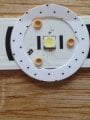
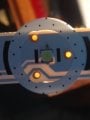
Could you take some sharp (in focus) shots of one of the LEDs and the surrounding circular area? It would help a lot.
 

Rich2

Joined Mar 3, 2014
254
Hi
Thanks for all your replies, just tested the first string and the good LED's are howing 0.776v

Hi
Sorry last reply not finished.
Tested the first strip ( 4 LED's ) with a diode tester , the 2 known good ones are showing 0.724v and the other 2 are showing 0.312 v , so can I take it that would be a test to do all the others ?.How do I tell what voltage a LED is, I am going to connect the up the panel and see what voltage is supplied to the 2 sets of strips, 1st set has 27 LED's in series and the 2nd set has 18 LED's in series .
White LEDs are usually 3.2 to 3.4 volts so be careful with the supply, it could be 90v
 

Ya’akov

Joined Jan 27, 2019
10,226
The photos are very small but from what I can see the LED has a very good chance of being a multi-chip type. The use one substrate with multiple chips and cover them all in phosphor. They would be in series so you have to multiply about 3V by the number of diodes involved.

They will light dimply at lower voltages and you can actually see the individual chips in most cases at the low light level. I am guessing there are 3 per device which would be about 9V to light them. It's just a guess based on apparent size.
 

Thread Starter

spike1947

Joined Feb 4, 2016
537
Just checked the feed from the power board to the 2 sets of LED's , set with 27 LED's = 172v, second set with 18 LED's = 143v .
 

Thread Starter

spike1947

Joined Feb 4, 2016
537
The photos are very small but from what I can see the LED has a very good chance of being a multi-chip type. The use one substrate with multiple chips and cover them all in phosphor. They would be in series so you have to multiply about 3V by the number of diodes involved.

They will light dimply at lower voltages and you can actually see the individual chips in most cases at the low light level. I am guessing there are 3 per device which would be about 9V to light them. It's just a guess based on apparent size.
 

Attachments

Thread Starter

spike1947

Joined Feb 4, 2016
537
Hi
Thanks for all your replies, tested now wih 6 to 6.5 v supply and all is well, total of 45 LED's only 5 bad, so am quite happy at that, now how do I find a twin LED to repl;ace them, I mean what search criteria would I use ?
 

MisterBill2

Joined Jan 23, 2018
27,407
Use an accurate DVM and measure the voltage across an LED that looks like it is working OK.
And good luck removing the failed LEDs. I tried to salvage some once and it seems that they are glued in place and then soldered.
 

Thread Starter

spike1947

Joined Feb 4, 2016
537
Hi
Have managed to sort some 6v LED size ( 3535) also I have managed to desolder them from the strip , have a vid of me doing just that, don't know how to get people to see it, two large to post on here !.
I converted an old iron , bypassing the thermostat, l put some solder on the top and when it melted ( around 235) switched iron off and it stayed hot long enough to do at least 1 chip, I feel quite chuffed with that .
cheers
Spike
 
Top