Terminating a bus on both ends!

AnalogKid

Joined Aug 1, 2013
12,154
Consider an imperfect termination as a way to relieve stress on the bus drivers. In VME systems, the 5 V signalling system is terminated at near 200 ohms on each end, and the backplane impedance is 50 ohms. VME was developed in 1981, before CMOS bus drivers were available and accepted by the industry. TTL, and LSTTL were much better at sinking current than sourcing, so the bus has a termination voltage of 2.94V (330 ohms to +5, 470 ohms to GND) and a Thevenin equivalent impedance of 194 ohms. 36 years later it still is one of the most reliable industrial/MIL bus structures. Active termination methods significantly reduce the termination network static current.

ak
 

Thread Starter

AnalogDigitalDesigner

Joined Jan 22, 2018
121
Consider an imperfect termination as a way to relieve stress on the bus drivers. In VME systems, the 5 V signalling system is terminated at near 200 ohms on each end, and the backplane impedance is 50 ohms. VME was developed in 1981, before CMOS bus drivers were available and accepted by the industry. TTL, and LSTTL were much better at sinking current than sourcing, so the bus has a termination voltage of 2.94V (330 ohms to +5, 470 ohms to GND) and a Thevenin equivalent impedance of 194 ohms. 36 years later it still is one of the most reliable industrial/MIL bus structures. Active termination methods significantly reduce the termination network static current.

ak

yes but as you know my circuit is CMOS.

Can someone please answer me questions.........instead of jumping the fence into other things.........please!
 

ebp

Joined Feb 8, 2018
2,332
ak, you're not really a kid, are you? Only old people know about VME bus. I don't know about VME bus. Unibus, on the other hand ...

crutschow: Series termination is good for situations where there is a driver at one end of a transmission line and a receiver at the other. The signal can look really horrible in between (try your sim with 2 or 3 longer sections of line & look at the signals where they join). Tektronix used both series and parallel termination on the same line in many of their high performance analog oscilloscopes. Of course that means either the driver or receiver must have a gain of 2 to compensate for the attenuation. I've seen some interesting writings on issues with regard to that (can't remember where for sure; I think it's in a book with chapters by a bunch of notable analog people & edited by Jim Williams - haven't looked at it for some years). Series and parallel term is very common for video signals, even with quite low bandwidth.
 

crutschow

Joined Mar 14, 2008
38,538
Can someone please answer me questions.
Okay, I think a thevenin termination roughly equal to the line impedance at the far end with no driver termination may work for both lines. It is simple and will minimize the voltage loss due to termination.

Below is the LTspice simulation of such a (long) line with a 4MHz signal using a 120Ω equivalent termination.
It uses an arbitrary value of 200Ω for the T1 line to show the effect of a 40% mismatch between the characteristic impedance and the termination.

Since the actual line impedance is unknown (and likely varies along the bus) you will probably have to experiment with the values of R1 and R2 (always keeping them equal) to give the best looking waveform.
A wire that is not close to a ground plane, can have a much higher characteristic impedance, perhaps in the 200-400Ω region, (For example, twin-lead has a characteristic impedance of 300Ω with a lead spacing of about 0.3 inches) so you might have to significantly increase the value of R1 and R2 for the best waveshape.

upload_2018-2-16_19-12-49.png
 
Last edited:

Thread Starter

AnalogDigitalDesigner

Joined Jan 22, 2018
121
Okay, I think a thevenin termination roughly equal to the line impedance at the far end with no driver termination may work for both lines. It is simple and will minimize the voltage loss due to termination.

Below is the LTspice simulation of such a (long) line with a 4MHz signal using a 120Ω equivalent termination.
It uses an arbitrary value of 200Ω for the T1 line to show the effect of a 40% mismatch between the characteristic impedance and the termination.

Since the actual line impedance is unknown (and likely varies along the bus) you will probably have to experiment with the values of R1 and R2 (always keeping them equal) to give the best looking waveform.
A wire that is not close to a ground plane, can have a much higher characteristic impedance, perhaps in the 200-400Ω region, (look at 300Ω twin-lead for example) so you might have to significantly increase the value of R1 and R2 for the best waveshape.

View attachment 146209


You are always the best, most responsible, and kind person on this forum. Most other people just go about mumbling at themselves and going off-topic and talking about what they want to talk rather than actually trying to help people. But you are excellent, responsive and helpful. My respect for you is high.

So you recommend a thevenin termination for both types. That makes a lot of sense to me. But ebp said that I need to decouple thevenin terminations. I am quite confused about that. Would you kindly explain to me why, and how to do this?

Again, thank you my friend.
 

Thread Starter

AnalogDigitalDesigner

Joined Jan 22, 2018
121
Cruts, let me please ask you this as well if I may. Did you look at my image, with a solution where I decrease bus length by adding a few 244 buffers along the bus, and tri-stating a few of them depending in what driver is driving? Despite being harder to construct, do you think that is an OK solution for a homebrew project like this?
 

crutschow

Joined Mar 14, 2008
38,538
But ebp said that I need to decouple thevenin terminations. I am quite confused about that. Would you kindly explain to me why, and how to do this?
That just requires a 100nF decoupling capacitor from the 5V end of R2 to ground.
Did you look at my image, with a solution where I decrease bus length by adding a few 244 buffers along the bus, and tri-stating a few of them depending in what driver is driving? Despite being harder to construct, do you think that is an OK solution for a homebrew project like this?
It adds significant complexity, but it should help, if necessary.
Too bad you can't try the bus without it first but I suppose that's not practical.
 

AnalogKid

Joined Aug 1, 2013
12,154
yes but as you know my circuit is CMOS.
Can someone please answer me questions.........instead of jumping the fence into other things.........please!
Kinda pushy for a new guy.

Your question in post #1 was answered in post #2. Since you are unclear about how termination networks and Thevenin equivalent impedances work, I offered a decades-old, thoroughly researched, and well documented system for you to study as an example of how to approach your design.

ak
 
Last edited:

AnalogKid

Joined Aug 1, 2013
12,154
ak, you're not really a kid, are you?
From the PDP-8 to CPCI to 10 Gbit Ethernet switched fabrics, I have done backplane and interface designs or component-level maintenance for 23 bus systems: 14 industry standard, 3 customer internal, and 6 that I grew from scratch for customer products.

The most entertaining industry standard buses are CPI and CompactCPI. These were designed from the ground up for a CMOS environment, and have *no termination*; they rely on the reflected wave as part of the detected signal amplitude. This is not a good approach for this thread for several reasons, so I can't say more.

ak
 

ebp

Joined Feb 8, 2018
2,332
@ak
PDP-8 I once repaired a wire-wrap backplane in a biggish PDP-8 ("TSS-8") that had executed a halt and catch fire - crochet hooks to find the major burned wires and all that crossed them.
I haven't done much of anything digital for some years & now I've quit doing any of it. I miss it much the same way I miss cornflakes when they aren't in my bed anymore.

Can you tell me if there is a way to unwatch and terminate emails from all threads? I can't find such info. This post is mainly to to that with this thread, since it appears I can't without making a post. All my feeding spoons are in the dishwasher and the whaaambulance is busy elsewhere.Sheesh!

Cheers!
 

Thread Starter

AnalogDigitalDesigner

Joined Jan 22, 2018
121
That just requires a 100nF decoupling capacitor from the 5V end of R2 to ground.
It adds significant complexity, but it should help, if necessary.
Too bad you can't try the bus without it first but I suppose that's not practical.

I don't understand why you told me to terminate the (many drivers 1 receiver) bus only at the receiver end however ? Because there will be reflections just as well from the other end. Shouldn't I terminate both ends at Thevenin ?

On the other hand, why do you recommend thevenin instead of parallel or AC termination ? In fact, because I will be using 74HC244 buffers at each output, and they can source/sink up to 35mA, I should be fine if I terminate it at 200 ohms parallelly, is that true?

Thank you.
 

Thread Starter

AnalogDigitalDesigner

Joined Jan 22, 2018
121
Kinda pushy for a new guy.

Your question in post #1 was answered in post #2. Since you are unclear about how termination networks and Thevenin equivalent impedances work, I offered a decades-old, thoroughly researched, and well documented system for you to study as an example of how to approach your design.

ak

yes thank you. I am just in a hurry to solve this particular problem right now. appreciate your help for sure
 

Thread Starter

AnalogDigitalDesigner

Joined Jan 22, 2018
121
Parallel termination at the transmitting end doesn't work well since the output impedance of the driver is low. The termination will look like the parallel value of the driver output impedance and the termination resistance, so the termination needs to be in series.
The output impedance of a 74HC04 is about 50Ω so you would add about another 50Ω in series with the output for a 100 ohm transmission line.

But you may not need termination.
How long is the bus?
If the signal rise-time (about 8ns for the 74HCo4) is significantly longer than the electrical bus length, reflections are generally not a problem.
Here's a excerpt from this Analog Devices paper:
View attachment 146181

Based upon that criteria, you are okay if your bus length is ≤16 inches.


I think there is a catch here Cruts. You say parallel term. does not work well at the transmitting end. But all my devices are tri-stated and the furthest device away from the receiver will be tri-stated except when it itself transmitts, in which case the parallel termination at its end really does not matter because the reflections would come mostly from the other end (receiver), and that end is terminated as well, so no reflections from there. In the case where the driver at the far end is not itself driving, it will be tri-stated, so its output impedance is infinity.

That being said, it seems to me that parallel termination in this case would be good? Note that this is for the (many drivers, one receiver) bus.

Do you agree with this ?
 

AnalogKid

Joined Aug 1, 2013
12,154
I don't understand why you told me to terminate the (many drivers 1 receiver) bus only at the receiver end however ? Because there will be reflections just as well from the other end.
No, there will not. Part of transmission line theory is that if you send a wave down a line to a perfect termination, there is no reflected energy. In this case, it doesn't matter if the transmitter's source impedance matches the line, because there is no energy coming back to it to re-reflect.

ak
 

Thread Starter

AnalogDigitalDesigner

Joined Jan 22, 2018
121
No, there will not. Part of transmission line theory is that if you send a wave down a line to a perfect termination, there is no reflected energy. In this case, it doesn't matter if the transmitter's source impedance matches the line, because there is no energy coming back to it to re-reflect.

ak

Please confirm you know which topology I am referring to. if a driver that is right at the middle of the line sends a signal, from that driver's point of view, there are two open ends. if you terminate just the receiver end, the other end is still open and will reflect. which is the exact question I asked in this thread, and received a positive answer in post #2 as you said. I asked if I needed to terminate both ends.


i have made many drawings of my topology but they seemed ignored. my (many drivers 1 receiver) topology is the most important one. in this case, if there is a driver right at the middle of the line, and it sends a pulse, won't the pulse reflect from both ends if they are open ? if I terminate only the receiver end, then no reflections from there I understand. But what about the the end where I have more drivers?

Do you want to say that there will be no reflections from the other end (where i have further drivers) because the voltage at the first driver in question (right in the middle) is constant at 5V, and therefore no reflections can pass through that point ?

So in this case actually, I really only need to terminate the receiver, because the other side only has drivers and doesn't matter.

I got you. Forgive my ignorance. I am happy to learn about that. Fantastic. But please confirm this is correct... thank you
 
Last edited:

crutschow

Joined Mar 14, 2008
38,538
why do you recommend thevenin instead of parallel or AC termination ?
An ac termination is only needed if you want to conserve power.

I recommended a thevenin (two resistor) termination because it makes both the plus and minus signal levels more symmetrical around the mid (switching) point of the CMOS logic.
This improves noise immunity and less chance a reflection will cause a received signal error.
if a driver that is right at the middle of the line sends a signal, from that driver's point of view, there are two open ends. if you terminate just the receiver end, the other end is still open and will reflect.
Yes, I didn't properly consider the reflection from the end if you have a driver in the middle (or other than the end) of the line.
That will likely require a termination at both ends of the line.
For that you may need a higher current driver, depending upon what the line characteristic impedance actually turns out to be.
 

crutschow

Joined Mar 14, 2008
38,538
No, there will not. Part of transmission line theory is that if you send a wave down a line to a perfect termination, there is no reflected energy. In this case, it doesn't matter if the transmitter's source impedance matches the line, because there is no energy coming back to it to re-reflect.
But if the transmitter is at the center of the line, there will be a large reflection from the far end of the line that will cause signal distortion when it arrives at the received end.
 

Thread Starter

AnalogDigitalDesigner

Joined Jan 22, 2018
121
But if the transmitter is at the center of the line, there will be a large reflection from the far end of the line that will cause signal distortion when it arrives at the received end.

I thought that at first too. But the driver in the middle is holding that point at 5V. So whatever reflection comes from the other far end (non receiver end), will have no effect on the line further down from the driver. Do you agree to this? How could any reflections pass through that point, if the voltage at that point is held at 5V for example? I actually think that there will be no reflections passing thru there and going to the receiver now. Please tell me what you think. This is rather tricky!
 

Thread Starter

AnalogDigitalDesigner

Joined Jan 22, 2018
121
But if the transmitter is at the center of the line, there will be a large reflection from the far end of the line that will cause signal distortion when it arrives at the received end.

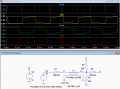
I did a quick simulation. The two transmission lines are separated by a driver, with its output resistance of 10 ohms showing.

the left end means the end to the far left of both the driver and receiver. it means the rest of the bus, where there are more drivers in tri-state mode.

the right end means the receiver. terminated parallelly at the impedance.

the graphs are in this order:
left : far left end of the bus, unterminated
middle: point where the driver attaches
right: receiver end


as you can see the reflections go crazy at the left side, unterminated, but they never bleed through the driver and reach the receiver, because the driver's point of contact is held at 5V.

the right side has almost no reflections as it's terminated (improperly).

do you agree?

 
Last edited:
Top