Temperature Sensor made with Transistors

MrAl

Joined Jun 17, 2014
13,704
Hello,

To thread starter:
I dont see any temperature parameter in any of your equations.

Before the internet we had books upon books, stacks of books, shelves of books, almost all where at least an inch thick hardcover. A lot were data books from manufacturers about their parts lineup.

There were some good articles about temperature characteristics back then. What's his name from Nati9onal Semiconductor (unfortunately deceased now) published graphs of diode characteristics vs temperature. That's explained a lot.
One of the common ideas about diode temperature response is that the voltage drops by 2.2mv per degree C. This of course changes over the entire range so it's just a starting point.
You can do your own little study though using a cardboard box and heat source like a light bulb or heat cone. Gradually raise the temperature inside the box and note teh diode voltage (using a constant current drive). You can log the results and draw conclusions. You may want to do this with several diodes of the same time and maybe different types.

Diodes are or at least were used as 'single point' temperature sensors. For temperature control often you only need to sense one temperature such as 80 degrees. That means you only care about one voltage level and if it goes down you know the temperature went up,and if the voltage goes up you know the temperature went down. Either way you provide feedback to the heater or cooler to adjust the temperature back to the point where the voltage is the same again.
For limit detection, if the voltage drops too low you know the device being monitored is too hot so you can shut the system down.

A lot of this has changed due to the invention of digital temperature sensors. They provide really good measurements of temperature and provide a digital signal well suited for microcontroller applications.
 

Thread Starter

kiweered

Joined Dec 13, 2021
28
hi,

R12 is definitly adding an offset to vout event if I don't understand why...
By changing R12 value I can have 0V at 0°C, this is nice.
But the sensibility of V(out) with the temperature is still low. I don't know why the common emmiter with Rc/RE=10 don't amplifiate the signal.

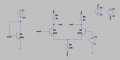
I also try the differential pair amplifier but I'm struggling finding the good values of Rc1, Rc2 and Re to have a good amplification. Again there are a lot of ressources on internet to study an already made system but nothing about how design one. I'm just changing R3,R8,R9 and V3 randomly, trying to figure what's happening ...

Capture d’écran 2022-01-12 à 23.35.10.png
 

Thread Starter

kiweered

Joined Dec 13, 2021
28
Hello,

To thread starter:
I dont see any temperature parameter in any of your equations.

Before the internet we had books upon books, stacks of books, shelves of books, almost all where at least an inch thick hardcover. A lot were data books from manufacturers about their parts lineup.

There were some good articles about temperature characteristics back then. What's his name from Nati9onal Semiconductor (unfortunately deceased now) published graphs of diode characteristics vs temperature. That's explained a lot.
One of the common ideas about diode temperature response is that the voltage drops by 2.2mv per degree C. This of course changes over the entire range so it's just a starting point.
You can do your own little study though using a cardboard box and heat source like a light bulb or heat cone. Gradually raise the temperature inside the box and note teh diode voltage (using a constant current drive). You can log the results and draw conclusions. You may want to do this with several diodes of the same time and maybe different types.

Diodes are or at least were used as 'single point' temperature sensors. For temperature control often you only need to sense one temperature such as 80 degrees. That means you only care about one voltage level and if it goes down you know the temperature went up,and if the voltage goes up you know the temperature went down. Either way you provide feedback to the heater or cooler to adjust the temperature back to the point where the voltage is the same again.
For limit detection, if the voltage drops too low you know the device being monitored is too hot so you can shut the system down.

A lot of this has changed due to the invention of digital temperature sensors. They provide really good measurements of temperature and provide a digital signal well suited for microcontroller applications.
Hi !
Thanks for the explaination but I think I had already understood that.

You know this project is a a boring school subject... If I wanted to implement a temperature sensor I would use a termistor or at least AOP with a PN junction (bipolar or diode) to amplifiate. Here we have boring limitation from the project subject : transistors and resistances only.
Again my goal is to have a decent voltage increasing with temperature at the exit of "I don't know wich circuit"
 

ericgibbs

Joined Jan 29, 2010
21,442
By changing R12 value I can have 0V at 0°C, this is nice.
Hi kiw,
It is a simple method of setting Vout=0v at 0Cdeg, it is a ZERO set pot.

To correct for the spread in the parameters for the various components used in your circuit.
You will need some adjustable method of setting the ZERO and SPAN [Gain] in your circuit.

E

Hi C, is this for me.?
It would seem that both transistors contribute to the change in output voltage with temperature.
Is that your intention?
 

crutschow

Joined Mar 14, 2008
38,508
Hi C, is this for me.?
It would seem that both transistors contribute to the change in output voltage with temperature.
Is that your intention?
Yes.
Your circuit in post #15 would seem to have both transistors contribute to the output change in voltage with temperature.
Or am I misunderstanding the circuit?
 
Last edited:

crutschow

Joined Mar 14, 2008
38,508
I also try the differential pair amplifier but I'm struggling finding the good values of Rc1, Rc2 and Re to have a good amplification. Again there are a lot of ressources on internet to study an already made system but nothing about how design one. I'm just changing R3,R8,R9 and V3 randomly,
Random seldom works well in electronic design. :rolleyes:
I learned transistor design synthesis more or less on my first job (sort of learn-while-you-earn time). and at that time there were no simulation tools (not even a calculator) to help with that.

Since this is school work, you should learn the basics of transistor and differential stage design.
(You would not design the circuit that way if you could use any components, but I would assume your teacher had you do the design with only transistors so you would learn more about their operation and perhaps, limitations).

There are two main aspects to doing the design of a transistor circuit.
One is the DC bias voltages and currents you want.
Two is the desired gain of the circuit.

You can add some resistance in the emitter of each differential transistor to control the gain.
Here's an analysis of such a differential circuit.
Also you need to consider the signal bias if you want a zero output at zero degrees from the differential stage.
For example, biasing the diode-connected temperature sensor transistor so that it gives a nominal -0.6V instead of +0.6V output to the differential input (for NPN transistors) would help with that.

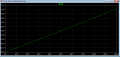
Below is the simulated output of the sensor going to a two-transistor differential stage circuit to show you it can be done:

1642100631303.png
 
Last edited:

ericgibbs

Joined Jan 29, 2010
21,442
hi Carl,
It is not my circuit, it is the TS's modified to show him how to Zero the Plot output.
I realize that the modified circuit will change the slope angle due to the temperature changes, how is that a problem if the overall circuit response is linear.?

I would not use a circuit of that type for reading temperature.
E
 
Top