Television antenna...

Thread Starter

Externet

Joined Nov 29, 2005
2,626
Hello all.
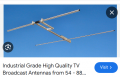
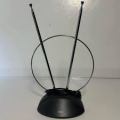
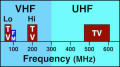
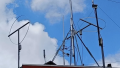
A television receiving simple antenna receives fine a dozen channels along the spectrum 50 to 700 MHz... The antenna is not tuneable, it has fixed dimensions. A couple of channels get poor-to-no reception.
There is uncertainty if the not received channel signals are so because :

- their signal strength arrives weak, or
- the orientation is wrong, or
- temperature affects the propagation, or
- time of the day impairs reception, or
- the dimensions of the receiving elements are not optimal for those channels, or
- the frequency response of the antenna dips at them...

Are these reasonable guesses ?

The channels received fine are in many very different frequencies. How come the fixed receiving elements of the antenna do receive signals with so varied frequencies ?
OR :
Why a television antenna with fixed element dimensions receives well a wide variety of frequencies ?

1732933476876.png
 

SamR

Joined Mar 19, 2019
5,470
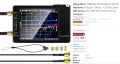
Or, plug the antenna into...
1732935949475.png
They do a bang up job of antenna analysis. And if it is tunable, you will be able to get it spot on! It can quickly weed out the fakes... Much better then the old fashioned dip coils we used to swear by.
 

SamR

Joined Mar 19, 2019
5,470
- their signal strength arrives weak, or
Depends on line of sight distance... Elevation, elevation, elevation...

- the orientation is wrong, or
1732957530712.png1732957655713.png
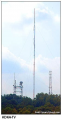
Vertical tower and horizontal yagi?!?! Never did understand that one but if you are close enough... Once again, elevation, elevation, elevation...

- temperature affects the propagation, or
No. Nor moisture. Heavy rain, possible. Vegetation in the way, yes.

- time of the day impairs reception, or
Nope, line of sight and no ionospheric bounce at VHF/UHF frequencies over the horizon but possible tropospheric tunneling with temperature inversion layers can give an "over the horizon" boost.

- the dimensions of the receiving elements are not optimal for those channels, or
- the frequency response of the antenna dips at them...
Well one can only hope (better to test) that the antenna designers had at least an iota of knowledge in what they were doing.
 
Last edited:

Thread Starter

Externet

Joined Nov 29, 2005
2,626
Vertical tower and horizontal yagi?!?! Never did understand that one but if you are close enough...
The vertical tower just gets to height; its radiating antenna at the top emits horizontal polarization. ;) The tower does not radiate (for TV)
1732978092060.png


Never had an instrument to read on Smith chart. :(

It bothers me a lot, that these are vertical since day 1 for a horizontal polarization TV signal :rolleyes: :

1732978224260.png1732979923026.png
 
Last edited:

nsaspook

Joined Aug 27, 2009
16,251

SamR

Joined Mar 19, 2019
5,470
Never had an instrument to read on Smith chart. :(
That's where the NanoVNA shines and far far cheaper than the bench Hewlett Packard VNAs and Signal Analyzers, even the 30+ year old used ones. At least since the advent of Cellular Towers there are a lot more used ones available on the surplus sales market. The NanoVNAs and TinySAs don't have all the bells and whistles of their big brothers but their accuracy is pretty darn close to them. And a whole lot more portable!
 
Last edited:

crutschow

Joined Mar 14, 2008
38,322
Why a television antenna with fixed element dimensions receives well a wide variety of frequencies ?
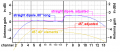
A simple fixed element antenna such as you show, has a varying sensitivity over that broad band of frequencies, with the max sensitivity likely near some mid frequency.
It works because the signal is strong enough at a particularly broadcasting frequency to still be detected by the TV.

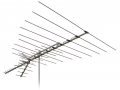
A broadband antenna such as the log-periodic shown in post #4, generally have a more uniform sensitivity over their design frequency range.
 

Thread Starter

Externet

Joined Nov 29, 2005
2,626
Thanks, gentlemen.

This strikes me :
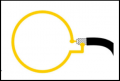
...the UHF loop is a mainly a magnetic field antenna where the polarization depends on the H or V feed position...
What is the feed position ?

1732991132881.pngScreenshot from 2024-11-30 13-10-00.png

The loop on the left, feed at its 'side'.
The loop at the right, feed at its 'bottom'
Does it mean one is vertically polarized and the other is horizontally polarized ? Which is which ?

What about the plane of the loop ? Does not? determine its polarization as in next image, the left loop is horizontally or vertically polarized ?

1732991630757.png

If that loop above on the left fed at the bottom gets its feed point on the side by rotating it 90 degrees in the same plane as is, does it change its polarization ?
===================================================================================================


The next image shows a horizontal plane loop (yes, on soil) If you remove the soil; is it vertically polarized, horizontally polarized or none as the polarization depends on the feed point location ?

1732992028704.png

----> Polarization goes with the plane of the loop or with the position of the feed or both or none ? <----
 

nsaspook

Joined Aug 27, 2009
16,251
Thanks, gentlemen.

This strikes me :


What is the feed position ?

View attachment 337058View attachment 337057

The loop on the left, feed at its 'side'.
The loop at the right, feed at its 'bottom'
Does it mean one is vertically polarized and the other is horizontally polarized ? Which is which ?

What about the plane of the loop ? Does not? determine its polarization as in next image, the left loop is horizontally or vertically polarized ?

View attachment 337059

If that loop above on the left fed at the bottom gets its feed point on the side by rotating it 90 degrees in the same plane as is, does it change its polarization ?
===================================================================================================


The next image shows a horizontal plane loop (yes, on soil) If you remove the soil; is it vertically polarized, horizontally polarized or none as the polarization depends on the feed point location ?

View attachment 337060

----> Polarization goes with the plane of the loop or with the position of the feed or both or none ? <----
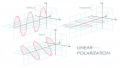
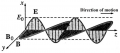
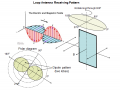
Antenna polarization is the direction of the electric field by convention. If you rotate the coordinate, the physics of EM radiation follow.
1732995151189.png

1732993597062.png
1732994992830.png
1732994125508.png
1732993831357.png

Time for some reading if you want to to build intuition on the subject.

https://www.rfcafe.com/references/articles/wj-tech-notes/Antenna-Polarization-v6-4.pdf
 
Last edited:

MisterBill2

Joined Jan 23, 2018
27,186
Several reasons why TV antennas work well (sometimes.) Any antenna will capture SOME signal, and with a high power transmitter and a sensitive receiver, SOME is often enough. And when they DO NOT work, consider that reflections can cause dead spots for some frequencies. And when an antenna is resonant it can receive very well. Also, being aluminum, there can be oxide insulation develop in joints that is a very good insulation.
 

Thread Starter

Externet

Joined Nov 29, 2005
2,626
Thank you, fellows. The geometry of the radiowave and electric/magnetic components is understood, and the electric field position naming the polarization.

----> The wave polarization goes with the plane of the loop or with the position of the feedpoint or both or none ? <----

===================================================================================

In other words, this loop below works on vertical or horizontal polarization wave? :

1733054699322.png

=========================================================================================

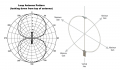
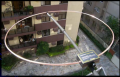
About directionality , From the fourth image in post #10 above, for these loop antennas below to receive optimally in the pictured position; the RF signal source should be coming from either the left or right ( or above ! ) of the guys in the image; correct ?

1733055008400.png
 

nsaspook

Joined Aug 27, 2009
16,251
Thank you, fellows. The geometry of the radiowave and electric/magnetic components is understood, and the electric field position naming the polarization.

----> The wave polarization goes with the plane of the loop or with the position of the feedpoint or both or none ? <----

===================================================================================

In other words, this loop below works on vertical or horizontal polarization wave? :

View attachment 337095

=========================================================================================

About directionality , From the fourth image in post #10 above, for these loop antennas below to receive optimally in the pictured position; the RF signal source should be coming from either the left or right ( or above ! ) of the guys in the image; correct ?

View attachment 337096
You know the answers, why are you asking?
 

SamR

Joined Mar 19, 2019
5,470
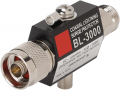
The first thing you check are the coax fittings. A possible problem with coax is that moisture intrusion can ruin it. A VNA becomes a good diagnostic tool for a previously tested antenna system to aid in finding the problem. Loop antennas for the HF, well once HF signals bounce off the ionosphere, they become elliptical so polarity is no longer an issue. Loop antennas, to me, are a consideration where real estate is limited so long dipole antennas are ruled out and costly towers are a "not in the budget" possibility. I had very poor performance from the HF vertical trap antenna I once had even with installed ground plane horizontal wires. Which are a real pain in the backside to maintain and mow around and also weedeat between. I do have at the top of my "tower" a 28'? vertical 10M antenna w/ ground plane fiberglass horizontals and a fiberglass marine VHF vertical above the eaves near the peak of the roof. Then there is grounding... I have a "board" in one of the sliding windows as a feed-through point. Aluminum sheeted and grounded to an 8' ground rod by 10AWG bare copper. In said board are SO-239 coax bulkhead fittings whose outer shell is grounded by the aluminum grounded plate. In addition, each one has a coax lightning arrestor which is also connected to the ground rod by 10AWG copper wire. Having a "high point" antenna above the house without one is asking for trouble. Even without a direct stike, the arrestor spark gaps need to be checked at least annually for erosion as any lightening strike even somewhat close by can have it's charged field picked up by the antenna and grounded through the arrestors spark gap to the ground rod. I once came home from work in a bad thunderstorm. When I exited my car to run for the house I held my briefcase over my head to keep the rain off my glasses. Lightning struck some good distance away and I received a static shock from the aluminum frame of the breifcase to my hand. Needless to say, pun intended, I was quite shocked at it happening.

1733081937753.png
These come in various "flavors" with some air gapped spark gaps and some use a sealed gas tube element that has to be replaced if damaged. Some have sharpened metal spark gap points that can be reshaped and their gap adjusted. I stay away from the real cheap ones whose gap cannot be checked for damage as we have a lot of lightning here on the coast. In the summer we have a couple of months of every day afternoon thunderstorms from ~1pm to 4pm.
 

SamR

Joined Mar 19, 2019
5,470
Also, being aluminum, there can be oxide insulation develop in joints that is a very good insulation.
Good point! Here on the coast, our plant electricians always used an "antiox" paste (especially on large conductor) bolted wire connections. Even copper oxidizes especially here outdoors in a subtropical marine environment. Never tried it on aluminum antennas (which I no longer have) but all of my outside antenna work is done with stainless steel fittings. I mention it because while I've never used it, I have heard of it being used. Especially for aluminum beam antennas on top of near inaccessible towers. Not something you can climb up to or take down yearly for close inspection.
 
Last edited:

MisterBill2

Joined Jan 23, 2018
27,186
This discussion has shifted to radio and transmitting antennas, which mostly cover a very small frequency range, and often tend to be resonant. The original broadcast TV antennas covered a range of at least 3:1 or more. '
The reality is that the common TV broadcast receive antenna was usually a serious compromise that provided an "adequate" capture area for the anticipated signal strength/ versus cost and size.
 

nsaspook

Joined Aug 27, 2009
16,251
This discussion has shifted to radio and transmitting antennas, which mostly cover a very small frequency range, and often tend to be resonant. The original broadcast TV antennas covered a range of at least 3:1 or more. '
The reality is that the common TV broadcast receive antenna was usually a serious compromise that provided an "adequate" capture area for the anticipated signal strength/ versus cost and size.
Most of the decent consumer outdoor TV antennas are of a wide-band design like log-periodic and/or bow-ties for UHF.
https://www.solidsignal.com/xtreme-signal-long-range-hd-vhf-uhf-fm-outdoor-tv-antenna-hd8200xl
1733159763047.png
 

Thread Starter

Externet

Joined Nov 29, 2005
2,626
Thanks, gentlemen.
This thread never intended to relate to transmission antennas, just television reception with bandwidth for all channels. The (large) magnetic loop being one of them.
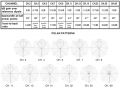
Have this information about polarization; hope it is correct :

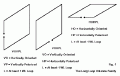
Loops families.gif
And would like to confirm if HOHPL is the only omnidirectional. No interests in bowties, yagis or log-periodics.
The circumference for 50MHz is 6m =~ 1.9m diameter. For 600MHZ, is 0.5m circumference =~ 0.15m diameter.


.
 

Ya’akov

Joined Jan 27, 2019
10,226
The transmissions are typically circularly polarized to reduce multipath interference, or, if the station is feeling fancy, elliptically polarized to provide a horizontal component for rooftop antennas.
 
Top