Tektronix 2225 repair

Thread Starter

philba

Joined Aug 17, 2017
959
I'm no repair-Pro so hoping some smarter folks than I can help me. My Tektronix 2225 (50 mhz analog, 1980s) scope died on me. Won't power on. I'm taking this as a sign that I need to replace it with a DSO. But it's been a good friend to me and it's so well designed and constructed, I want to repair it. Probably will keep it,

Any way, the only additional symptom is that, after switching it off, the Power and Sweep LEDs light up for several hundred mS. At least there's one cap somewhere that works...


So I got the service manual and took the case off. Dave of eevblog did a 2225 teardown vidoe - nice find. This is an amazingly well constructed and documented piece of equipment. Pretty sure it is a power supply problem. First order of business was a visual inspection. No obvious signs of burnt components, blue smoke, bulging electrolytics and such.

I took a number of voltage readings at various test points labeled on the bottom of the main board. They all read low - 40-60% of what they should be. So, yeah, still sounds like the power supply. I shut the scope down and started tracing from the mains input. The bridge rectifier diodes on the "Mains Input Board" have weird resistance measurements - all 4 measure 48K ohms in both directions. Strange. All 4 blown? I lifted one and tested with the DMM diode checker and it looks good (no conductance one direction, 0.527 V the other). Sigh, that would have been too easy.

Ok, next, onto the the preregulator board.

Any guidance would be muchly appreciated.
 

MrChips

Joined Oct 2, 2009
34,628
No problem. Analog scopes are a joy to fix, especially when you have the service manual from Tektronix.
I am away from my repair bench hence it will be days before I get a chance to look at your problem.

Don't despair. There is a good chance we can get this up and running.
 

GopherT

Joined Nov 23, 2012
8,009
I'm no repair-Pro so hoping some smarter folks than I can help me. My Tektronix 2225 (50 mhz analog, 1980s) scope died on me. Won't power on. I'm taking this as a sign that I need to replace it with a DSO. But it's been a good friend to me and it's so well designed and constructed, I want to repair it. Probably will keep it,

Any way, the only additional symptom is that, after switching it off, the Power and Sweep LEDs light up for several hundred mS. At least there's one cap somewhere that works...


So I got the service manual and took the case off. Dave of eevblog did a 2225 teardown vidoe - nice find. This is an amazingly well constructed and documented piece of equipment. Pretty sure it is a power supply problem. First order of business was a visual inspection. No obvious signs of burnt components, blue smoke, bulging electrolytics and such.

I took a number of voltage readings at various test points labeled on the bottom of the main board. They all read low - 40-60% of what they should be. So, yeah, still sounds like the power supply. I shut the scope down and started tracing from the mains input. The bridge rectifier diodes on the "Mains Input Board" have weird resistance measurements - all 4 measure 48K ohms in both directions. Strange. All 4 blown? I lifted one and tested with the DMM diode checker and it looks good (no conductance one direction, 0.527 V the other). Sigh, that would have been too easy.

Ok, next, onto the the preregulator board.

Any guidance would be muchly appreciated.

Get the service manual, there is a troubleshooting section. Full detail. Users manual is much less helpful. This place offers both for $12. Usually delivers high quality scans in about 2-hours.

http://artekmanuals.com/manuals/tektronix-manuals/
 

Thread Starter

philba

Joined Aug 17, 2017
959
Well, I've already pulled the mains input board and pulled the 2200 uF cap off it. My DMM doesn't handle caps that large so I wrote a program for an arduino nano to test larger caps based on the RC constant. The 2200 uF cap tested out to 2270 uF (1.135 S to 63.21 % of the arduino output voltage). This little test program is surprisingly accurate. I tested 10 different value caps from 10 uF to 2200 uF and it measured them all to fairly credible values.

Anyway, that caps not the problem so I soldered it back in. onward!
 

spinnaker

Joined Oct 29, 2009
7,830
Well, I've already pulled the mains input board and pulled the 2200 uF cap off it. My DMM doesn't handle caps that large so I wrote a program for an arduino nano to test larger caps based on the RC constant. The 2200 uF cap tested out to 2270 uF (1.135 S to 63.21 % of the arduino output voltage). This little test program is surprisingly accurate. I tested 10 different value caps from 10 uF to 2200 uF and it measured them all to fairly credible values.

Anyway, that caps not the problem so I soldered it back in. onward!
And you say your no repair pro? You are better than me. It scared the heck out of me to tear into that supply. Maybe yours is different. My caps were really buried.

Also very impressive that you were able to write your own capacitor tester.

Drop a line on that yahoo group. You will have this fixed in no time at this rate.
 

Thread Starter

philba

Joined Aug 17, 2017
959
And you say your no repair pro? You are better than me. It scared the heck out of me to tear into that supply. Maybe yours is different. My caps were really buried.

Also very impressive that you were able to write your own capacitor tester.

Drop a line on that yahoo group. You will have this fixed in no time at this rate.
Thanks. I've joined that group.

The cap checker is pretty simple. I'm thinking of putting together a project to post.
 

Thread Starter

philba

Joined Aug 17, 2017
959
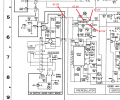
I got a little farther. Looking at the preregulator circuit, I think I found a problem. It looks like the mains input board is working ok but the first stage of the prereg is Q913. E, B and C all read +67.5V. I think that means it's shorted out. It's 10V higher than the voltage at the emitter is supposed to be which may also be a symptom. In addition, resistance between E, B and C is 0.
scope1.png
 

LesJones

Joined Jan 8, 2017
4,511
I think the original problem was something was drawing too much current. This probably caused Q913 to fail short circuit. As a result of this I think some component between Q913 and the original fault has failed open circuit. (As with Q913 short circuit there waas then nothing to limit the current.) I think now because of the open circuit there is no load on the power supply so the voltage at the output of the bridge is higher than it would be if it was supplying the normal current. I think R907 is the current sense resistor which would normally have a small voltage across it. I think you will find that the voltage across R907 is very low indicating that the power supply is supplying very little current. I would start to look for a component in series with the power supply output that has failed open circuit. I would then look for a component after the one that has failed open circuit that has failed short circuit.

Les.
 

Thread Starter

philba

Joined Aug 17, 2017
959
Thanks Les. This failed transistor opens up a bunch of problem areas to chase as the prereg voltage of 38V goes to 2 other boards . With the blown transistor (TIP30) passing +67.5V, it may have caused damage there as well. There is likely havoc in the preregulator. I probably will need to replace the TL594 - it's absolute max is, gulp, 41V. Probably both are TU. The LM358 may well be, too. This may turn out to be more than I want to do. Sigh.

I want to give your post a "like" but forgive me if can't bring myself to like bad news!
 

Thread Starter

philba

Joined Aug 17, 2017
959
To close the loop, I fixed it.

The minimal repair was 1 cap and 2 transistors (C914, Q913, Q923) but I replaced all the caps in the power supply section. Total cost was about $7.

I'm still going to get a DSO but am waiting to see pricing on the new siglent-sds1204x-e. And, thinking the 1202x-e might drop in price when the 1204 is released to the US market.
 
Last edited:
Top