Technics SU-VX800 amplifier

JoeJester

Joined Apr 26, 2005
4,390
I mentioned reviewing the output circuitry, and absent a problem with an input pin on an IC, I can only envision a potential problem past the speaker relay contacts of that pi-filter or the speaker itself.

I post the circuit for @MrChips and @Technics44 comments, if any.

The circuit is straight forward ... and here it is ....vx-800-output-passive.jpg
 

Thread Starter

Marius83

Joined Dec 28, 2017
423
I'll recommend the following using the attached "cropped" version of the Volume Control board from the schematic.

Unplug the set.


Adjust the signal generator for a 2 volt peak to peak signal on your oscilloscope. It may change depending on the connection especially with the right side of the schematic diagram ....

Make connections per the table ...

Adjust the potentiometer from minimum to maximum while observing the oscilloscope.

Here's the schematic ....

View attachment 222117

Here's the testing plan ...

View attachment 222118

and finally ...

A video about testing potentiometers .... you will see an overload condition using the DMM ... which may have been when there was a ranging issue..... the analog and dmm tests were ohm meter testing.

I might need some more explaining to test the volume control.:D

I don't have an actual signal generator, sorry, i believed my computer and sound file with a certain frequency could do the job.. could it?
I measured the output of my head unit i have here for music, and it got over 2 Volts at the low(signal) output, should do fine then or what ?

What frequency should i use for testing?

And, you mentioned an analog meter to test this with, but my Oscilloscope could do the job too? - so i don't need to get a analog meter, or should we test with both?

And, how would i set up the scope for this measurement?
See picture how i set it...

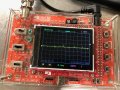
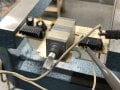
oscilloscopee.jpgpotentiometer.jpg
 

Thread Starter

Marius83

Joined Dec 28, 2017
423
I can understand if you guys are tired of this thread..... seems we're getting nowhere..

I might just try to install new powertransistors again and run it, i have re-melted a series of solderjoints which didn't look good... might be lucky :rolleyes: :)
 

dataworx

Joined Nov 27, 2013
12
I can understand if you guys are tired of this thread..... seems we're getting nowhere..

I might just try to install new powertransistors again and run it, i have re-melted a series of solderjoints which didn't look good... might be lucky :rolleyes: :)
You can't finish it yet, we're waiting to celebrate this thread's 3rd birthday!!

/joke. Really hoping you can sort this out - I've been following this from the start and remain amazed at the level of assistance and cooperation from both ends.
 

Thread Starter

Marius83

Joined Dec 28, 2017
423
:DI have had a little break.... i haven’t done anything since last update.

But i’m soon planning to put in new power transistors and try again, after the remelting of a lot of solder joints which didn’t look good.:rolleyes:
 

Ylli

Joined Nov 13, 2015
1,092
I haven't been following the thread, and I don't intend to go back and read the whole thing, but I did pull the schematic to take a look. That is the most convoluted amp I have ever seen.
 

MisterBill2

Joined Jan 23, 2018
27,591
The TS asked, a while back, if the adjustment of that variable resistor could have an effect. It can have a very big effect since it adjusts the bias, and thus the idle current, through the output stages.
This is a direct coupled amplifier and so every condition back through the very first direct coupled stage will affect the output stage. So a leaky capacitor at the input can easily destroy the output transistors. Or it can be a leaky transistor in an earlier stage.
That is a fundamental problem with all DC amplifiers.
All DC amplifiers are a bit more complex because they need much more feedback to keep all of the stages at the correct bias points. All this in the name of avoiding "capacitor delay", which was a marketing claim back in the day. I suggest that the fuse in the power leads to the output stages be checked to see it it is the correct value. Of course some brands did use the output transistors as the fuses because it was cheaper to build without actual fuses.
 
Last edited:

Thread Starter

Marius83

Joined Dec 28, 2017
423
I am once again looking at this amplifier.............. only thing i have done since last time, i have remelted a lot of solder joints who did not look good at the PCB.
And now i have replaced the four output transistors at LEFT channel with all new Toshiba ones as last time. Q505/Q509, Q515/Q517

Power ON.

All looked good, and i started with adjusting at VR401 and VR402 and let it idle for some time and checked if the voltage was correct, which it was.
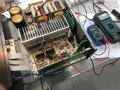
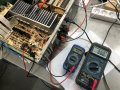
So i went further on, planning to adjust the ICQ, the manual says to adjust between 4-7 mV at these points (TP501/TP502).
But when i now connected my DMM's and powered up, i got a reading at about 50 mV at LEFT channel even with VR403 adjusted all down.

What could cause this? :D:D

amp1.jpg
amp2.jpg
 

MisterBill2

Joined Jan 23, 2018
27,591
In some amplifiers there is a temperature sensing diode that fails open and causes problems. I have not examined the circuit, but it seems that some component is now not within specifications. My first guess is a leaky transistor in the earlier stages, or an open or shorted diode, then a leaky capacitor. Unfortunately that does include most of the components. The bad news is that in a direct coupled amplifier almost all of the parts do affect the whole circuit.
 

Thread Starter

Marius83

Joined Dec 28, 2017
423
Last time when the output transistors failed at LEFT channel, it was just replacing them and try adjusting again.

This time something else might have suffered some damage, since i got this high reading at TP501..

What would most likely be the culprit.. could it be anything?
@MrChips or @JoeJester are you here? if you haven't had enough of this thread yet... hehe...

Actually i found R547 to be open... could this cause the problem? Replacing it now..
 

Thread Starter

Marius83

Joined Dec 28, 2017
423
Replacing R547 got the voltage to 0 at TP501 :)

Will try to set the ICQ and let it idle... then try to play music again like earlier if i get to that point ..
 

Thread Starter

Marius83

Joined Dec 28, 2017
423
So i did set the ICQ like in the manual, after some idling, bot channels ended at 6 mV.

And i have now played music on both channels in over an hour... but i'm still afraid o_O

I still have my DMM's connected at TP501 and TP502 , i see the voltage increase as i turn up volume, but i can see the LEFT channel sometimes doubles the value compared to the RIGHT when playing.
Switched the DMM's and it still shows the same.

I don't know if this has something to do with LEFT channel blowing up at all, just wanted to mention it........ still playing...


Thread Starter

Marius83

Joined Dec 28, 2017
423
I have now played music for hours, even as loud as my small 6.5 inch speakers can handle.
Have been afraid to turn volume up and down, since it went wrong last time when i turned volume down.... but i just turned volume up and down several times without any problems.

What is happening??? o_Oo_O:D

The sound is a bit scratchy at some places on the volume knob, scared me to death... but nothing happens..
 
Last edited:

MrChips

Joined Oct 2, 2009
34,829
Congratulations! Sounds like you have it under control.

If there is an opening in the VOLUME pot, squirt some IPA (iso-propyl alcohol) into it and work it back and forth while it is still wet and with the power off.
 

Thread Starter

Marius83

Joined Dec 28, 2017
423
Congratulations! Sounds like you have it under control.

If there is an opening in the VOLUME pot, squirt some IPA (iso-propyl alcohol) into it and work it back and forth while it is still wet and with the power off.
I'm not sure enough to celebrate yet .. :D
But it sure looks good right now!

No opening in the volume pot, seems like i need to desolder it to check if there's an opening on the underside...:rolleyes:
 
Top