Switch 5v into 12V from same source line.

Thread Starter

1nvalid

Joined Nov 22, 2023
7
Hey Circuit Team,
Sorry if this isn't in the right category you are welcome to change it.


What I'm aiming to achieve here is to construct a circuit/layout capable of switching over to a different voltage source when detected from an external source.

Let's consider an example:

I currently have a 5V source supplying power, which must initially undergo a handshake process with my phone to detect a signal. Once the signal is detected, the Dashboard screen will display a Navigation Map. However, the 5V 1Amp output, used to charge the latest phones, isn't sufficient.

Therefore, I'm aiming to supply 12V power along the same line as the 5V, but I want this 5V power to be cut off once 12V is detected automatically. Essentially, when the 12V power source is manually activated, I want the 5V line to deactivate, allowing the 12V power to take over.

I've managed to achieve this manually, but now I'm looking to automate the process.

My question is, would using one or two relays to make this process, or is the solution a bit more complex than just utilizing relays?
 

Thread Starter

1nvalid

Joined Nov 22, 2023
7
Is there only one supply input, if so will the device work on 12V or 5V ?

There is two power supplies,

1. one supply comes from the JetSki @ 5V
a. this will only be used for the first 1min to authenticate that i have a phone connected

2. the other comes from a USB 12V Charger
 

Dodgydave

Joined Jun 22, 2012
11,395
So can you just power put both supplies on at the same time on separate inputs or is there only one supply input, if so you will need a diode on the 5V supply.
 

Thread Starter

1nvalid

Joined Nov 22, 2023
7
There is only 1 USB Output that i plug the
So can you just power put both supplies on at the same time on separate inputs or is there only one supply input, if so you will need a diode on the 5V supply.
I can power up both supplies separate they don't come from the same circuit.
 

Thread Starter

1nvalid

Joined Nov 22, 2023
7
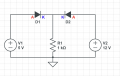
You could use Schottky diodes in series with both the 5V and 12V to block the voltages from interfering with each other.
I will give it a look,
But wouldn't this give 17V added together. All i am doing is restricting using the Diode from not going back into the 5V line right or vice versa?
 

wayneh

Joined Sep 9, 2010
18,104
Something like this perhaps
You've drawn it correctly but I'm wondering if this really accomplishes what you need? The load on the 5V source would be essentially zero once the 12V source is on. If the 12V is not on or available, the entire load would fall on the 5V source.

I'm wondering if the handshaking will occur as intended with a diode in the power line, even a low ∆V Schottky. If the handshake occurs only on the data lines, it should be fine.
 

Thread Starter

1nvalid

Joined Nov 22, 2023
7
You've drawn it correctly but I'm wondering if this really accomplishes what you need? The load on the 5V source would be essentially zero once the 12V source is on. If the 12V is not on or available, the entire load would fall on the 5V source.

I'm wondering if the handshaking will occur as intended with a diode in the power line, even a low ∆V Schottky. If the handshake occurs only on the data lines, it should be fine.


The load on the 5V will be zero, which is acceptable. When the 12V shuts off, the 5V will resume control.

The handshake process occurs solely during the unit's boot-up phase. It takes approximately 3-4 minutes until Bluetooth connectivity is established. Then, the software loads to prompt the phone to open its own special Maps app, which runs in the background. Even after manually disconnecting the 5V+ lead from the head unit, the map remains active.

This particular thing on these units has never been done before. This will be the first of its kind.
 

wayneh

Joined Sep 9, 2010
18,104
You should be good to go then with your drawing. Any diode you might have on hand should work, at least for testing, as long as it's rated for the current. I agree that Schottky diodes should be used for your final build.
 

Thread Starter

1nvalid

Joined Nov 22, 2023
7
Do you guys have in mind the model/part number for the Diodes. the 5V side only outputs MAX 1-A
the 12V side outputs MAX 2.5-A
 

wayneh

Joined Sep 9, 2010
18,104
I'd use the same model for both, just for convenience. I shop at Mouser, Newark and Digi-Key. It's likely the shipping will exceed the parts in cost. I think DigiKey might have a flat $5 shipping fee and that might give them the edge but it depends where you are and so forth. Sometimes certain parts are on special - you just have to look. You can likely find cheaper options at Amazon or EBay but the risk of counterfeit parts is much higher at those sited. Caveat emptor.
 

MisterBill2

Joined Jan 23, 2018
27,530
Hey Circuit Team,
Sorry if this isn't in the right category you are welcome to change it.


What I'm aiming to achieve here is to construct a circuit/layout capable of switching over to a different voltage source when detected from an external source.

Let's consider an example:

I currently have a 5V source supplying power, which must initially undergo a handshake process with my phone to detect a signal. Once the signal is detected, the Dashboard screen will display a Navigation Map. However, the 5V 1Amp output, used to charge the latest phones, isn't sufficient.

Therefore, I'm aiming to supply 12V power along the same line as the 5V, but I want this 5V power to be cut off once 12V is detected automatically. Essentially, when the 12V power source is manually activated, I want the 5V line to deactivate, allowing the 12V power to take over.

I've managed to achieve this manually, but now I'm looking to automate the process.

My question is, would using one or two relays to make this process, or is the solution a bit more complex than just utilizing relays?
Switching to 12 volts at the same connector used to supply 5 volts to an expensive phone appears to me to be A VERY POOR CHOICE!! Automated or not, the destruction would be over before an error was noticed.
 
Top