Supply and Regulator Circuit

Thread Starter

JulesP

Joined Dec 7, 2018
458
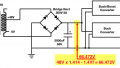
Option 2 is better, but using the 48V tap and a TIP41C transistor as it has a 100V rating,, I would use a 10K pot for the 60V supply. Also use the 12V tap .
Thanks but how can I get up to 60V out of a TIP41C if I’m only supplying 48V RMS to it?

The 12V and LM317 option is fine then.
 

ElectricSpidey

Joined Dec 2, 2017
3,335
I'm just wondering why you would want to replace a fixed regulator with a variable one if variability is not needed?

You will need two more resistors.
 

Thread Starter

JulesP

Joined Dec 7, 2018
458
Here we go again! Why do you guys here go along with him and his fringe stuff? Just a very quick Google read on what he's trying to do shows that it isn't a feasible thing. It's been tried sing 1952 by real scientists, physicists and hasn't been found to work, other than in theory. But I'm pretty sure a so called *pyhsics teacher*(his words from another of his threads) that needs to come on an internet forum will be the one to crack the problem.

"Whilst the method of PDC electrolysis has been proven by Ghoroghichian and Bockris in 1952 and 1985 to work extremely well in theory, it is difficult to replicate with consistently positive results in practical experimentation. Hence, the many mechanisms that have been patented are unable to be repeated and used in industry " From - https://en.wikipedia.org/wiki/Pulse_electrolysis#Disadvantages This was just one of the many things out their.
If I choose to spend some time exploring electrolysis using HV pulses then who are you to say it’s a waste of time?

If mankind only ever tried something once then we wouldn’t have got very far. Why play a musical instrument when someone else has played it before you and much better?
 

Thread Starter

JulesP

Joined Dec 7, 2018
458
I'm just wondering why you would want to replace a fixed regulator with a variable one if variability is not needed?

You will need two more resistors.
I thought the LM317 could be used for either and the pot let you set the output at precisely 12V. What resistors do I need to add to the adjustment pot?
 

shortbus

Joined Sep 30, 2009
10,050
If I choose to spend some time exploring electrolysis using HV pulses then who are you to say it’s a waste of time?
I have no problem when YOU waste Your time at all. But when you bring people other than your self and a forum that normally is full of smart helpful people and is one of the top, if not the top electronics sites into helping you and giving you something to try and add credence to YOUR work I do have a problem with that.

Using more than low voltage high amperage to electrolysis is a well proven accepted approach to doing it. After all of the time that it has been done and proven to work, with pulsed electrolysis not working, wouldn't your time be better spent going on with new experiments?
 

Thread Starter

JulesP

Joined Dec 7, 2018
458
I have no problem when YOU waste Your time at all. But when you bring people other than your self and a forum that normally is full of smart helpful people and is one of the top, if not the top electronics sites into helping you and giving you something to try and add credence to YOUR work I do have a problem with that.

Using more than low voltage high amperage to electrolysis is a well proven accepted approach to doing it. After all of the time that it has been done and proven to work, with pulsed electrolysis not working, wouldn't your time be better spent going on with new experiments?
There are many varieties of pulsed electrolysis and not all of them have been done enough to say that they are all in vain. And that’s only one reason . . .
 

Alec_t

Joined Sep 17, 2013
15,121
I have often wondered if a simulation package would be useful and maybe there is a free one that is worth using.
LTspice (a free download from AnalogDevices) is excellent. It does have a steep learning curve, but that's well worth the effort. Many members here use it. There is a good Help section, a user group at groups.io, many online tutorials.
 

Dodgydave

Joined Jun 22, 2012
11,395
Yes 0/12 for the 12V line but how to I get 60VRMS from a 48VRMS input to the transistor? I thought you were saying earlier use the voltage between the 110 and the 48 which is 62V.
By the time you have regulated it with the capacitor it will be approximately 65V.
 

Thread Starter

JulesP

Joined Dec 7, 2018
458
LTspice (a free download from AnalogDevices) is excellent. It does have a steep learning curve, but that's well worth the effort. Many members here use it. There is a good Help section, a user group at groups.io, many online tutorials.
Thanks for that. Will give that a go.
 

Thread Starter

JulesP

Joined Dec 7, 2018
458
By the time you have regulated it with the capacitor it will be approximately 65V.
Ok. But do you agree that the average voltage from FW rectification is a bit less than the RMS value? The cap smoothing obviously raises the average value.
 
Top