Supply and Regulator Circuit

Thread Starter

JulesP

Joined Dec 7, 2018
458
I don't see how that can work. Buck converters go from a higher voltage to a lower voltage.
The 12V supply should be a traditional mains to 12V supply, unless you need it to be portable, then maybe you could do a single SEPIC converter for say 13.8V to 11.2 on the input.
https://www.ti.com/lit/an/snva168e/snva168e.pdf

Using the primary voltage to control the output voltage is IMHO a dubious enterprise
If I take 60V from a step down mains transformer and feed to a Buck regulator to give 0-60V for the flyback transformer, then that should be ok. Yes it won’t work if I start with 48V.
 

Dodgydave

Joined Jun 22, 2012
11,395
The 0-60V is to power the primary of a flyback transformer where the output will be 0-30kV at around 2A-10mA.

I can use two separate Buck converters, a separate one for the 12V supply if needed, which would be cheaper than making a PCB and all the parts.

Looking at your circuit, are you going to use a 48V center tapped Transformer, if so you can use one half to produce the 12V and the full windings to use the 60V , then you can use the transistor method as described instead of the buck.
 

Papabravo

Joined Feb 24, 2006
22,083
If I take 60V from a step down mains transformer and feed to a Buck regulator to give 0-60V for the flyback transformer, then that should be ok. Yes it won’t work if I start with 48V.
You're not accounting for the fact that an AC transformer is measured with an RMS (Root Mean Square) value. The peak value of an AC waveform is the RMS value times the square root of 2 (1.414...). So your 24VAC transformer will produce a rectified DC output of 24 x SQRT(2) - (Rectifier diode drops) = 33.99 - 1.4 = 32.54 VDC
double that for two transformers center tapped and you get 65.08 Volts.
 

Thread Starter

JulesP

Joined Dec 7, 2018
458
Looking at your circuit, are you going to use a 48V center tapped Transformer, if so you can use one half to produce the 12V and the full windings to use the 60V , then you can use the transistor method as described instead of the buck.
The 48V was using 24-0 and 0-24 taps on the transformer but I can use a transformer with a different format. If I use one 48V from a transformer then the transistor method can give me 0-60V and the other 48V can give me 12V via a Buck regulator? Is that what you mean?
 

Thread Starter

JulesP

Joined Dec 7, 2018
458
You're not accounting for the fact that an AC transformer is measured with an RMS (Root Mean Square) value. The peak value of an AC waveform is the RMS value times the square root of 2 (1.414...). So your 24VAC transformer will produce a rectified DC output of 24 x SQRT(2) - (Rectifier diode drops) = 33.99 - 1.4 = 32.54 VDC
double that for two transformers center tapped and you get 65.08 Volts.
True but the idea of the 4k7 pot is to tweak that down to give what is required, except that it appears I would need a different transistor.
 

Dodgydave

Joined Jun 22, 2012
11,395
Yes , use a Transformer that has ideally two outputs, then you can use the LM317 or other 12V regulator for the pwm, and the power transistor for the 60V supply.
 

Thread Starter

JulesP

Joined Dec 7, 2018
458
Yes , use a Transformer that has ideally two outputs, then you can use the LM317 or other 12V regulator for the pwm, and the power transistor for the 60V supply.
Ok thanks but I’m not exactly clear how one of the 48V taps can give me up to 60V and it’s been said further back that the 2N3055 is not a good choice for that role.
 

Tonyr1084

Joined Sep 24, 2015
9,744
Noticed my name was mentioned. Not sure why, but OK.

So first, I'm not highly knowledgeable with transformers other than they transform voltage from one level to another. When it comes to flyback transformers I know even less. Far less. In fact, I haven't given much study to how exactly they work. But doesn't a flyback transformer need some kind of sine wave? Switching? I really honestly don't know. Which leaves me wondering - are you powering a transformer like a flyback from a DC source?

I also noticed @Papabravo mentioned the RMS value versus the peak value. In your schematic you show a 48V transformer output on the secondary. When rectified and filtered you will get the peak value minus the forward voltage of the two diodes that are active during any phase of the sine wave. So assuming your transformer is putting out 48V RMS, the two forward voltage drops of two of the four diodes in the bridge rectifier will drop approximately 1.4 volts. 48V - 1.4Vf = 46.6VDC. The filter cap will store and deliver the peak voltage of (46.6 x 1.414 = ) 65.89VDC. Any components you put on that level of voltage must be rated to handle it. A good engineering practice (I'm not an engineer) is to over value your component needs by a factor of 1.3 times or 133%. So if you're pushing (lets just go ahead and call it) 66VDC, your components should be rated for a voltage of at least 85.8 volts. 85 volts should be good enough, plus you leave some headroom for your design, should something cause a power surge somehow.

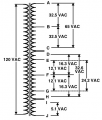
There are many transformers available. I happen to have a few in my stock that came out of old stereo's which have a wide variety of outputs. Here's one I happened to test and record its outputs:
1605904553840.pngAs you can see, I can derive 65VRMS from pins A and C. Pins E and F will vive me 12.1 VRMS. To limit the number of diode forward voltage drops I could use just two diodes instead of the full wave bridge rectifier with four diodes, I can use E & G with the anodes of two diodes going to each, one to E and one to G and use F as a center tap. I still have 12.1 volts but instead of having 1.4Vf I will have only 0.7Vf (Vf = Forward Voltage Drop).

Since I don't know what purpose each voltage range will be for, just going off your initial drawing I would use the 65VRMS of pins A & C for my 65 volts for the flyback. However, I would not be rectifying or filtering them. As for the 12 volts - E & F with a full wave bridge rectifier OR E & G with just two diodes and F as a center tap.

You want a variable output of zero to 60 volts for the flyback. I would approach that with an autotransformer, a transformer with a center wiper for the tap. In my case, using my transformer the autotransformer would deliver zero to 65VAC. If for some reason you need it to be DC I would put the BR (bridge rectifier) after the autotransformer.

When you drop 65 volts down to 12 volts using a 12V regulator (assuming they can handle that high an input) you would be converting 53 volts into heat. Wasted heat. That's why LM78xx regulators are not the favored type of regulation. They take the extra voltage and convert it into heat. Not by design but by ohms law. The excess voltage has to go somewhere. In the case of the LM's it converts to heat.

Let me look for a diagram showing two diodes and center tap for full wave rectification. When I find it I'll post it.
 

Tonyr1084

Joined Sep 24, 2015
9,744
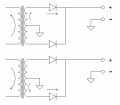
Was quicker to make a new drawing of how you can use two diodes and a center tap transformer to get a full wave rectification:
1605905974501.pngThe top illustration assumes a counter clockwise current on the primary and a clockwise current on the secondary. Between the common (ground) and the top diode current flows to give you a positive voltage. When the current reverses the lower diode gives you a positive voltage. You are using only one diode at a time whereas the full wave BR will always conduct through two diodes at any given moment. A center tap transformer has this advantage, using only one diode at a time, thus reducing the forward voltage drop from 1.4 to 0.7Vf.
 

Thread Starter

JulesP

Joined Dec 7, 2018
458
Was quicker to make a new drawing of how you can use two diodes and a center tap transformer to get a full wave rectification:
View attachment 222884The top illustration assumes a counter clockwise current on the primary and a clockwise current on the secondary. Between the common (ground) and the top diode current flows to give you a positive voltage. When the current reverses the lower diode gives you a positive voltage. You are using only one diode at a time whereas the full wave BR will always conduct through two diodes at any given moment. A center tap transformer has this advantage, using only one diode at a time, thus reducing the forward voltage drop from 1.4 to 0.7Vf.
Thank you for all that. I will read it with a fresh mind tomorrow and reply. There have been a lot of suggestions given which is great but my head is buzzing with what’s the best path to take.
 

sparky 1

Joined Nov 3, 2018
1,218
To JulesP;
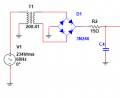
A simulation allows you to change the components. The following is just a start is meant point out some considerations.
The Inrush current on the capacitor and which rectifier diodes. If better noise reduction is desired possibly there is another option.
In simulation R2 forms a filter. I used a ballpark value 15 Ohms. R2 is a noise reduction consideration that could make a difference.
When the filter attenuates ripple the voltage regulator reduces noise, the second regulator and filter the ripple is almost negligible.
Could a dual polarity configuration with +24 and -24VDC work as well ? This leads to how many Amperes of load will be applied ?
If yes the load and noise is a concern then would a 60VCT transformer having less droop for that load could be significant.
As an example where knowing the application's requirement makes a difference, I need to avalanche a 2N2369 my power supply only goes to 48V.

Without those requirements initialized the schematic presented to EE suggests that the noise and load was already evaluated.
I only put half the schematic in order to save half the work of redoing it. That is my experience working in physics labs not to outguess the director and his team knowing there is a pause, a time for feedback and after lunch they would discuss and decide.

In some of your previous educational physics projects there were precision A/D implications, the variety of power supply was
not as big concern.

Simulating with and without 5 Watt R2 makes a significant difference on output ripple. Then the next stage regulator's ripple rejection
and more filtering are the next most significant in analysis. A dual polarity 24V is cost effective and more versatile provides 1.5 - 48V and dual polarity 24V if needed.


image_2020-11-20_200251.png
 
Last edited:

Thread Starter

JulesP

Joined Dec 7, 2018
458
You want a variable output of zero to 60 volts for the flyback. I would approach that with an autotransformer, a transformer with a center wiper for the tap. In my case, using my transformer the autotransformer would deliver zero to 65VAC. If for some reason you need it to be DC I would put the BR (bridge rectifier) after the autotransformer.
Sounds like a good idea although I have read that an autotransformer is best suited to small variations around the input voltage. In my case I'm going from 230 to 0-60V so is this viable?

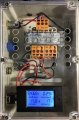
I already have a 50VA transformer as shown in the pic with its range of outputs. Would something like this be useable given that it already has a Bridge rectifier and cap smoothing?

Mains Transformer.jpg
 

Thread Starter

JulesP

Joined Dec 7, 2018
458
Thanks for your collective thoughts.

I have often wondered if a simulation package would be useful and maybe there is a free one that is worth using.

The intended use for the 12V supply is just to run a 555 based PWM so whatever such a chip demands in terms of ripple and stability. I assume that the LM317 or similar will manage its output appropriately.

The 0-60VDC is to be stepped up by a flyback transformer to a max 30kV to provide HV pulses to an electrolysis cell. The nominal squarewave pulses in (0-5V) will result in spikes out since the transformer will only respond well to the rising and falling edges.

I'm imagining that the current draw in the cell will be in the mA range so maybe 5mA max as this type of electrolysis relies on the voltage causing the water dissociation via a dielectric breakdown rather than a simple trade of electrons via the electrodes.

Regarding the RMS values mentioned, if my transformer output is 48VRMS then the average voltage resulting from FW rectification is 0.9xVRMS, as I understand the theory, and so about 43V (-1.4V from the diodes?) do not in the 60+V region.

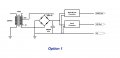
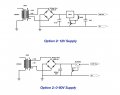
In responding to the previous contributors I have drawn up the two pathways for building this stage of the power supply, one using buck/boost converters and the other using modifications to my first circuit. These are shown in the attached 2 pics.

Two questions arise:

Firstly, looking at the mods to my first circuit I have changed the transistor to the MJE3055 and the voltage regulator to the LM317 with accompanying changes to the components around it. Is this now workable?

Secondly, if I use the transformer shown in my previous post, with its various tap-off points, would I use the 12V and the 110V taps in parallel to supply the regulator and the transistor respectively via the two routes shown in Option 2, requiring two bridge rectifiers? Also will the 4k7 pot allow me to adjust Vbe from 0-60V on the MJE3055?

HV Supply Option 1.jpegHV Supply Option 2.jpeg
 

Dodgydave

Joined Jun 22, 2012
11,395
Option 2 is better, but using the 48V tap and a TIP41C transistor as it has a 100V rating,, I would use a 10K pot for the 60V supply. Also use the 12V tap .
 
Last edited:

shortbus

Joined Sep 30, 2009
10,050
The 0-60VDC is to be stepped up by a flyback transformer to a max 30kV to provide HV pulses to an electrolysis cell.

Here we go again! Why do you guys here go along with him and his fringe stuff? Just a very quick Google read on what he's trying to do shows that it isn't a feasible thing. It's been tried sing 1952 by real scientists, physicists and hasn't been found to work, other than in theory. But I'm pretty sure a so called *pyhsics teacher*(his words from another of his threads) that needs to come on an internet forum will be the one to crack the problem.

"Whilst the method of PDC electrolysis has been proven by Ghoroghichian and Bockris in 1952 and 1985 to work extremely well in theory, it is difficult to replicate with consistently positive results in practical experimentation. Hence, the many mechanisms that have been patented are unable to be repeated and used in industry " From - https://en.wikipedia.org/wiki/Pulse_electrolysis#Disadvantages This was just one of the many things out their.
 
Top