You are avoiding the question, did you read All of the information I provided or not. Again I an not interested in anything but a yes or no answer so answer the question!
30 year old Sharp calculator with an excellent 1/x function:
5 layers of 1 ohm resistors equals 0.437956204 ohms.
Note that this is less than post #74 (4 layers) and more than post #76 (seven layers), agrees with posts #19 and #44, and took 16 seconds to calculate.
But this, right off the bat, was in direct contradiction to your first post in which you said that adding a bunch of 1 K resistors in the special network of yours should result in a super accurate resistance of 1 kΩ.
Then the next thing you said was:
Which, of course, is nonsense and provides extremely strong proof that your experiment is highly flawed in some way.
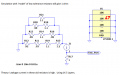
Your pictures are of too poor a quality to back out what the circuit is (i.e., the actual connections, regardless of what you may or may not have intended) and, even if we could, there is no way to tell what the points were where you made your measurements or how you made your measurements.
Then you proceed to continue to use a simulation circuit that had already been pointed out was meaningless:
But you still insisted that IT showed that you still have a 1 Ω resistor, followed by some lame excuse that your results must be do to high leakage currents in these old resistors.
30 year old Sharp calculator with an excellent 1/x function:
5 layers of 1 ohm resistors equals 0.437956204 ohms.
Note that this is less than post #74 (4 layers) and more than post #76 (seven layers), agrees with posts #19 and #44, and took 16 seconds to calculate.
This is what the sim shows for...
5 layers: 0.437962598... Ω
6 layers: 0.408163265... Ω
That 30 year old Sharp is very possibly very similar to the scientific calculators I used to prefer before I got turned onto HPs (although that was closer to 40 years ago). I really liked those Sharps -- far better than I like any of the myriad TI and Casio calculators I have handy now.
Using the Windows Calculator (which is a pretty good calculator, when all is said and done), yields 0.4379562043795620437956204379562 Ω, which matches yours to the extent that it displayed the results (I remember the 10-digit display almost all scientifics had back then). The LTSpice results are artificially poor, because it is based on what is reported as the current in the Operating Point panel, which displays six sig figs (with trailing zeroes suppressed). So it is showing -2.8333 A. That is pretty clearly probably -2.28333... A, which then matches both your calculator and the Windows calculator.
But this, right off the bat, was in direct contradiction to your first post in which you said that adding a bunch of 1 K resistors in the special network of yours should result in a super accurate resistance of 1 kΩ.
Which, of course, is nonsense and provides extremely strong proof that your experiment is highly flawed in some way.
Your pictures are of too poor a quality to back out what the circuit is (i.e., the actual connections, regardless of what you may or may not have intended) and, even if we could, there is no way to tell what the points were where you made your measurements or how you made your measurements.
Then you proceed to continue to use a simulation circuit that had already been pointed out was meaningless:
But you still insisted that IT showed that you still have a 1 Ω resistor, followed by some lame excuse that your results must be do to high leakage currents in these old resistors.
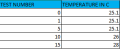
I have no idea where it is at or what it represents. I don't see it in any of the things you have posted, either in the post itself or in an attachment. The only place where I have seen anything temperature-related are the three plots in the PDF file you posted back in Post #11. I've already pointed out that your document contains information that makes no sense, is not explained, or that appears to have zero relevance to your claims. Specifically, those three temperature-related charts, one of which shows a multi-valued relationship. What is leading to that? Some form of hysteresis? You don't explain what they are or how they were measured, and now you expect me to read your mind.
But no temperature-related elements have any bearing at all on what is being discussed. If you can come up with some rationale for how it is in anyway relevance to whether the equivalent resistance of your layered network converges to 0.5 Ω or whether it continues to go down toward zero without bound, then please enlighten us.
What's the point? Other than trying to avoid discussion of your continued claim that your resistor network somehow converges to a value that is 1/2 of the nominal size of each resistor (or it is that it is the same as the nominal size of each resistor, since that was your initial claim)?
What's next? Demanding that I tell you what is meant by the word "Entry" in your document?
Since you have become enamored with Yes/No questions, how about answering one. Do you still maintain that your layered network converges to 0.5 Ω if 1 Ω resistors are used? Yes or No?
If you want to continue discussing this claim, I'm willing to. If not, that's fine, too, but I see no point in continuing to play this latest, pointless game of yours.
You can conclude whatever you want -- I can't control where your tantrums lead you.
I have no idea where it is at or what it represents. I don't see it in any of the things you have posted, either in the post itself or in an attachment. The only place where I have seen anything temperature-related are the three plots in the PDF file you posted back in Post #11. I've already pointed out that your document contains information that makes no sense, is not explained, or that appears to have zero relevance to your claims. Specifically, those three temperature-related charts, one of which shows a multi-valued relationship. What is leading to that? Some form of hysteresis? You don't explain what they are or how they were measured, and now you expect me to read your mind.
But no temperature-related elements have any bearing at all on what is being discussed. If you can come up with some rationale for how it is in anyway relevance to whether the equivalent resistance of your layered network converges to 0.5 Ω or whether it continues to go down toward zero without bound, then please enlighten us.
What's the point? Other than trying to avoid discussion of your continued claim that your resistor network somehow converges to a value that is 1/2 of the nominal size of each resistor (or it is that it is the same as the nominal size of each resistor, since that was your initial claim)?
What's next? Demanding that I tell you what is meant by the word "Entry" in your document?
Since you have become enamored with Yes/No questions, how about answering one. Do you still maintain that your layered network converges to 0.5 Ω if 1 Ω resistors are used? Yes or No?
If you want to continue discussing this claim, I'm willing to. If not, that's fine, too, but I see no point in continuing to play this latest, pointless game of yours.
I had no intentions to upset you or anyone else on the forum. I love reading what you have to say, I can tell you are a very intelligent person and I have learned a lot from you in the past. Let's end this on a happy note and just say it was a fun discussion. I am using these networks on a breadboard and that was lots of fun as well. I like to checkout things that are kind of esoteric. So no hard feelings on my end and thanks for all your input as well.
Let us apply 1V across the network. All branches have 1V applied.
Calculate the current in each branch.
Sum the currents. Calculate effective resistance.
Can you see that your results differ beginning at step 3?
At step 1, we agree that the current in 1Ω is 1A
At step 2, we agree that the current in 2Ω is 0.5A. Total Current is 1.5A
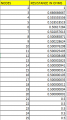
At step 3, I calculate that the current in 3Ω is 0.333333A. Your calculation reveals that the current is 0.3A.
Let us apply 1V across the network. All branches have 1V applied.
Calculate the current in each branch.
Sum the currents. Calculate effective resistance.
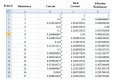
Can you see that your results differ beginning at step 3? View attachment 306417
Well, I think they match, it is just that at step '3' in the second chart shows up as step 2 under the label 'Effective Resistance'. Thus the two charts are 'co-joined'.
Yes I know what you are getting at, it appears that I am wrong and maybe you are correct. Anyways, I have been making a C# program that uses Visual Studio (Windows) application to perform this calculation. Do you know any C#?
Yes I know what you are getting at, it appears that I am wrong and maybe you are correct. Anyways, I have been making a C# program that uses Visual Studio (Windows) application to perform this calculation. Do you know any C#?
Well 1/3 equals 0.333... with a continuing repeat of '3' that does not stop, while
0.3 is a rounded version of 1 third with 1 digit of precision thus 0.3.
Well 1/3 equals 0.333... with a continuing repeat of '3' that does not stop, while
0.3 is a rounded version of 1 third with 1 digit of precision thus 0.3.
And I read that one of your concerns was the lack of precision?
The reason that your calculations appear to converge is because the error made by using 0.3 instead of 0.333333 is that it puts the total current above the correct value. Hence every subsequent calculation is trying to make up for the initial error made.
Will you accept that 1/3 is 0.3333333... and this is where your calculation went astray?
Using 0.3 instead of 0.333333 is an error just a bit less than 10%*. Can you see that is a significant error and it’s use (0.3) may/will result in an incorrect response?
And I read that one of your concerns was the lack of precision?
The reason that your calculations appear to converge is because the error made by using 0.3 instead of 0.333333 is that it puts the total current above the correct value. Hence every subsequent calculation is trying to make up for the initial error made.
Will you accept that 1/3 is 0.3333333... and this is where your calculation went astray?

 Facebook
 Google
 GitHub
 Linkedin