I understand what you did but most calculators do not have the accuracy that a powerful spread sheet program like Excel has. The double precision numbers have enough accuracy to verify the convergence. Also did you let the number 'go' and not round them? Rounding will also cause a problem with convergence, you cannot round the numbers, it invalidates any formula trying to achieve convergence. I might if I get some time wright a small C program to verify that Excel is accurate. And send you the program. Also did you perform actual board testing with a real circuit? I have and in confirms by calculations.
That is I simply applied the Scientific Method. After the concept I had to prove or disprove it. That required an experiment and the experiment confirms the calculations.
Yes, I know all that. The experiments still have yielded some interesting results. The resistance goes up closer to the target the more bottom rows you add to it. Also the power distribution gets evenly distributed throughout the resistor network. I was able to pull well over 3W of power into the network. You seem to have something against experimentation, but I am not sure what it is? Is not science about experimentation?
Let's take your five layers of 1 kΩ resistors. You say that you put well over 3 W into it. So let's use 3 W for discussion.
The total resistance is about 438 Ω. But you claim it somehow converges on 500 Ω. Fine. Let's use that. How much voltage across 500 Ω does it take to get 3 W into it? Would agree that it takes about 39 V? Is that what you are applying?
How much current is flowing in that top layer consisting of a single 1 kΩ? Easy, 39 V / 1 kΩ = 39 mA. How much power does that translate to? Again, easy. 1.521 W. So more than half of the 3 W is being dumped into that single resistor.
How about each of the resistors in the fifth layer, consisting of five 1 kΩ resistors in series? Still not difficult. The current in this string is 39 V / 5 kΩ = 7.8 mA, resulting in a total power dissipating in the entire string of 0.304 W and just 61 mW in each resistor. This is just 4% of the power dissipated in the top resistor.
How can you say that the power is evenly distributed?
What measurements back up that claim? What are the voltages at each node in the network? Are they consistent with this assertion?
Well that looks good on the surface, but you made one major fault, you only used 5 significant digits for the accuracy. You must use something more modern like a double precision floating point numbers. This is in excel and proves it is converging on 0.5 and very quickly at that it only took 21 steps in excel and about 1 minute to make the chart. I took it out to a total 3221 Entries and solid as a rock at 0.5
You need to show the equations you used in each cell, because they are wrong.
If you show your formulas, we can help you see the errors.
What is your definition of a "node"? If it's the number of layers in your tree, how can 2 layers have a resistance 1 Ω when that is clearly what you get with just a single layer.
I understand what you did but most calculators do not have the accuracy that a powerful spread sheet program like Excel has. The double precision numbers have enough accuracy to verify the convergence. Also did you let the number 'go' and not round them? Rounding will also cause a problem with convergence, you cannot round the numbers, it invalidates any formula trying to achieve convergence. I might if I get some time wright a small C program to verify that Excel is accurate. And send you the program. Also did you perform actual board testing with a real circuit? I have and in confirms by calculations.
That is I simply applied the Scientific Method. After the concept I had to prove or disprove it. That required an experiment and the experiment confirms the calculations.
The current Windows calculator uses far more sig figs than Excel does. But even single precision floating point math is far more than sufficient for the task at hand.
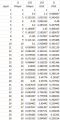
But since you seem to be in awe of Excel, let's see what Excel says.
The first column is the number of resistors in that layer.
The second column is the total resistance of the resistors in that layer.
The third column is the conductance of that layer (which is the reciprocal of the resistance of that layer).
The fourth column is the sum of the conductances of that layer and all of the layers above it.
The fifth column is the corresponding resistance of that layer in combination with all of the layers above it.
As you can see, the results match what everyone, except you, is getting.
I understand what you did but most calculators do not have the accuracy that a powerful spread sheet program like Excel has. The double precision numbers have enough accuracy to verify the convergence. Also did you let the number 'go' and not round them? Rounding will also cause a problem with convergence, you cannot round the numbers, it invalidates any formula trying to achieve convergence. I might if I get some time wright a small C program to verify that Excel is accurate. And send you the program. Also did you perform actual board testing with a real circuit? I have and in confirms by calculations.
That is I simply applied the Scientific Method. After the concept I had to prove or disprove it. That required an experiment and the experiment confirms the calculations.
And your measurement disproved your claim right from the very start. You stated that the resistance of the mesh was 1 Ω regardless of how large the mesh was. Your measurement shows that this was not even remotely the case. So how does that experiment confirm your calculations?
And your measurement disproved your claim right from the very start. You stated that the resistance of the mesh was 1 Ω regardless of how large the mesh was. Your measurement shows that this was not even remotely the case. So how does that experiment confirm your calculations?
The current Windows calculator uses far more sig figs than Excel does. But even single precision floating point math is far more than sufficient for the task at hand.
But since you seem to be in awe of Excel, let's see what Excel says.
The first column is the number of resistors in that layer.
The second column is the total resistance of the resistors in that layer.
The third column is the conductance of that layer (which is the reciprocal of the resistance of that layer).
The fourth column is the sum of the conductances of that layer and all of the layers above it.
The fifth column is the corresponding resistance of that layer in combination with all of the layers above it.
I want to thank everyone for their contribution to this thread, it has been a great learning experience for me and my hope is that everyone else has found it interesting as well. Thanks.
Getting upset about it is not gentleman like. Please try to remain civil. The word damn is not a good word and it can hurt peoples feelings. What are you thinking?
There is NO round off error in this calculation AT ALL. The equivalent resistance of just the first four layers is already LESS than 0.5 Ω. There is NO mechanism by which adding additional strings in parallel with the first four is somehow going to raise the total resistance.
Your speadsheet doesn't show anything of the sort.
You have hardcoded the first two rows in the resistance column to be 1 and 0.666666666666666.
What is the basis for doing that?
Then you are somehow claiming that the total resistance of a network with N+1 layers is somehow equal to one-third of the sum of 1 Ω and the resistance of the N layer network.
What is the basis for that claim?
It makes zero sense from a few perspectives. First, it has no awareness of how many resistors are in the row that is being added to the prior network. Second, where does the magic 1/3 come from?
What do you mean by "converging"? There are
2 values beginning in 0.30
5 values beginning in 0.25
17 values beginning in 0.20
55 values beginning in 0.17
What do you mean by "converging"? There are
2 values beginning in 0.30
5 values beginning in 0.25
17 values beginning in 0.20
55 values beginning in 0.17
The series that is actually not converging is the series
G = 1/1 + 1/2 + 1/3 + 1/4 + ...... 1/N + 1/....
The sum of this series goes to infinity, but we are not interested in G, but rather R = 1/G, which therefore does converge, but to 1/Inf = 0.
Another, more practical, way of thinking about this case is that the sense in it which it doesn't converge is that it doesn't converge to a non-zero value that is dependent on the size of the resistors. Instead, whatever resistor size you choose to use, the limit of the total resistance will always be the same, namely zero.

 Facebook
 Google
 GitHub
 Linkedin