Summing Amplifier + Bandpass Filter

crutschow

Joined Mar 14, 2008
38,526
I will maybe upgrade that filter and add another First order sallen key filter with the same cutoff frequencies, to get a 3rd order bandpass. Is that how it works?
There's no such thing as a first-order Sallen Key filter.
You just add a first-order RC filter at the input.
Here's a site that has a design tool to calculate the values for a third-order Sallen Key LP filter.
 

Audioguru again

Joined Oct 21, 2019
6,826
You do not have a "virtual ground". Instead you have a +50V/-50V 300W power supply.
If your two 50V power supplies are completely isolated then it works fine. If the amplifier produces 250W into your 4 ohms speaker then the amplifier must be class-D (very efficient) because an older class-AB amplifier will need a power supply with a current of about 5A to power its heating.

There is no such thing as a first-order Sallen-Key filter. A first-order highpass filter is simply a capacitor feeding a resistor to ground. A third-order Sallen-Key Butterworth filter is a complicated calculation but it is common, its cutoff is still -3dB but is slope is much steeper than a second-order.

The second-order Butterworth filter with -3dB (half max power) at 30Hz cuts deep bass sounds but the compromise might allow your little woofer to survive the bass-reflex design. The -3dB of the filter plus the -3dB of the speaker cuts 30Hz to 1/4 max power and 20Hz will not be heard but you might hear the huffing and puffing from the port.
 

Attachments

Audioguru again

Joined Oct 21, 2019
6,826
A cutoff frequency is at -3dB (half max power). If you simply add a first-order filter in the front of a second order Sallen-Key Butterworth filter then:
1) The cutoff frequency will be at -6dB (half max power).
2) The Sallen-Key filer will be messed up by the fairly high impedance driving it.
3) The response will no longer have a sharp Butterworth cutoff but will gradually drop and will cut frequencies higher than the cutoff frequency.

On-line calculators solve these problems but often use very odd resistor and capacitor values.
 

Thread Starter

Yeye

Joined Nov 12, 2019
47
Only i can tell, whether the woofer will survive the filter or not.( I got the graphs and parameters for my subwoofer enclosure ) That has nothing to do with electrical parameters. It's a mechanical thing called Cone excursion, which is the distance a woofer moves. If it is too high, it will cause overheating at the coil because the magnetic fields exceeded the permanent magnets fields -> The energy wastes as heat. Or it will die because the cone movement is basically too high for the woofer itself -> Cone may crack. The amplifier is a class d one, because at 1st, they're way cheaper and at 2nd they're far more efficent ( Sometimes even double efficency compared to A/B ones ) my model gots around 96% efficency, if i remember correctly. I will cool it anyways. Now third time im asking:
Which values for an input/ output capacitor, and where to place them?
And isn't it enough if i just smooth out my chinese +/- 12v board with a big capacitor? Then the noise should disappear, right?

Thank you as always
 

Audioguru again

Joined Oct 21, 2019
6,826
You will not have a proper filter if you simply add an RC in front of a Sallen-Key Butterworth filter. ALL the RC parts must be re-calculated to make a third-order Sallen-Key Butterworth filter.

I think the bass-reflex woofer smashes its coil against the magnet structure at low frequencies, but we do not know at which frequencies and powers.

A big capacitor has inductance that works poorly at high frequencies. Maybe the switching power supply needs a few smaller paralleled capacitors to filter out the switching noise.
 

crutschow

Joined Mar 14, 2008
38,526
You will not have a proper filter if you simply add an RC in front of a Sallen-Key Butterworth filter. ALL the RC parts must be re-calculated to make a third-order Sallen-Key Butterworth filter.
True.
I didn't mean to imply that you could just add the RC filter at its input without changing all the component values.

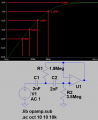
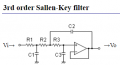
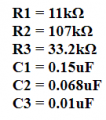
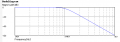
Here're the results from the site I posted, for a 3-pole Butterworth,, 100Hz, LP Sallen-Key filter, which selected standard value components.
As expected, itt rolls off at 18db/octave or 60dB/decade.

1573845417159.png1573845461235.png
1573845604247.png
 
Last edited:

MrAl

Joined Jun 17, 2014
13,708
Hello again,

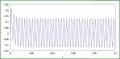
Here is the result of a low pass filter excited by a sine wave.
The graph shows what happens when there is a change in volume during a song or speech.
Note the first few waves are higher than the others. That is a result of using a simple filter for audio work. The frequency here is a bit higher than a bass note but for lower frequencies the increase in wave amplitude near the start of the change is even higher than that shown.
What effect this would have on the bass notes is it would cause a 'thumping' bass sound where each note would cause the speaker cone to jump out farther than it normally would for that note. And this is just using a first order filter with no resonance ... imagine what could happen with a 2nd order filter.
So the 'attack' is altered and so the instrument does not sound as it should but ends up sounding sort of like a bass combined with a bass drum.

This is probably one of the reasons why professionally designed audio filters are more complicated. Note how different the design of quality equalizers are then ask why, then do some simulations to compare.

Filter_20191115_230532.jpg
 

MrAl

Joined Jun 17, 2014
13,708
So what do you think, i should do?
Thank you for the explanations :)
Hi,

Oh is that a reply to my post?
If so, i would think you could look at some graphic equalizer schematics and see if you can grab some sub circuits to make a good filter. Alternately look for some book on filters for high quality audio.
 

Audioguru again

Joined Oct 21, 2019
6,826
MrAl, your amplifier is AC-coupled (like many amplifiers) and your tone began near its negative peak. Then of course the positive-going beginning is more positive than it should be. Then the coupling capacitors slowly discharge. I think it sounds normal without a thump.

To avoid a POP or THUMP, that is why many muting circuits ramp down a signal level before muting then ramping up the signal level after un-muting, instead of having a delay that is waiting for a zero-crossing activation.
 

crutschow

Joined Mar 14, 2008
38,526
imagine what could happen with a 2nd order filter.
A 2nd order Linkwitz-Riley filter is the preferred filter for high end speaker designs.
There is no filter that will not give the result you show with the artificial waveform you simulated.
No real music waveform starts like that, at the negative peak.
 

Thread Starter

Yeye

Joined Nov 12, 2019
47
Okay, so it seems i'm good with what you recommended?
Then I will use the Sallen key as a low pass and the Linkwitz Riley as the subsonic, or is such a combination dumb?
If the Linkwitz Riley produces subsonic noise, then i will use it to get rid of it's own noise and even a bit more than that, to get rid off the frequencies below my enclosure resonance Frequency / BR resonance / Fc ( Cutoff Frequency ).
How does that sound?
As power supply i will use many small capacitors at the output of my +/- 12v board ( which values should i choose? ), to get rid of the switching noise it might produce. Then at the output of the last Opamp, i will use an Output Capacitor ( High capacity [It has to be in series, so low capacity would mean its a highpass at high frequency...], to not filter the signal, but block the DC )
 
Last edited:

MrAl

Joined Jun 17, 2014
13,708
MrAl, your amplifier is AC-coupled (like many amplifiers) and your tone began near its negative peak. Then of course the positive-going beginning is more positive than it should be. Then the coupling capacitors slowly discharge. I think it sounds normal without a thump.

To avoid a POP or THUMP, that is why many muting circuits ramp down a signal level before muting then ramping up the signal level after un-muting, instead of having a delay that is waiting for a zero-crossing activation.
Hi,

Sorry to say that you dont understand this graphing.

Firstly,
That is a graph of the OUTPUT not the INPUT.
The input starts at zero and is a pure sine wave of amplitude 1 for testing.

Secondly,
Any signal such as from a guitar has what is called an "attack" period. That is the time when the wave first starts, even if there was a wave before that. So even mid music piece if the bass player plucks a string the intensity changes abruptly and so we will see a similar effect. That is why i posted that particular waveform to illustrate what happens when a note changes or a new note begins or even the singers voice changes amplitude abruptly.
 

MrAl

Joined Jun 17, 2014
13,708
A 2nd order Linkwitz-Riley filter is the preferred filter for high end speaker designs.
There is no filter that will not give the result you show with the artificial waveform you simulated.
No real music waveform starts like that, at the negative peak.
Hi,

I dont know where you got the idea that the waveform started at the negative peak.
What would give you that idea?

That is the output of the filter not the input. The input is a pure sine wave that starts of course at 0 volts. The reason for that waveform as i have said many times in the past is the exponential part of the filter response which is often overlooked in AC analysis because for that kind of analysis we are usually interested only in the response after a long time has passed. So this is nothing new at all nor unusual, unless we have an application that can ignore the initial response after an abrupt change in amplitude or even frequency for that matter.

But doesnt a 2nd order LR filter have a linear phase response?
 
Last edited:

crutschow

Joined Mar 14, 2008
38,526
I dont know where you got the idea that the waveform started at the negative peak.
Because the output appears to start at the negative peak.
Since you didn't post the input signal or the circuit we can only surmise that.
But doesnt a 2nd order LR filter have a linear phase response?
A 2nd order Bessel filter does, but so does a single-pole RC filter.
 

MrAl

Joined Jun 17, 2014
13,708
Because the output appears to start at the negative peak.
Since you didn't post the input signal or the circuit we can only surmise that.
Hi,

Ok, so now you know. The input is a pure sine and the circuit is an ordinary RC low pass filter.
 

MrAl

Joined Jun 17, 2014
13,708
Of course a plucked guitar sting is louder at the beginning. You do not know if the leading edge of the sound is positive or negative phase.
Hi,

No that's not the effect being seen in the graphic.
It is not due to a plucked string it is a constant amplitude sine wave input. The initial plucking causes an even larger excursion, but if the filter does not behave then the excursion is even larger and it sounds like a thump at the beginning of the sound.
To state this another way, it alters the attack. A plucked string has a certain attack and that is normal, but the filter itself modifies the attack such that it becomes larger at the beginning which of course means the instrument sound is altered from that of normal.

The beginning of any zero tone is zero it can not have a phase other than zero.
The main idea is to check the effect to make sure it is not too bad.
 

Thread Starter

Yeye

Joined Nov 12, 2019
47
After a few simulations/tests in real life, i realized i'm kind of fucked. One option was to smooth out the noisy voltage of my chinese Dual voltage Board. I tried using 2 1000uF / 1mF E-Cap at the -12v to Gnd and at the Gnd to +12v Output. So 2 E-Caps at the Output stage. When plugging in a speaker, it's still noise as hell.
Second Option was to use DC with voltage splitter to do that virtual GND thing again. Then i would have to remove that DC offset again at the Output stage. When simulating, i couldn't Find a value for that Capacitor, to remove all the offset but don't lower the signal. ( Capacitor is in series -> Highpass Filter. Low value -> No dc, but also no signal, because high cutoff frequency. )
What to do now?
 
Top