Summing Amplifier + Bandpass Filter

Thread Starter

Yeye

Joined Nov 12, 2019
47
The power amplifier doesnt need anything... it works just as it is... I think i have to use an output coupling cap at the output of the pre amp and thats it... then i should get that problem away... but what to do with all the other points, any ideas?

EDIT: No, thats just what i want, dont ask why, its just that :)
Thank you
 

Audioguru again

Joined Oct 21, 2019
6,826
You said that you have a virtual ground on a 100V power supply voltage? Then how do you connect the speaker to ground?
Is the amplifier made to be powered from +50V and -50V so it is missing a huge output capacitor to feed AC to the speaker but block the 50V DC? Please post a link to the amplifier.
If you add an output coupling capacitor then its value must match the charging time of the input capacitor of the amplifier to avoid a huge POP sound when it is turned on or is turned off.
 

Thread Starter

Yeye

Joined Nov 12, 2019
47
Okay, i want the bass to be just a bit louder... Thats why, so the bass Frequencys are KIND OF "doubled" ( All the low frequencies, the tops will play will add up with the ones, the sub plays... ) In general just to have bass louder
 

Audioguru again

Joined Oct 21, 2019
6,826
Your ebay ad for the Chinese amplifier is written in a foreign language. The same amplifier is at Banggood and AliExpress and I found their ads in English. They say an output of 500 Whats (which is not 500 Watts) with a +100V/-100V supply.
The International Rectifier datasheet for the driver IC says 380W at 10% distortion with a +65V/-65V supply into 4 ohms.
One comment at diyaudio says 280W at 10% distortion with the +65V/-65V power supply. Most comments say the amplifier is too small and will overheat with such high power.

You might be lucky and get 250W into 4 ohms with fairly low distortion using a +50V/-50V power supply.
It has no output capacitor so it will not work with your 100V supply unless you have something that splits it (not a virtual ground circuit).

What will you use for a subsonic filter? The second-order Linkwitz-Riley highpass filter produces plenty subsonics.
 

Thread Starter

Yeye

Joined Nov 12, 2019
47
As i already wrote 2 Times, the amplified board DOES WORK with my virtual +-50v... There is no need of a output capacitor, since the ground for the speaker is just the virtual gnd (50v) so no dc Offset.. just a biased Signal and a positive voltage as ground...
 

Audioguru again

Joined Oct 21, 2019
6,826
A virtual ground is an imaginary ground that sometimes is used to bias the very low current of an amplifier's input, not the very high current of its output.
Please post a schematic of your "virtual ground" circuit , how it connects to the amplifier and how the speaker gets its ground.
I suspect that your "virtual ground" is not properly grounding the speaker so it cuts all bass frequencies.
 

MrAl

Joined Jun 17, 2014
13,708
Hey guys,
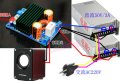
I bought one of those mono amplifier boards for subwoofers etc. Since it only has 1 input channel ( and ground ) and no Bandpass filter ( which i need, because i wanna use it as a subwoofer amplifier ) I tried developing a Circuit which combines those 2 circuits. I did that by using
http://falstad.com/mathphysics.html
the analog Filter and the analog Circuit simulator applet. Both circuits worked ( IN THEORY ) just as i wanted them to. View attachment 191225View attachment 191227
( The 2 signal sources are the Left and Right channel from my Aux cable/3.5mm Phone Jack )
Im quite sure the summing amplifier should work just fine as i planned it ( correct me if not ).
But finally after recieving the PCB and the Components and testing it all, it didnt work. After trying to only use the Mono sum part, i heared noise and very light music ( my input signal ) when connecting a test speaker ( I dont have measurement equipment accurate enough for this )...
Is the reason just bad contacts or why doesnt it work?
Thank you in advance
Just a note, you should also check the phase shifts when dealing with audio or you may not like the sound quality.
 

MrAl

Joined Jun 17, 2014
13,708
The ear is not sensitive to phase shift.
Maybe your ear isnt, but everybody else's is :)
That's only true when with only one channel and when the phase does not change.
Two striking examples are the guitar phase shifter sound effects pedal and with stereo channel audio outputs when they mix so the listener hears the sum of the two channels.
Since a bass channel is usually part of a stereo system i would want to check it out especially when the other channels are also going to be phase shifted. It does depend on the amount of phase shift also though so if it is small it may not matter, but it could be significant so it is worth looking into for any given setup.
 

crutschow

Joined Mar 14, 2008
38,526
Two striking examples are the guitar phase shifter sound effects pedal and with stereo channel audio outputs when they mix so the listener hears the sum of the two channels.
But that's not an effect of the ear being sensitive to phase.
It's the adding or cancelling of the two wavefronts in the air as their relative phases are shifting which changes the sound intensity..
That can be measured with a sound meter.

But your point is valid.
The relative phase of the sound coming from two or more speakers is definitely of concern.
In the case of a subwoofer, the placement in the room also affects the phase of the sound relative to that from the other speakers.
 

MrAl

Joined Jun 17, 2014
13,708
But that's not an effect of the ear being sensitive to phase.
It's the adding or cancelling of the two wavefronts in the air as their relative phases are shifting which changes the sound intensity..
That can be measured with a sound meter.

But your point is valid.
The relative phase of the sound coming from two or more speakers is definitely of concern.
In the case of a subwoofer, the placement in the room also affects the phase of the sound relative to that from the other speakers.

Yes the position of the woofer is a good point also.

But all i said was that he should study the effect of the phase shifts, then you said the human ear is not sensitive to phase shifts which made it sound like you were trying to nullify my entire statement. So i joked a little but then explained my position.

Also, have you ever had a guitar and phase shift sound effects pedal? That is similar to a Wah Wah pedal but different sound effect. The phase shift pedal is just one single channel (normally) and yet you can certainly hear a dramatic effect when you push the pedal up or down and that is usually just one tone (possibly with some lower level harmonics).. What we hear is the dramatic change in sound when the phase shifts. What i think it is though is that some frequencies shift more than others and that makes it sound very weird but interesting. This was in widespread use back in the 1970's and maybe later but i dont hear anyone using it anymore.
The basic operation was to shift the phase of the signal and mix it with the original signal i think. That would create an effect that damps some frequencies and not others. If this occurs naturally in a poorly designed system, the effects could be very undesirable. It could boost or cut some frequencies in a somewhat random way.
 

Audioguru again

Joined Oct 21, 2019
6,826
In "the good old days" there were stereo shops with a stereo system playing. The salesmen usually had the speakers wrongly connected out-of-phase which cancelled the bass so they turned up the bass tone control to maximum. I would sneak in, connect the speakers in-phase then turn down the bass tone control to normal and the sound was much better.
 

Thread Starter

Yeye

Joined Nov 12, 2019
47
I think i know how the thing with Phase works... Two waveforms add up as soon as they hit each other.. If they both are 0 degrees phaseshifted, then their Amplitude adds up. If they are 180 degrees relative to each other Phase shifted, they cancel each other out. But u cant head a Phase shift. The only thing u might hear is the change when playing the note, and WHILE the note is playing, you activate the Phase shift. But if u Play those 2 Notes seperately, you shouldnt hear anything, since it is same shape, same Amplitude and same frequency. The difference in Phase just acts like if you were standing a bit further away / a bit closer to the speaker.
 

Thread Starter

Yeye

Joined Nov 12, 2019
47
And to answer your request for a schematic of the Virtual ground thing, @
Audioguru again amp3.jpg
It's just like that. That chinese amplifier board isnt the same as on that picture, but that picture shows exacly what i did. My chinese amplifier board gots one GND input, one -VCC and one +VCC input. When connecting the REAL 0v to -VCC of the amplifier board and REAL +50v to the GND input of the Amplifier board, we got virtual -50v at -vcc of the amplifier board. +VCC of the amplifier Board is then connected to REAL +100v, so we got virtual +50v referenced to the virtual Ground.
There only are 2 Speaker outputs, just like in this picture, so i connected the GND out to the minus terminal of my Speaker and the Positive / Signal out to the plus terminal of my speaker. There are 2 possibilites of how this is working:
1st: The GND output terminal for my speaker is Virtual Gnd, so it is REAL +50v. The Signal output then had to be REAL +50v and the amplified output signal. So the difference between those 2 terminals is just the amplified signal. Voltage is relative, and thats what is being used in that case.

2nd: When creating that amplifier Board, they built in an output Capacitor, just as u recommended me, to block the dc. If that's the case, the Positive output terminal is just the amplified signal and the negative output is REAL gnd, so REAL 0v.

Both is possible, i will measure how it really is, in the next days.
Thank you as always.
 

Thread Starter

Yeye

Joined Nov 12, 2019
47
Okay i just developed another Filter. Screenshot (40).png
It is a 2nd order Sallen key Bandpass Filter. Upper Fc = 100hz (-3db @ 100hz). Lower Fc = 30hz (-3db @ 30hz).
This time i used high resistor values. The current flowing is just some little micro amps. The only disadvantage i could see in such a construction is maybe the influence of Electromagnetic radiation. I dont know, but i think Electromagnetic radiation could highly influence the signal, since we're talking about micro amps right here. What do you guys think about that design?
I will maybe upgrade that filter and add another First order sallen key filter with the same cutoff frequencies, to get a 3rd order bandpass. Is that how it works? And if i now want to use an input and output capacitor, which values should i choose, and where to place them? Those caps are ( if i understood it correctly ) just to block the DC, if i power that circuit with virtual +- voltage again, right? If i now place a smoothing capacitor at the end of my chinese +-12v board, then i could use that to not have to use virtual voltages again. How does that sound?

Thanks again in advantage, i hope you still reading this :)
 

MrAl

Joined Jun 17, 2014
13,708
I think i know how the thing with Phase works... Two waveforms add up as soon as they hit each other.. If they both are 0 degrees phaseshifted, then their Amplitude adds up. If they are 180 degrees relative to each other Phase shifted, they cancel each other out. But u cant head a Phase shift. The only thing u might hear is the change when playing the note, and WHILE the note is playing, you activate the Phase shift. But if u Play those 2 Notes seperately, you shouldnt hear anything, since it is same shape, same Amplitude and same frequency. The difference in Phase just acts like if you were standing a bit further away / a bit closer to the speaker.
Hi,

Yes normally i dont think you can hear a simple phase difference. With two channels though the mix could render the quality very low.
Also, the exponentials involved could affect what we call the "attack" of the sound. The phase changes the way the environment reacts to the phase at the start of any sound piece which may or may not be heard depending on environmental factors. I think it may be hard to tell the difference though in most cases.
 
Top