Suggest a suitable material

Thread Starter

strantor

Joined Oct 3, 2010
6,875
Your ABS plastic sheet at 48 x 48 x 3/4 will weigh about 72 pounds. 100 pounds for a 1" sheet. Freight will kill on a single sheet. Call allied plastics in Houston for a quote. They buy by the truckload and they may let you pick it up.

You may be better off casting your own. It may sound strange but the cheapest and strongest may be casting concrete. If you keep your eye open, you may fins a perfect mould - like a plastic bushel basket. Add some glass fibers or short polypropylene rope (1/4") that will Fray into individual fibers to add toughness and prevent crack propagation if you have a vibrating or stressful application. I've cast umbrella anchors out of concrete using plastic pastry packaging from the grocery store. My wife thought I was crazy but she loved the fluted edges - I put a PVC pipe inside that I tapped out for the umbrella pole. I've also done a picnic table top and a counter top for the basement bar.
No it doesn't sound strange. I've looked into casting machine tools in concrete a few years ago, and found out that they did it during WWI and WWII sucessfully. I've revisited the idea a few times since then, but until your post, I had yet to apply the idea to this tool. Now that you got me thinking about it, I think it may be the answer to some of the problems tcmtech brings up.

Have you ever seen how they used to pour a babbitt bearing? Its just a hollow shell and you stick a shaft through it. The shaft has some flutes turned in it. They coat the shaft in a thin film of carbon from a blow torch and then they pour the case full of babbitt, which by my understanding is like lead, with lubricating properties like graphite. The babbitt turns solid, trapping the shaft in place by the flutes. The only clearance between the shaft and the solid babbitt is whatever space the carbon took up, which i guess couldn't be more than a micron. It makes for a very good rigid rotation- no play in it at all. No moving parts. No machining required.

Perhaps I could make the disk (or at least the outer edge of it) out of something that's naturally slippery, like UHMWPE or nylon or teflon, coat the outside of it with a very thin layer of grease or vaseline just for good measure, and then pour concrete into a square mold form around it, trapping it in place.

I've also been considering making the whole thing thicker. Instead of 1" plate, make it like a 6" puck.

Combining these two ideas, the inner puck could be made by sandwiching plates of alternating diameter, like 36" then 38" then 36", etc. To achieve the effect of the fluted shaft used in a babbitt bearing.
 

Thread Starter

strantor

Joined Oct 3, 2010
6,875
Tcmtech i get what you're saying about linear slides/drives being resistant to being forced by a bad cutter. The cutter fights back against or away from the leadscrew/ballscrew threads depending whether climb milling or not, and the leadscrew/ballscrew is not easily coerced into reversing course. The Fighting gets exponentially more intense if the cutter is dull, broken, or clogged. This would be a huge problem for this machine the way i drew it using a belt drive. A better option would be a worm drive on O.D. of the plate/puck. It should provide the same fight-back that a linear screw provides. A worm drive can be made in the home shop with crude tools as well. You can do it with a threading tap chucked up in a power drill.
 

cmartinez

Joined Jan 17, 2007
8,760
It would be difficult to make to and maintain for any degree of precision milling work especially if manufacturing costs are a concern. :(
It is my understanding that the OP's purpose is not to make a manufacturing machine, but rather a machine that can be readily made by someone with limited resources. All the factors that you mentioned in your assessment are essentially true. And yes, I could mention a few more disadvantages to the design, the most important being that all commercially available materials are sold in rectangular sheets, and not in circular cutouts. Also the the bearings would have to be preloaded to absorb all possible play between the plates.

But there is one thing that drew my attention, and that is that this design would have extreme rigidity and robustness dealing with radial forces.
Standard XY machining systems are normally configured as a tool that linearly moves along a single bridge (y axis) that travels on a rail on each of its two extremes. The bridge behaves like a beam supported on both sides and is susceptible to distortion and vibration due to reaction forces produced by the cutting tool, especially when these forces are perpendicular to the beam.
In this case, the geometry is such that both circle-axis behave as a single two-dimensional plane (and not just a beam) that equally absorbs all forces regardless of direction, except for the forces orthogonal to that plane, which in the end would be more rigid than the straight beam axis configuration anyway.
Yes, there could possibly be the problem of clogging, and also the accumulation of chips and dust trapped between the motion plates and the material being cut, but those are problems that can be solved if the mechanism were mounted vertically.
So why has this design not been seen in modern machining equipment? To me, the obvious answer would be that it's simply impossible to control with any degree of acceptable precision without the aid of computers... but that's a problem that can today be very easily solved. Anyway, this machine might never be practical for manufacturing purposes, but at least its design is original enough to be taken seriously.
 

tcmtech

Joined Nov 4, 2013
2,867
What I am talking about with flexing is the 4 5 and 6th axis loads caused by torque.

That is to say that in a live load there are more than just the three linear axis motions/force vectors to deal with. Each of the three primary axis X, Y, Z also experience torsional loading as well which is where flat sheets will tend to show the most flex being the primary loading forces from the cutter are offset either above or below the primary plane of the sheet.

Think about it for a bit and you will see there are more than just three axis of forces to deal with. ;)
 

cmartinez

Joined Jan 17, 2007
8,760
Think about it for a bit and you will see there are more than just three axis of forces to deal with. ;)
I know about those other axis of torsion, and the way I see it, in that regard this design is more rigid than a bridge-type XY system too... at least assuming that the thickness of the bridge and the thickness of the planes are equal and that the proper tolerances and preloading are applied.
The question here would be if it is practical and more economical to build and operate or not... For instance, the inner and outer races of each disk in question would either need to be heat treated or somehow hardened, otherwise the hertz forces exerted by the bearings would start pitting and distorting the races and the entire assembly would start wobbling around...
So I guess the big Q here would be "would I, myself build it?" ... probably not, at least until I did some real life numbers (mainly cost) comparing it to conventional XY systems, and figured a way of preserving those races in shape for the long run.
 

sirch2

Joined Jan 21, 2013
1,071
I think Strantor's idea is very clever but another potential problem is the non-linearity of errors due to the circular motion. Consider the cutter at top dead centre (ie. diametrically opposite the motor) then the slightest movement of the disk will cause a much larger X axis movement than Y axis but when the the cutter is 90 degrees from TDC then the same degree of motion will give a large Y axis movement and a small X movement.

Whatever it is made out of it WILL flex to some degree and however easy circles are to cut they will never be perfect (and cutting a large hole in a sheet of anything is likely to allow internal stresses in the sheet to relax and make the hole non-circular) so the amount of error in X and Y at a given point will vary from place to place and so will be hard to compensate for.
 

Thread Starter

strantor

Joined Oct 3, 2010
6,875
Well I sat on this idea for a mere 7 years and someone already beat me to it! No respect, I swear.

Not exactly the same, conceptually the same though.


MrSalts

Joined Apr 2, 2020
2,767
Well I sat on this idea for a mere 7 years and someone already beat me to it! No respect, I swear.

Not exactly the same, conceptually the same though.

I'm not seeing how the original design specification is met by anything in the video. Please explain how the video solves the original design spec.
I want to make something like a lazy susan turntable, but flush.
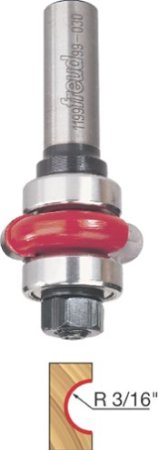
Imagine a card table top made out of a 1" thick piece of MDF 48"X48", and you cut a 36" diameter hole in the very center. Now I want the inner disk (cutout) to remain exactly where it was, but rotate - I don't want it to be elevated or recessed like a lazy susan bearing would require. I was thinking to use a router to go back through the circular channel with a fluting bit like this :
(pretend it says 1/2" instead of 3/16")

and turn it into a bearing race on both sides, then fill up the channel with 1/2" bearing balls.

I'm pretty sure that idea would suck because the MDF would crumble under heavy load. The load will be pretty heavy, in multiple axes; imagine this lazy susan card table has steel legs anchored to the ground and a pole standing up in the middle of the rotating disk - a fat man standing up on the table grasping the pole should not be able to damage or misalign the disk by throwing his weight against and away from the pole.
 
Top