Suggest a suitable material

GopherT

Joined Nov 23, 2012
8,009
Your ABS plastic sheet at 48 x 48 x 3/4 will weigh about 72 pounds. 100 pounds for a 1" sheet. Freight will kill on a single sheet. Call allied plastics in Houston for a quote. They buy by the truckload and they may let you pick it up.

You may be better off casting your own. It may sound strange but the cheapest and strongest may be casting concrete. If you keep your eye open, you may fins a perfect mould - like a plastic bushel basket. Add some glass fibers or short polypropylene rope (1/4") that will Fray into individual fibers to add toughness and prevent crack propagation if you have a vibrating or stressful application. I've cast umbrella anchors out of concrete using plastic pastry packaging from the grocery store. My wife thought I was crazy but she loved the fluted edges - I put a PVC pipe inside that I tapped out for the umbrella pole. I've also done a picnic table top and a counter top for the basement bar.
 

cmartinez

Joined Jan 17, 2007
8,760
The most successful product developments are done in an iterative process. It i/ less tha $500 project and done on his free time. So very little risk. If he discovers a failure mode or feficiency, he will know exactly where. But he will also have a prototype in hand to show other people. People who can help him and people who may need one.

Don't shut him down because his idea is not perfect. It doesn't have to be perfect, it is only an idea at this point.
That's pretty much how I develop and/or sell some of my ideas too
 

cmartinez

Joined Jan 17, 2007
8,760
I'm now seriously considering making my own composite sheet like Micarta or FR4.
That's a good possibility... I once started making a chess set out of wood and discovered that, considering the piece's small dimensions, the material was too fragile when stressed perpendicular to the grain. So what I did was I bought maple laminate 1/32" thick and glued 5 layers together at right angles, in effect making my own plywood. I was very surprised at the results and at how tough and rigid it was.
Another possibility as that you experiment with multiple layers of formica

Capture.JPG
 

tcmtech

Joined Nov 4, 2013
2,867
Actually making perfect circles in metal or even hard wood is very hard.

Just turning a small simple shaft in mild steel or aluminum takes substantial machine and tool ridgidity just to do basic cutting with low tolerances and by low tollerances I mean holding a +- .020 per revolution.
 

Thread Starter

strantor

Joined Oct 3, 2010
6,875
Actually making perfect circles in metal or even hard wood is very hard.
No it isn't. Making perfect circles to an exact dimension is though. Thankfully I don't need to do that.
Just turning a small simple shaft in mild steel or aluminum takes substantial machine and tool ridgidity just to do basic cutting with low tolerances and by low tollerances I mean holding a +- .020 per revolution.
Who said anything about turning shafts? Who said anything about mild steel and aluminum? Who said anything about a tolerance spec?

You're going above and beyond to try and shoot this down, and I don't understand why.

When I'm talking about making circles, I'm talking about doing it with a router fixed to the center of the workpiece by a rigid rotating radius bar. You drill the hole in the center, bolt the radius bar to it, and move the router in the only direction that it can possibly move, which happens to be in a perfect circle. The actual dimension of the circle is not important. The important part is that it's perfectly round (which it is), and that the gap between the inner and the outer is consistent (which it is, unless the router bit changes dimensions as you cut - just go over it again with a brand new bit).
 

jpanhalt

Joined Jan 18, 2008
11,087
No it isn't. Making perfect circles to an exact dimension is though. Thankfully I don't need to do that.

Who said anything about turning shafts? Who said anything about mild steel and aluminum? Who said anything about a tolerance spec?
Actually, I believe you did:
Not Top Secret, just Middle Secret. It's for milling circles in metal. I can mill circles in wood with a router and a pivot/radius (that's how I plan to make this thing), but I can't mill steel with a router, and that's what this thing will do. It will have a spindle motor mounted on it, with the shaft/chuck extending downward through the plate.
Please don't get me wrong. Many woodworking tools can be used to cut metal, including some steel, using modern cutters. I remember the first time 30 years ago that I saw a shop cut a 2"X3" solid aluminum bar on a Delta table saw with a carbide blade. Since then, I have cut aluminum that way myself.

John
 

Thread Starter

strantor

Joined Oct 3, 2010
6,875
Actually, I believe you did:


Please don't get me wrong. Many woodworking tools can be used to cut metal, including some steel, using modern cutters. I remember the first time 30 years ago that I saw a shop cut a 2"X3" solid aluminum bar on a Delta table saw with a carbide blade. Since then, I have cut aluminum that way myself.

John
I apologize for not being clear; What I was trying to convey, is that I will use a woodworking router to make this apparatus. The apparatus will be made of wood or composite or plastic, because I do not have the ability to make the apparatus out of metal with just my router. Ideally the apparatus would be made of metal. Once the apparatus is complete, the apparatus will (or should hopefully be) capable of milling metal. The apparatus will be fitted with a milling spindle motor as I mentioned in your quoted text.

I did not intend that I would be cutting circles in mild steel or aluminum in the course of building the apparatus, which is how I initially interpretated tcmtech's reply to imply. I interpreted it that way because at the time of his reply, I was thinking about, and the discussion was centered on, fabricating the apparatus, not about using it. However in re-reading his posts I see that he is probably referring to milling metal with the apparatus after it is built, which is a perfectly valid concern, and is a concern that I also share. So, tcmtech, I apologize for the misunderstanding, and your feedback is appreciated.
 

cmartinez

Joined Jan 17, 2007
8,760
So, tcmtech, I apologize for the misunderstanding, and your feedback is appreciated.
strantor, I'm afraid that all of the explanations you've had to give is the price to pay for your semi-secrecy...
how long do you think it'll take before you have a working prototype?
 

Thread Starter

strantor

Joined Oct 3, 2010
6,875
strantor, I'm afraid that all of the explanations you've had to give is the price to pay for your semi-secrecy...
how long do you think it'll take before you have a working prototype?
How long before a working prototype? Too long. Maybe never. Too many ideas, not enough time. I've been thinking about it, and I've sat on too many ideas for too long and never took them anywhere. This project has just as much chance of going nowhere. So I've decided the cat out of the bag. I'll toss it out there, and if anybody sees promise in it and wants to pick it up and run with it, you have my blessing, but I'd appreciate some feedback and credit. ...and some money if it makes you rich ;).

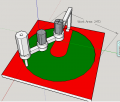
The concept is akin to this articulating arm design. This design is used on some engravers I've seen:
arm2.png

Problem #1 with this design, if to be adapted to metal milling, is that it lacks rigidity. The milling spindle mounted out at the end of the articulating arm is free to twist the arm and bounce it around.

Problem #2 with this design is obvious, and has been shown here by the red "no fly zone"
arm1.png

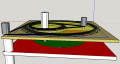
My design addresses both of these issues by replacing the articulating arm, with eccentric nested disks.
yyb1.png

yyb2.png

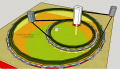
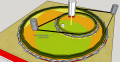
The smaller inner disk overlaps the epicenter of the larger outer disk, enabling the milling head to pass over dead center.
Here are 3 pics from one vantage point, showing the range of motion:
yyb3.png yyb4.png yyb5.png

The rigidity issue of the articulating arm gives way to side loads being spread out over the circumference of the disk(s).
The No-Fly zone is eliminated with the milling head being able to cover every square inch of the 28"D circular work area. Also, this design allows the rotating segments to spill full circle if needed, whereas if the articulating arm were up against one side and needed to be on the other side, it would have to reverse ~340 degrees to get there.

The geometry for both should be identical. They are both 2 segments of rotation with 7" radius, coupled at the ends. The CNC controller for it would have to do tons of trigonometry for every movement, but that shouldn't be a problem with today's computing devices. Despite being made of circles, it should be able to mill straight lines, or any shape within the work envelope.

I have not drawn the Z-movement mechanism because I have not yet decided how I want to tackle that. I am brainstorming more DIY-able circular mechanisms.
 
Last edited:

cmartinez

Joined Jan 17, 2007
8,760
Beautiful contraption... I'm going to study it and ponder every aspect of it to see if it is also practical, and what other advantages and disadvantages it has... congrats... I can see you've put a lot of thought and imagination on in... wish there were a thumbs-up emoticon in this editor...
 

MaxHeadRoom

Joined Jul 18, 2013
30,658
Years ago I bought the book by Langlios for the DIY sinker EDM but never got around to it, maybe one day.....o_O
I have enough parts around, so that is no excuse.
Max.
 

shortbus

Joined Sep 30, 2009
10,050
A sinker EDM has been my ongoing project. Have had the head, tank and base done for years now. The electronics is my stumbling block. Want to make it a pulse type instead of the RC type in the Langolis/Home shop machinist book.
 
Last edited:

cmartinez

Joined Jan 17, 2007
8,760
Now I'm totally lost. your making this round but for milling. In ~50yrs of machine work, most round things have been done in a lathe. Milling is usually a linear/straight process. And using hand power to do a milling operation is just asking for trouble. Standard milling direction, you won't get enough force. Climb milling direction, you won't be able to hold the part back, the cutter will pull it.
I believe his purpose is to use it as a 2 axis CNC, and the design is done so as to avoid linear bearings altogether, which can be quite expensive.
 

tcmtech

Joined Nov 4, 2013
2,867
I believe his purpose is to use it as a 2 axis CNC, and the design is done so as to avoid linear bearings altogether, which can be quite expensive.
Precision linear bearings and drives are a whole lot cheaper to buy and work with over large diameter ring bearing systems. Thats just the first fatal flaw I see here.

Second stumbling block is that when using rotary cutters on a rotatable table they will always want to cog up and walk on the part being machined of which those forces can get very high real fast when a cutter clogs or chips and goes from cutting to gouging making it impossible to keep any real degree of precision or accuracy on the work being done.
With linear slides and drive mechanisms the very design of the sliding and driving components tend to be self locking with only the clearance tolerances between the mating components and the rigidity of the material they are made of as the primary factors for holding tolerances. Linear bearings and screw drives can be made to have zero clearance tolerances. large diameter ring bearings are extremely difficult toe make and keep in a zero clearance condition. Especially under compound axis loading conditions.

Third idea that thin plates will spread out the loading is incorrect. Thin plates will have huge rigidity problems against one axis of movement that again will compromise the precision and accuracy of the design.

As far as this being a new concept well to be honest the odds are it has been tried before but due to the complexities of the positioning system plus keeping any part of it in a tight enough tolerance to work with reliable repeatability plus the fact that a huge ring bearing is a massive trap for debris......... Thats why the design is not seen in modern machining equipment.
It would be difficult to make to and maintain for any degree of precision milling work especially if manufacturing costs are a concern. :(
 
Top