String light

Thread Starter

lichurbagan

Joined Jul 4, 2025
120
Does anybody have any experience in making string LEDs here? I am not interested in Neopixels. I want to make an LED string consisting of generic 5mm LEDs. If I want to run at LED string with 220V AC, how should I design the circuit? Should I connect the LEDs in series? Do I need a bridge rectifier?
 

dl324

Joined Mar 30, 2015
18,219
I see that LEDs connected to mains voltage is no longer a disallowed topic...

How many LEDs were you planning to use?

I'd avoid using a bridge rectifier if possible.

How were you planning to wire the LEDs to avoid potentially hazardous voltages being exposed?
 

WBahn

Joined Mar 31, 2012
32,703
Does anybody have any experience in making string LEDs here? I am not interested in Neopixels. I want to make an LED string consisting of generic 5mm LEDs. If I want to run at LED string with 220V AC, how should I design the circuit? Should I connect the LEDs in series? Do I need a bridge rectifier?
Yes, it is possible. But the fact that you are asking the question is an indication that you are likely to not appreciate the very real dangers associated with doing so. Please do not treat this lightly as you will be risking getting you or someone else tangled up with potentially lethal voltages and currents. There's a reason this used to be a banned topic and is still a discouraged one.

When you say, "generic" 5 mm LEDs, you need to be more specific. Your design will depend on WHICH 5 mm LEDs you choose to use. Are you at least going to have all of the LEDs in your string be the same part number? What are the specs as far as forward voltages and currents (see the data sheet)?
 

MisterBill2

Joined Jan 23, 2018
27,166
I have several items that have strings of LEDs powered thru a bridge rectifier. AND certainly connecting with any part of that string will pose a serious shock hazard! Thus the simple safety action is to avoid any contact with a string of LEDs powered by a mains connection.
BUT, How Ignorant Does a person have to be to not understand that ???? REALLY???? Other than little children, who others are obligated to protect???
 

WBahn

Joined Mar 31, 2012
32,703
I have several items that have strings of LEDs powered thru a bridge rectifier. AND certainly connecting with any part of that string will pose a serious shock hazard! Thus the simple safety action is to avoid any contact with a string of LEDs powered by a mains connection.
BUT, How Ignorant Does a person have to be to not understand that ???? REALLY???? Other than little children, who others are obligated to protect???
Lots and lots of people are that ignorant -- and many that aren't are that careless.
 

WBahn

Joined Mar 31, 2012
32,703
THAT is where we get "Natural Selection" from, otherwise called evolution.
Yes, I'm sure that will be very comforting to you when someone that you care about gets selected out because they weren't familiar with the risks of something they have little background in.
 

MisterBill2

Joined Jan 23, 2018
27,166
They are quite aware that touching mains wiring can be unsafe. AND we do keep the little ones away from wires. Education starts long before reading is learned.
 

Thread Starter

lichurbagan

Joined Jul 4, 2025
120
Yes, it is possible. But the fact that you are asking the question is an indication that you are likely to not appreciate the very real dangers associated with doing so. Please do not treat this lightly as you will be risking getting you or someone else tangled up with potentially lethal voltages and currents. There's a reason this used to be a banned topic and is still a discouraged one.

When you say, "generic" 5 mm LEDs, you need to be more specific. Your design will depend on WHICH 5 mm LEDs you choose to use. Are you at least going to have all of the LEDs in your string be the same part number? What are the specs as far as forward voltages and currents (see the data sheet)?
Sir, I understand your concern. That's why I think I'd better try a battery-operated one first. By generic, I mean the typical 5mm LED, which has a forward voltage of 2.0V and a rated forward current of 20mA.
 

WBahn

Joined Mar 31, 2012
32,703
Sir, I understand your concern. That's why I think I'd better try a battery-operated one first. By generic, I mean the typical 5mm LED, which has a forward voltage of 2.0V and a rated forward current of 20mA.
The "typical" such LED would normally be operated at a current of about half of the rated current, so let's shoot for 10 mA.

The voltage at that current might "typically" be 2.0 V (which means that it is likely a red LED), but that is probably spec'ed to vary from on LED to another over a range of about 1.8 V to 2.2 V. You need to allow for that.

The next consideration is how stable you want that 10 mA to be. How much can it vary up and down from that target and be acceptable.
 

MisterBill2

Joined Jan 23, 2018
27,166
Looking back at post #1, I see that the supply voltage, if mains power direct were used, will require a string of about 110 two volt LEDs. THAT would be quite a project to assemble. And it would still require, at the least, a series resistor to limit the current, as the forward voltage does vary with temperature. as well as with current. So if the TS can acquire a wall wart DC, or even AC supply, the project can be made smaller and thus simpler.
 

Jack3q

Joined Dec 9, 2025
1
I am sorry fellows but I feel this is a forum for knowledgeable electrical/electronic members. I understand your safety concerns for others but this forum is for sharing and exchanging expertise among people who are quite familiar with electrical safety.
Having troubleshot(?) many Christmas lights over the years, the led circuit being inquired about is a simple matter of using the same leds, calculating voltage drop and current limiting resistance and wattage(1/2 or 1).
And as my Papaw would say "ifn you ain't bin bit you ain't no electrician "!
 

MisterBill2

Joined Jan 23, 2018
27,166
One other consideration is that if the power supply is 220 volts and 50 Hz, with a single rectifier there would be a 50Hz flicker that might be unwanted. So using a bridge rectifier will reduce that flicker considerably. The actual insulation could consist of a brushed on coating of the clear adhesive used for plastic piping. I have used that in a few instances and it appears to protect copper wire from any tarnish.
The really challenging part of the project will be keeping the polarity right and making all of those 220 connections reliable and insulated adequately while looking good. And hope that none of the LEDs fail open, because in a series string of common LEDs there is no automatic shunting of an "failed open" device.

It will be good to see a report on how this project works out, after it is completed.
 

DickCappels

Joined Aug 21, 2008
10,661
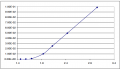
I still have hundreds of LEDs that I bought on the cheap the day after Christmas 25 years ago. One key difference between these LEDs and the ones I buy from a distributor is that these have relatively high internal resistance.

1765636422469.png

Notice that the VI curve is linear, not like a diode.

I would not waste a dollar (US$) on a string of AC powered LEDs.
 

Reloadron

Joined Jan 15, 2015
7,855
Does anybody have any experience in making string LEDs here? I am not interested in Neopixels. I want to make an LED string consisting of generic 5mm LEDs. If I want to run at LED string with 220V AC, how should I design the circuit? Should I connect the LEDs in series? Do I need a bridge rectifier?
LED strings can be bought off the shelf or built. All things considered I would drop the 220 VAC idea and go with a store bought string using a store bought string. Consider the current limiting resistors and all the mounting and soldering (What's your plan for mounting?) .

Ron
 

MisterBill2

Joined Jan 23, 2018
27,166
I still have hundreds of LEDs that I bought on the cheap the day after Christmas 25 years ago. One key difference between these LEDs and the ones I buy from a distributor is that these have relatively high internal resistance.

View attachment 360444

Notice that the VI curve is linear, not like a diode.

I would not waste a dollar (US$) on a string of AC powered LEDs.
What I see is a low power LED with a built in resistor. The LED saturates at about 1.85 volts and the resistor limits the current just like a resistor should, in a linear manner.
 

WBahn

Joined Mar 31, 2012
32,703
I am sorry fellows but I feel this is a forum for knowledgeable electrical/electronic members. I understand your safety concerns for others but this forum is for sharing and exchanging expertise among people who are quite familiar with electrical safety.
If you peruse the threads, you will see that there is no shortage of people asking for assistance that have zero awareness of electrical safety, and very frequently don't realize that they don't.
 

MisterBill2

Joined Jan 23, 2018
27,166
@Jack3q: You need to be aware that for at least some of us, we are obligated to mention any real hazard associated with whatever advice we provide. (That is why I commented on the insulation requirement.)
There are others who also participate who fear all perceived possible electrical hazards. (I AM NOT one of those folks)
Besides that, there are a few folks who are able to cite applicable portions of electrical codes frequently.
They are all concerned about safety, IN ADDITION to providing useful advice and suggestions.

AND, aside from that, this whole site has rules about what sort of hazardous circuits may be presented for discussion.

SO, please don't feel that they are on your case.
 
Top