Stepping up the current

MisterBill2

Joined Jan 23, 2018
27,164
Connecting to those higher currents on a PCB will lead to problems because of the resistance voltage drops. I have been down that road into the swamp of disaster. The connections are always the problem and failure points.
 

Thread Starter

Admsher

Joined Sep 18, 2024
12
Connecting to those higher currents on a PCB will lead to problems because of the resistance voltage drops. I have been down that road into the swamp of disaster. The connections are always the problem and failure points.
That's a shame, do you recommend any method which I can implement outside of the pcb?
 

MisterBill2

Joined Jan 23, 2018
27,164
There are different copper thicknesses available for PC boards, as well as reliable design guides. In addition, there are also alternative methods for connecting to PCBs operating at higher current levels. Standard thru-hole connections do not work!!!
Unfortunately the project that I had inherited had not utilized those sources. I was the one hired to complete the project after the ones who designed it had departed.

Certainly scaling the project design will require a different circuit board with a different layout.
And since TI provides components for EVs, they should have a great deal of knowledge about the components used for the higher current levels.
 

Thread Starter

Admsher

Joined Sep 18, 2024
12
I'm still a bit confused about stepping up the current rating, are you suggesting to increase my copper thickness??
 

BobTPH

Joined Jun 5, 2013
11,463
I'm still a bit confused about stepping up the current rating, are you suggesting to increase my copper thickness??
There is a lot more to it that. All of the power devices will have to be upgraded. Their gate driver IC or circuit might need upgrading. The control logic will need tweaking. And more things I am not thinking of immediately.
 

MrChips

Joined Oct 2, 2009
34,628
Going from 20 A to 100 A is no easy task. If you were to look at a wire gauge chart you would see that the size of the wire has to increase substantially.

1726750114397.png

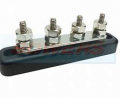
You would also need 100 A bus bars.

1726750337601.png
 

MisterBill2

Joined Jan 23, 2018
27,164
A caution is that the chart is based on voltage drop in a length of wire, it is not based on heating. Certainly the two are related, and voltage drop will lead to performance issues. But heating will lead to system failure eventually, rather than instantly. In a soldered joint, if the current must pass exclusively thru the solder, the heating will be greater because of the higher resistance of the solder. The use of silver-alloy solders tends to reduce that problem some. But the possibility of localized heating requires a more detailed evaluation of the construction details, and connection gaps closed by the solder.
 

Thread Starter

Admsher

Joined Sep 18, 2024
12
Well this looks in a way to make a new design all over which I am not looking forward to, will it help if I just use multiple boards like this to split the current up to the acceptable 20A range?
 

Thread Starter

Admsher

Joined Sep 18, 2024
12
By multiple boards i mean add 4 more boards with only fet drivers as one monitor and gauge is more than enough in my opinion
 

Papabravo

Joined Feb 24, 2006
22,058
By multiple boards i mean add 4 more boards with only fet drivers as one monitor and gauge is more than enough in my opinion
Are you suggesting that you will connect the outputs of 5 boards together to deliver 100 Amperes of current? How will you deal with the problem of current hogging?
 

crutschow

Joined Mar 14, 2008
38,316
How will you deal with the problem of current hogging?
Theoretically, course, that can be minimized with a small resistor in series with each output
For example a resistor to give a 100mV or so drop at full-load, with the output voltages tweaked to balance the currents, should work reasonable well.
The obvious downside is that it degrades the load voltage regulation by the resistor voltage drop.
 

Thread Starter

Admsher

Joined Sep 18, 2024
12
Theoretically, course, that can be minimized with a small resistor in series with each output
For example a resistor to give a 100mV or so drop at full-load, with the output voltages tweaked to balance the currents, should work reasonable well.
The obvious downside is that it degrades the load voltage regulation by the resistor voltage drop.
I was not aware of this issue but I feel it's worth a shot since I could not find any good design which fits my case thanks for all you guys and your input on this
 

crutschow

Joined Mar 14, 2008
38,316
I was not aware of this issue
The problem is that, due to slight output regulation voltage between units, the one with the highest voltage will tend to hog the current until it goes into current limit, which is not good.
Thus some way to help the units share the load in spite of those small regulation voltage differences is needed.
One simple way is the addition of a small resistor in series with each output.
The value of the resistor is determined by the expected maximum voltage variation between outputs, and how close you want to balance the currents.
 

Papabravo

Joined Feb 24, 2006
22,058
The problem is that, due to slight output regulation voltage between units, the one with the highest voltage will tend to hog the current until it goes into current limit, which is not good.
Thus some way to help the units share the load in spite of those small regulation voltage differences is needed.
One simple way is the addition of a small resistor in series with each output.
The value of the resistor is determined by the expected maximum voltage variation between outputs, and how close you want to balance the currents.
I think there may be a good deal of fiddling around to get to where you want to be. Let us know how it works out for you.

ETA: At 20 Amperes output a "small" resistor like say 50 milliohms will dissipate:

\( (20\text{ Amperes})^2\times50\text{ mΩ}\;=\;20\text{ watts} \)

Although the resistor will have a "small" resistance it will need a "large" size to dissipate that much heat. Oh and BTW, such resistors are not necessarily cheap. I would include some safety factor and go for 50 Watt units if I were doing this.
 
Last edited:

MisterBill2

Joined Jan 23, 2018
27,164
It may be that there are other battery management packages at TI. And it may be possible to split things up, depending on what the battery arrangement is. Are you really planning on a single 100 amp battery pack?? If that were five of the 20 amp packs then five BMS assemblies could work. It is the lack of information leading to a lack of suggestions.
 

Thread Starter

Admsher

Joined Sep 18, 2024
12
It may be that there are other battery management packages at TI. And it may be possible to split things up, depending on what the battery arrangement is. Are you really planning on a single 100 amp battery pack?? If that were five of the 20 amp packs then five BMS assemblies could work. It is the lack of information leading to a lack of suggestions.
It's an 11C 33.6 Ah battery and our requirement is around 117 A of continuous current, so yeah we are using one battery pack for now
 

Thread Starter

Admsher

Joined Sep 18, 2024
12
For the 100mV drop I proposed, the resistor would be 5mΩ and the power dissipation 2W.
is it possible to get a reference design for the same, this concept is very new to me and i would like to get as much knowledge as possible from your side
 
Top