That is, you could charge a large battery, like a deep cycle marine battery and use it as a “tank”, charging the on-board batteries multiple times. This could potentially last a very long time.
My only question here... can i hug you. Love it, its simple and beautiful solution for what i need. I could have a large Lifepo4 on either side of the rail.
Btw, I was going to discuss about rfid reader power draw but lets 'tank' that discussion!
I believe that with help from this forum, I have got a pretty solid design. So, it pains me to say I am not at liberty to disclose any further details about the project. I'd love to but i am not allowed to. However, i am very happy with the way everyone in this discussion has helped me. So thrilled and thankful
Thank you. The battery life is my main concern. In terms of the NEMA 17, the torque we have is 0.42n.m. If a small enough stepper motor is used, and it is completely stopped at every interval, will it make a better choice in terms of battery usage and other features combined?
The only advantage I can see in using a stepper is that the Indent feature, even when non-powered would help retain a position, otherwise they are essentially power wasters in the course of operation.
What is the RPM requirement of the motor?
What form does the system controller take? PLC? Smart Relay? Picmicro? Arduino? or ?
I see re-reading the OP, it is a quite a slow motor moving procedure, it would not only be a power saver to use high gearing , but help a DC or BLDC motor hold position when stopped at a limit etc,
Given that the track has no inclines, as stated in post #1, holding while stopped is not required. Aside from that, efficient gearing will allow for motor operation at a most efficient speed, whatever that may be. So the brushless DC motor has won the job.
You guys have spent much time on motors but, I think, missed something. He is wanting this to move over 100meters, `328 feet. Getting and supporting that much rail and making the joints seamless, to my mechanical brain, will be a very big part of the problem, much bigger than the motor.
Aluminum rail, like the 80-20 or similar stuff is both expensive and heavy over that distance. Why not, if the camera is to stop at the same place every time, just use several cameras? Might be cheaper in the long run and less of a mechanical problem.
You guys have spent much time on motors but, I think, missed something. He is wanting this to move over 100meters, `328 feet. Getting and supporting that much rail and making the joints seamless, to my mechanical brain, will be a very big part of the problem, much bigger than the motor.
Aluminum rail, like the 80-20 or similar stuff is both expensive and heavy over that distance. Why not, if the camera is to stop at the same place every time, just use several cameras? Might be cheaper in the long run and less of a mechanical problem.
The camer may not be $17 cheap camera For a really good camera, which is not what I would have based on my photography talents, one can spend $1200 to $1500. Aside from that, it is not what the customer asked for.
I am sure that there is a lot more to this project than we are told, although unlike many, the TS has given us an adequate amount of detail. And it may be that some portion of this system already is in place. I know that a few years back there was a similar request with much less detail that got a lot of random answers.
Also, there are other sources of materials than the local parts jobber, and they have better products and better pricing.
It would also be helpful to know the type of controller involved, as previously mentioned. ?
If high reduction gear ratio is used then BLDC 'cogging' at low RPM, may not be an issue,
Also What I have used in the past for a long operating table is a rack & pinion, there are relatively cheap but apparently well made versions out there.
I think the sensors at the stopping position (Micro switche, optical sensors etc.) are the best solution The sensors would interrupt the power to the motor which would cause the carriage to stop. The motor would be pulsed on for a short time to move it past the sensor. It would then continue to run until it reached the next sensor. Also it might be better just to have one sensor on the carriage the things that triggered the sensors at the stopping positions on the track.
And what does that have to do with supporting even that rail over 100 meters? In the green house shown it would be simple, but this sound like it's outside, since the solar cell battery recharge was mentioned.
We're going to need slow movement. Probably around 20/30rpm is also fine. We've two options to run it. 1) camera MCU is powerful enough to handle the motor and its main job as a DSP. It can take motor to its position, stop it and then access data from sensor. So, we get the same MCU to do both the jobs. 2) if the same MCU proves to be inefficient for both jobs, we will add arduino nano in the mix.
You guys have spent much time on motors but, I think, missed something. He is wanting this to move over 100meters, `328 feet. Getting and supporting that much rail and making the joints seamless, to my mechanical brain, will be a very big part of the problem, much bigger than the motor.
Aluminum rail, like the 80-20 or similar stuff is both expensive and heavy over that distance. Why not, if the camera is to stop at the same place every time, just use several cameras? Might be cheaper in the long run and less of a mechanical problem.
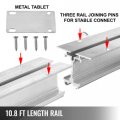
The rail we are going to use comes in size of 1200 each and multiple ones can be attached together. When put together they are steady enough. Yes, for it to work effectively, each rail will need to have mounting support. The following products, which run on a similar design, are being used to carry much heavier load with multiple aluminium rails joined together. If roof mounting is uneven, it can also be mounted to the side poles - if available. The cost comes to around $15pm installed. Its a one off cost. The amount is a close to accurate guesstimate, not a real number.
Having multiple cameras is surely a simpler solution. However, for our use case, it will result in multiple streams, multiple batteries, multiple edge devices etc. We did look into it and seems to end up being more complicated. Also, we don't have an option to get someone to change 20 batteries every couple of days.
You're right, its not a very cheap camera. At the same time, its not a very expensive camera either. However, its mostly the logistics of changing multiple batteries etc is not going to work with multiple cameras.

 Facebook
 Google
 GitHub
 Linkedin