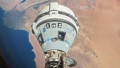
And Liftoff ! The Starliner, Atlas 5, carrying two American heroes….
With Boeing’s recent track record, these two guys are definitely “heroes” to allow themselves to be launched in such a contraption. /Sarcastic mode turned off.
The spacecraft was proceeding to its planned rendezvous despite an earlier loss of some of its guidance thrusters due to a helium propulsion leak, which NASA and Boeing said should not compromise the mission.
The CST-100 Starliner, with veteran astronauts Barry "Butch" Wilmore and Sunita "Suni" Williams aboard, was due to arrive at the orbiting platform after a flight of roughly 25 hours following its launch from Cape Canaveral Space Force Station in Florida.
Thanks to the Boeing Starliner, astronauts can soon pee in peace. When the new human-rated spacecraft successfully ferried NASA astronauts Butch Wilmore and Suni Williams to the International Space Station (ISS) on Wednesday, it added a last-second high-prized payload along with it: A brand new pump for the urine processor.
...
“The station is designed to be closed loop system,” Dana Weigel, NASA’s ISS Program Manager, told reporters last week before launch. Meaning, every little bit of water you can recycle needs to be recycled. So when the pump failed early, it “put us in a position where we had to store an awful lot of urine ... Obviously adding two crew members to that further constrains the storage capabilities.”
WASHINGTON — NASA and Boeing have pushed back the return of the CST-100 Starliner spacecraft from the International Space Station until at least early July to continue studies of propulsion system problems.
Unlike three previous delays, NASA did not disclose a new departure date for Starliner. Instead, NASA stated only that it is “evaluating future return opportunities” for the spacecraft after a scheduled spacewalk July 2, the second of a pair of spacewalks planned at the ISS.
The NASA statement did not disclose long Starliner could stay at the station, only that the crew “is not pressed for time to leave the station since there are plenty of supplies in orbit” and there are no other missions scheduled to go to the station through mid-August. Stich said at a briefing just after Starliner’s June 6 docking that the spacecraft could remain at the station for 45 days.
Would you, as the Starliner commander, risk crews lives on that very expensive IMO bucket of bolts? Load it up with stuff (trash or junk) and send it back without a crew until these issue are nailed down and fixed for real.
Still, Steve Stich, NASA’s Commercial Crew Program manager, said Friday that the space agency is considering extending the maximum length of Starliner’s mission from 45 days to 90 days. And there is no firm return date on the horizon.
Part of that desired extension is driven by ground tests that Boeing and NASA plan to carry out in New Mexico, seeking to better understand why some of the Starliner’s thrusters unexpectedly failed during the first leg of its journey. (Four of the five failed thrusters on Starliner have since been restored; however one thruster is not expected to work for the remainder of the mission.)
Not stranded my butt ... I am almost completely convinced now that they're stuck in the Space Station, and Boeing is desperate to find a way of bringing them home without losing face.
The US space agency is set to face a flurry of questions about recent reporting from media outlets suggesting the space agency is considering returning Wilmore and Williams on a SpaceX vehicle instead.
“Because what we do is complex, I firmly believe that we need to get closer to the production lines and development programs across the company,” Ortberg said in the letter. “I plan to be based in Seattle so that I can be close to the commercial airplane programs.”
"Boeing Starliner astronauts, stranded at the International Space Station after a weeklong test flight turned into a two-month stay due to thruster problems, may be forced to fly home on SpaceX in 2025, NASA has admitted."
In Greek mythology, Calypso (/kəˈlɪpsoʊ/; Ancient Greek: Καλυψώ, romanized: Kalupsō, lit. 'she who conceals')[1] was a nymph who lived on the island of Ogygia, where, according to Homer's Odyssey, she detained Odysseus for seven years against his will. She promised Odysseus immortality if he would stay with her, but Odysseus preferred to return home. Eventually, after the intervention of the other gods, Calypso was forced to let Odysseus go.
But according to the report, Boeing’s quality control systems fall short of NASA’s requirements, and some known deficiencies have gone unaddressed. What's more, the workers on the project are not, as a whole, sufficiently experienced or well trained, according to the inspector general.

 Facebook
 Google
 GitHub
 Linkedin