Standard Transformer Used As Auto Transformer Without Primary Neutral?

Status
Not open for further replies.

Thread Starter

Angstrom

Joined Aug 29, 2025
17
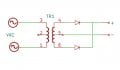
I'm considering the use of a standard transformer converted to an auto transformer, by connecting the primary and secondary windings as shown in the sketch below.

The transformer is also connected to a bridge rectifier.

The transformer isn't connected to a VAC neutral line as one isn't easily available. I'm not completely certain what affect that may have on the down stream circuitry. Maybe the ground potential will rise or fall (float)? I'd be interested to hear everyone's thoughts on how this will or will not work.

Transformer.png
 

Thread Starter

Angstrom

Joined Aug 29, 2025
17
Electricity must have a return path. Somehow this must connect to Neutral.
This is the same as connecting to only one end of a battery.
The intention is to use the AC hot as the return path. I'm trying to use the AC- pulse as return.

I have read via the internet (so maybe incorrect) that the primary side of utility distribution transformers are sometimes configured with a single hot connection to the primary, no neutral, and only a case ground on the transformer. If that works, I'd like to emulate it here.
 

be80be

Joined Jul 5, 2008
2,394
It works only if you use a ground for your return so 3 would go to a ground rod not 6 as you show

Utility distribution transformer using 1 hot uses the ground as return if you take the hot wire and read with a meter from hot to ground you get voltage from hot to nothing you get nothing
thats why you don't get shocked if your not grounded
 
Last edited:

Thread Starter

Angstrom

Joined Aug 29, 2025
17
It works only if you use a ground for your return so 3 would go to a ground rod not 6 as you show

Utility distribution transformer using 1 hot uses the ground as return if you take the hot wire and read with a meter from hot to ground you get voltage from hot to nothing you get nothing
thats why you don't get shocked if your not grounded
That makes some sense, but I still don't think I completely understand this.

If a hot wire was not connected to neutral or ground wouldn't the AC waveform within it continue to switch back and forth?

And if the waveform switches back and forth does this represent usable power?

I hope these don't seem like silly questions. I'm trying to wrap my brain around this.
 

boostbuck

Joined Oct 5, 2017
1,032
Power is voltage x current. The voltage switches back and forth but current cannot flow without a path, so power is v times zero = zero.
 

BobTPH

Joined Jun 5, 2013
11,463
What are you trying to accomplish?

Are you trying to boost the AC input to a higher voltage? Or lower it? Either can be accomplished with a standard transformer connected as an auto transformer.
 

Thread Starter

Angstrom

Joined Aug 29, 2025
17
Hmmm sorry about the boldness of that post!
Sometimes bolder is better! I might even need a neon sign from time to time.

I conceptually thought of the alternating frequency as the energy responsible for energizing a transformer. Since DC doesn't energize a transformer, I was thinking of the frequency as a sort of push-pull current operating at all times on an energized line. This is a good example of it's better to ask a stupid question than it is to not ask and stay stupid.
 

drjohsmith

Joined Dec 13, 2021
1,548
The intention is to use the AC hot as the return path. I'm trying to use the AC- pulse as return.

I have read via the internet (so maybe incorrect) that the primary side of utility distribution transformers are sometimes configured with a single hot connection to the primary, no neutral, and only a case ground on the transformer. If that works, I'd like to emulate it here.
you might be reading about three phase electricity,
which in delta wiring for transmission, is without a neutral,
and is converted to star wirting locally, using the local ground as the neutral..

this is neither of those
 

KeithWalker

Joined Jul 10, 2017
3,603
Sometimes bolder is better! I might even need a neon sign from time to time.

I conceptually thought of the alternating frequency as the energy responsible for energizing a transformer. Since DC doesn't energize a transformer, I was thinking of the frequency as a sort of push-pull current operating at all times on an energized line. This is a good example of it's better to ask a stupid question than it is to not ask and stay stupid.
Here is another way of thinking about it: You mention that the transformer is connected to VAC. How would you measure that AC voltage? If you just connect it to one terminal of an AC voltmeter, it would not show a voltage. The source needs a reference, which is neutral (ground). If you connect the meter between VAC and ground, you will measure the voltage referenced to ground.
Therefore, if you only connect your transformer to VAC, with no reference, no current will be able to flow. If you connect the transformer between VAC and ground, you will have a voltage across the winding and current can flow through it.
 

be80be

Joined Jul 5, 2008
2,394
You can see them one was to the hot side of 100 foot extension cord and the second one was to the screwdriver. There is about 18 inches long metal part of it.
 
Status
Not open for further replies.
Top