How far from industry standard is this schematic layout?

Thread Starter

TommyTwoThousand

Joined May 6, 2026
5
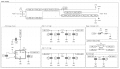
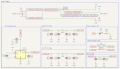
I'm learning a lot about circuit design and recently dove into power supplies. I found it difficult to follow after adding more elements to the design so I decided to redraw it like this:
power supply.png

Power connector on the left and power rails on the right with all the functional blocks needed to create them in between. I found it really easy to follow the path from input connector to power rails doing it this way. I also am new to everything I've sketched here so while I'm pretty sure I have the right blocks in place I am still not sure about the details.

This also lets me completely change any of the details in the block independently. Any of these blocks could get 10 times more complex without having to rip up or rearrange the others. Also some are probably overkill like the LED and choke but I wanted to do everything the same way.

This seems like its not even close to industry standard but it seems really useful to me as well. Is this similar to any other methods of drawing a complex circuit that I'm just unaware of? How else could I break down a complex circuit into functional blocks thats visually easy to follow?

Also any input on this design would be appreciated. It's for an analog video multiplexor PCB that I am designing. The mux chips require + and - 5V and there is a buffer on the output as well so I made the filtered power rails (+5VA and -5VA). The unfiltered +5V powers a GPIO expander and the choke seems to be recommended for filtering noise on analog video circuits. It might all be overkill but its helping me learn and I have tons of real estate on my board.
 

dl324

Joined Mar 30, 2015
18,244
I found it difficult to follow after adding more elements to the design so I decided to redraw it like this:
I find the connect-by-name approach to be very unappealing, particularly for understanding functionality. You might as well be reading the actual netlist (consisting of only component names, net numbers, and connectivity information). I also find colored schematics to be childish; as in a child gone wild with their colored crayons.

The direction of your connection arrows is non-standard (outputs should point out, inputs should point in). You have most of the components in the preferred vertical direction, yet you have C52, D1, and R39 on their sides (needlessly). Where are the other 38 resistors and capacitors to fill the numbering gaps?

I hope your style never ever becomes anything like a standard. I've seen some schematics for commercial parts that were almost as bad as yours.

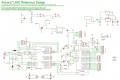
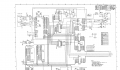
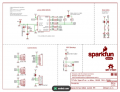
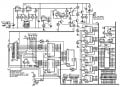
Here's a schematic for Arduino Uno. Lousy flow and in color:
1778337097272.png
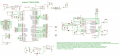
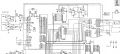
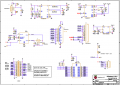
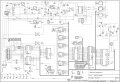
And Mega:
1778337174729.png
I imagine they're all similarly bad.

I saw another schematic that used the boxes/connect-by-name that you're using, also in color, but I don't recall what it was for.

Netlist fragment:
Code:
Version 4
SHEET 1 1460 840
WIRE 176 -112 32 -112
WIRE 336 -112 176 -112
WIRE 496 -112 336 -112
WIRE 640 -112 496 -112
WIRE 752 -112 640 -112
. . .
SYMBOL nmos 224 128 M0
WINDOW 3 58 54 Left 2
SYMATTR Value IRLZ44
SYMATTR InstName M1
SYMBOL nmos 288 128 R0
WINDOW 3 56 55 Left 2
SYMATTR Value IRLZ44
SYMATTR InstName M2
SYMBOL res 160 -96 R0
WINDOW 0 38 51 Left 2
SYMATTR InstName R1
SYMATTR Value 2k
SYMBOL res 320 -96 R0
WINDOW 0 40 53 Left 2
SYMATTR InstName R2
SYMATTR Value 2k
SYMBOL voltage 32 32 M0
WINDOW 123 0 0 Left 2
WINDOW 39 0 0 Left 2
SYMATTR InstName V1
SYMATTR Value 9
. . .
SYMATTR InstName R9
SYMATTR Value 10k
SYMBOL res 208 576 R0
WINDOW 0 38 53 Left 2
SYMATTR InstName R10
SYMATTR Value 100
SYMBOL npn 448 544 M0
WINDOW 0 29 38 Left 2
WINDOW 3 26 57 Left 2
SYMATTR InstName Q5
SYMATTR Value 2N3904
SYMBOL npn 480 464 R0
. . .
Also any input on this design would be appreciated.
The schematic is too messy for me to even bother trying to analyze.
 

Thread Starter

TommyTwoThousand

Joined May 6, 2026
5
The schematic is too messy for me to even bother trying to analyze.
So is the standard to just connect everything together in one big view? Are there any examples you can point me to for what's considered good practice?

Ultimately electronics is just a hobby for me but I'm a mechanical engineer as my profession so I do value good drawing style, even if it'll only ever be me reading it.
 
I don't think there is an "industry standard" but node naming is pretty common, especially where sub circuits are on a different page.

Personally, I find your example pretty easy to read.
 

dl324

Joined Mar 30, 2015
18,244
So is the standard to just connect everything together in one big view?
Yes. There's also using intelligent component placement to facilitate a proper flow (left-to-right and top-to-bottom).
Are there any examples you can point me to for what's considered good practice?
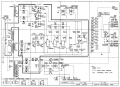
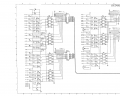
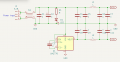
Here's a fairly decent example for a Leader LTC905 curve tracer:
1778338879810.png
I don't like how they drew the bridge rectifiers. And how they drew the switch wiring. Technically, wires shouldn't be drawn over symbols. But it's still easy to see what the connections are, so I'm okay with that variance (because the "correct" alternative would have been more difficult to follow). And I don't like how they drew the flip flop consisting of Q101 and Q102 (plus the identifiers are too far away from the transistors). Flip flops should be drawn with the transistors placed back-to-back; a non-standard flow used specifically for this case for easier recognition of functionality. And the lines for the grid designators (A-C, 1-4) are distracting.

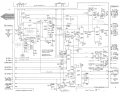
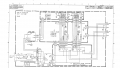
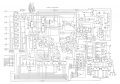
Here's a better example from a Tektronix 7704 scope with off-board connections:
1778339209019.png
About the only things I dislike are the ground symbols that don't point down and the staggered connections (vs crossing) like near Q2576. But the staggered connections were an accepted style. I think it was to address poor copying technology in the 1970's where connection dots could "disappear". I just analyze the circuitry in the vicinity and determine whether a connection dot was missing. The components placed in the non-preferred direction just make sense.
 
Last edited:

MrChips

Joined Oct 2, 2009
34,680
There are the two styles, fragment every function vs all connected into one schematic. I suggest that you seek a balance. Your objective is to show the overall flow of functions and signals while making it easy to follow. A lot depends on the overall complexity of the design. If the circuit can fit on one printed page, that would be my choice.

The same applies to software design and documentation. No function or subroutine should be larger than a printed page.
 

nsaspook

Joined Aug 27, 2009
16,265
...
The same applies to software design and documentation. No function or subroutine should be larger than a printed page.
Agree, if we are using a small print font.
1778342290448.png
The complexity of how to do one thing IMO should be the main determinant of function or subroutine source code size, not the number of characters on a page.
They can intersect but It's a guide, not a law.
 
Top