Hello everyone I would like to know if European AND US HD tv Standards compatible? Secondly how do tv networks do to transmit both images at the same time or through splitscreen? Thank for sharing your knowledge.
regarding practicality, TV sets tend to be multi standard ,
in analog days , it mattered, but now they are "just" computeres with software defined radios / receiveres.
The over-the-air standards are different.
But for transmission over TV network links the protocols are likely compatible or can easily be converted from one to the other by software.
For example, in the US, my TV can be set to view the same signal in 720 or 1080 resolution.
Yep. .
Every country tries to re live the 60s , so you can't receive other countries TV..
... .same went for dvds and area codes.
But
TV manufacturers make millions , it's cheaper for them to make front ends that can receive many / all areas TV .
Same as they use universal PSU.
So yes ,
But in reality , unlikely to be a different TV ..
.heck .
My TV also has internet TV , cable TV and teresrital TV capabilities ..
Because the schemes are different, the video you buy in another country will not play on the TV here. and the reverse is also true.
I will avoid commenting on the reasoning for this arrangement.
by "video you buy " , do you mean dvd etc ?
if so, many eu dvd playeres can play usa purchased dvds
our tvs and playere are very multi standard.
are u in tbe USA ?
When I came to Canada I got a job for a while managing a TV repair shop, one of the popular TV's that competed with Sony was the Dutch Co Philips, repiring these,
separated the men from the boys.
When I came to Canada I got a job for a while managing a TV repair shop, one of the popular TV's that competed with Sony was the Dutch Co Philips, repiring these,
separated the men from the boys.
I remember, when I was in college, encountering one of the "old boy TV repair guys" in my small home town in Wisconsin, and he wasn't the sharpest knife in the drawer.
We had a small B&W TV that developed a distorted picture after a few minutes of operation, so we took it to him.
After having it for a couple weeks, he said he couldn't find the problem, so I then opened it up and started measuring voltages with my new Eico VTVM I had just built from a kit.
Soon found that the B+ tube voltage was sagging after a few minutes, and traced it to a failing selenium rectifier that rectified the line voltage.
When I then told him what I had found he said "Oh yah, they often fail that way".
I remember, when I was in college, encountering one of the "old boy TV repair guys" in my small home town in Wisconsin, and he wasn't the sharpest knife in the drawer.
It's unclear what you mean by "both images" -- do you mean how to they transmit multiple channels and your TV selects one to display? Or do you mean how does your TV do split-screen so that you can, for instance, see one channel as the main image but then see another channel in a small box within the image? The former is done essentially the same way that you can have multiple AM or FM radio broadcasters in an area and each radio tunes to the station it want's to receive. Each signal is in its own portion of the spectrum and the filter circuits selectively pass the desired signal and rejects the others. The latter is primarily a function of the TV. It is just a computer that is displaying an image that it creates. It's analogous to having an e-mail app and a Word document open and visible on your screen at the same time, or watching two YouTube videos at the same time on your computer. They are just application windows. Back in the analog days, doing something comparable was quite an effort and only a few high-end television sets could do it. If you were watching any kind of split-screen image, it was being done at the broadcaster's end by assembling the final image on their equipment and then broadcasting the result as their single image.
I also remember tv sets that only had the VHF channels.
Later when the UHF channels came in use, you needed a separate converter to be able to receive them.
Now I am looking tv over the internet, using a google tv.
I also remember tv sets that only had the VHF channels.
Later when the UHF channels came in use, you needed a separate converter to be able to receive them.
Now I am looking tv over the internet, using a google tv.
And the real question is... do any/all of these changes actually represent progress?
When I was growing up, we could receive exactly five stations -- NBC, CBS, ABC (via their local affiliates), plus a local independent and PBS. We only had this many because we were in a major market (the Denver metro area). When I moved to Colorado Springs in the mid-90s, I could only receive three (the NBC affiliate, PBS, and a local independent). Yet, it was very infrequent that there wasn't something (seemingly) worth watching, though not necessarily at any given moment. You planned your "screen time" (no such phrase back then), because if you missed an episode of a show you liked, you'd have to wait and hope that you caught it during the summer hiatus when they broadcast reruns, but this also made it so that you would occasionally catch an episode of a show that you had never seen, even though you'd been watching it for years. Of course, this also meant that shows were almost always episodic, not serial, in nature, because the show writers couldn't assume that the audience was going to be able to follow story arcs and each show needed to be self-contained as far as its plot was concerned.
The limited number of shows and miss-it-its-gone factor forced you to be selective in which shows you watched regularly and also made you actually schedule your life more carefully. The week's TV listings came in a small-format magazine with the Sunday paper and you would scour the movie listings to see if there was anything you wanted to see and, if so, whether you could plan it into your schedule (sometimes yes, sometimes no). If not, too bad. You learned to live with not always getting what you want. Most families only had one TV in the house, so everyone had to watch the same thing at any given time. This forced you to communicate and compromise (okay, I'll forego seeing the movie on Tuesday if you'll agree to let me watch this special on Friday). It also forced you to actually spend time together, though whether that time was "quality time" is debatable.
The "news" generally came on at 5pm and 10pm (the local stations) with the national broadcasters generally having a show at 6pm (the times were regional because the national programs were broadcast nationally, so the local news keyed around them). That WAS quality time for us, because we would watch the news every day and actually talk about it and discuss it. Plus, with such a limited air-time budget, news organizations were a lot pickier about what stories they covered and spend the time and effort to create short, informative, impactful segments. Whether or not they were any more accurate or less biased back then is certainly questionable, though. But only being exposed to "news" an hour or two a day allowed you to keep in better in perspective and focus most of your time and energy on living your life in the real world around you.
I think one of the best unintended consequences was that it imposed a national common experience. The overall number of shows was sufficiently limited that you were almost guaranteed to be able to find some show you had in common with just about anyone else, which came in handy in awkward social situations, like Christmas get-togethers, because you could always ask, "So, what TV shows are your favorite?" and quickly find one that you could talk about. I don't know that the quality of programs was much better then versus now -- there was certainly no shortage of crappy shows back then. I think that the best quality shows were probably comparable between then and now, barring obviously greater production capabilities, such as CGI, available now versus then. But I think that a significantly higher fraction of programs approached the higher-end of the quality spectrum. Today, we are absolutely inundated with crappy shows because it is so much easier to find some platform that is willing to host it, so finding the quality programs, even if the absolute number of them is probably higher, is a bigger challenge.
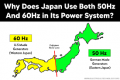
The US base at Yokohama (in the 50Hz zone) has its own 60Hz generation station just for the base.
Standards are great, that's why we have so many of them for doing the same thing.

 Facebook
 Google
 GitHub
 Linkedin