Facebook
 Google
 GitHub
 Linkedin
Hey guys. im just here for advice.
Im noooo good with tesla coils as ive tried many kinds but they never work for me so i guess im missing something. all i know is it a bad transformer working on resonance on primary in line with capacitance...
I'm trying to make a spark gap tesla. i built up the circuit to get a comfortable 3kV at the gap at an audable and visible frequency, seeing visible freq cuts off at around 28Hz im guessing im right on the edge as i can juuuuuuust barely sSEE is flicker seems like continious spark almost, ar a 1mm gap. so lets say the primary is 1mm(adjustable gap)28Hz 3KV 4.8uH(tested).
But my secondary is weeeeaaaakkkk.... sparks has increased though to about 9mm(27kv) but weak a.f..... its nothing compared to what ive seen or even bought....
1)why are my secondaries so low....
2)is it because my primary resonance between inductor and cap of f=1/2pi.sqr(LC)=487554Hz does not match my seconday resonance? how do i even calculate that?
im NOT look for huge sparks im looking for normal working so i can get proper 1cm long corona discharge before a spark.... my transformer should be able to suppy enough as it can output about 5kv but somewhere in my multiplyer it gets weaker...
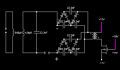
where am i wrong. please advise
Im noooo good with tesla coils as ive tried many kinds but they never work for me so i guess im missing something. all i know is it a bad transformer working on resonance on primary in line with capacitance...
I'm trying to make a spark gap tesla. i built up the circuit to get a comfortable 3kV at the gap at an audable and visible frequency, seeing visible freq cuts off at around 28Hz im guessing im right on the edge as i can juuuuuuust barely sSEE is flicker seems like continious spark almost, ar a 1mm gap. so lets say the primary is 1mm(adjustable gap)28Hz 3KV 4.8uH(tested).
But my secondary is weeeeaaaakkkk.... sparks has increased though to about 9mm(27kv) but weak a.f..... its nothing compared to what ive seen or even bought....
1)why are my secondaries so low....
2)is it because my primary resonance between inductor and cap of f=1/2pi.sqr(LC)=487554Hz does not match my seconday resonance? how do i even calculate that?
im NOT look for huge sparks im looking for normal working so i can get proper 1cm long corona discharge before a spark.... my transformer should be able to suppy enough as it can output about 5kv but somewhere in my multiplyer it gets weaker...
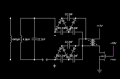
where am i wrong. please advise
Attachments
-
 23.9 KB Views: 0
Last edited: