Some basic queries about an RLC circuit

Thread Starter

William Johnson

Joined May 25, 2024
34
There's a project I'm working on, and I have some doubts regarding it.
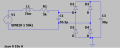
1724882197294.png
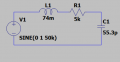
Given is a series RLC circuit, and output is to be observed across C1. When diode bridge rectifier is not connected across C1, the output is 1.66V sinusoidal, as expected. But, as soon as the DBR is connected, after that V_C1 takes almost 4s to settle to its final value (1.6V sinusoidal). Why is it taking so long? I know there are other rectifying circuits that might help, so any suggestions are welcome.
 

Attachments

DickCappels

Joined Aug 21, 2008
10,661
30 uF x 5k = 150 ms time constant. Having to wait for several time constants to pass is almost certainly what is taking the reading so long to settle.
 

Papabravo

Joined Feb 24, 2006
22,064
The generic diode may not be behaving the way you might expect. Try using a diode with an actual det of parameters. It will take many cycles of 50 kHz. to charge up that capacitor. I'm curious – what did you expect?
 

DickCappels

Joined Aug 21, 2008
10,661
The generic diode may not be behaving the way you might expect. Try using a diode with an actual det of parameters. It will take many cycles of 50 kHz. to charge up that capacitor. I'm curious – what did you expect?
I am having trouble getting a picture of what you mean by "...an actual set of parameters."
 

Papabravo

Joined Feb 24, 2006
22,064
I am having trouble getting a picture of what you mean by "...an actual set of parameters."
Go to the LTspice Help page for diodes and look at the list of default parameters. If you run a set of characteristic curves for the default diode they might surprise you. IMHO you are much better off using an actual device rather than the default model.

Framed in a slightly different fashion, put the diode model parameters side by side in a spreadsheet and look at all the default zeros.
 

MisterBill2

Joined Jan 23, 2018
27,271
Most diodes do not switch on instantly. although it looks like that when using a voltmeter. Nor do they turn off instantly. All of those parameters enter into a rigorous analysis, which is why usually we ignore them. Time delays and their effects add up. D.C. mentioned that but did not elaborate.
And aside from all of that, why does it matter, the voltage at the bridge input???
 

Thread Starter

William Johnson

Joined May 25, 2024
34
OK, and thanks for the good news. Now I am wondering what the problem was and what the solution was. We can all learn a bit from that.
The problem, among many others, was that the output voltage was not settling for as long as 30s. It just kept growing.
And that was because of no load resistor. I missed that part.
 
Top