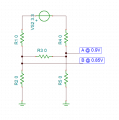
So you have a voltage minus something that is very clearly anything but a voltage.So far I have
VA- (1/(1/r1)+(1/r2)) * (1/(1/r3)+(1/r4)+(1/r5))=0
Again, you have the first term is a voltage while nothing after that has a voltage anywhere. Does that make ANY sense at all? Is there ANY way that it could POSSIBLY be correct?Va - ( (1/(1/r1)) + (1/(1/r2)) ) * ( (1/(1/r3)) + (1/(1/r4)) + (1/(1/r5)) ) = 0
Uh... Vs2 is a fixed 3.3 V.Vs2 would be 0.9 V for A and 0.85 V for B
What are these new currents I1 through I5?Va - ( r1(I1) + r2(I2) ) * ( r3(I3) + r4(I4) + r5(I5) ) = Vs2
???????Where Va= 3.3 Volts
and Vs2= 0.9 Volts
Hello there,
Hello there,Another point is that I don't think it is possible to calculate values R10 aand R40 as they are effectivly in series. It may be possible to calculate the sum of these two resistor values.
Les.
| Thread starter | Similar threads | Forum | Replies | Date |
|---|---|---|---|---|
| L | Electronics circuit solving apps | General Electronics Chat | 1 | |
| V | Solving the LC and Diode Circuit | Homework Help | 8 | |
| T | Having trouble solving this after calculating gm | Homework Help | 3 | |
| H | 18650->12V battery for UPS: solving the repetitive disconnect | Power Electronics | 8 | |
| L | Solving simple RLC curcit | Homework Help | 15 |