Solving the LC and Diode Circuit

Thread Starter

Vihaan@123

Joined Oct 7, 2025
220
1763730396692.png
I was able to solve the equation using the Laplace transform
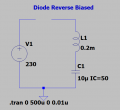
the circuit as below
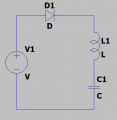
1763730550018.png
1763730568993.png
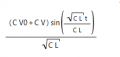
The current is
1763730615651.png
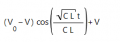
The capacitor voltage is
1763730710004.png
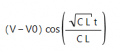
The inductor voltage is
1763730730532.png
Few things which are bothering
a. Should i consider diode as fully conducting and solve it or make diode part of the KVL equation and solve it?
b. I solved the circuit but intuitively i am not understanding the circuit, the sine and cos waveforms.
 

Thread Starter

Vihaan@123

Joined Oct 7, 2025
220
One question is if the diode is reverse biased at certain point in time t, can i apply KVL equation? Can i consider it as a loop?
1763785468819.png
 

WBahn

Joined Mar 31, 2012
32,703
You can picture the waveform as being a succession of instances of ping-ponging back and forth between two circuits -- on in which the diode is reverse biased and one in which it is forward biased. As long as the diode model is linear within each situation, you can use Laplace within that region. This is easy if the diode uses a piecewise-linear model, such as having no current when the forward voltage is below the knee voltage and a constant voltage when it is above the knee voltage. Then, you treat each segment as a separate response, but what you are looking for is to start with the initial conditions for the inductor and capacitor and then determining what they are at the end of that segment, which is determined by when the diode changes regions. Whatever they are at the end is then carried forward to the next segment.

But the presence of an inductor can complicate this, because of the inductive kick if you try to assume an instantaneous transition between regions.
 

MrAl

Joined Jun 17, 2014
13,667
View attachment 359202
I was able to solve the equation using the Laplace transform
the circuit as below
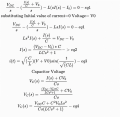
View attachment 359203
View attachment 359204
The current is
View attachment 359205
The capacitor voltage is
View attachment 359206
The inductor voltage is
View attachment 359207
Few things which are bothering
a. Should i consider diode as fully conducting and solve it or make diode part of the KVL equation and solve it?
b. I solved the circuit but intuitively i am not understanding the circuit, the sine and cos waveforms.
Hi,

Welcome to the strange world of rectifier circuits. These circuits always look so easy because of only a few components, but they can get pretty hairy because we have to solve for two different things: the waveforms up to a certain point and when the diode turns on or off, or if it even ever turns on or ever turns off, or if it turns on and off multiple times.

It looks like you are on the right track. To make it easier to understand, make V0=0 (the cap voltage is zero to start).
Also, you might find out the diode may be ON to start with, and then analyze the waveforms. Find out when the diode turns off, this will be BOTH a voltage and a time 't'. See if you can go from there.
To be more concise however, you want to first figure out if the first topology is with the diode on or off. Then go from there solving for any time the diode might turn on or off. One topology is with the diode ON, and the other is with the diode OFF, but you have to solve for both of these and there is a chance that it only goes ON or only goes OFF, or switches from ON to OFF or from OFF to ON. You have to solve for those conditions to see when or even if that happens. In some circuits the diode will turn on and off repeatedly for each cycle (like with an AC input voltage) and we would have to solve for all of those times until it reaches steady state.
This is what separates rectifier circuits from the simpler circuits were we only have to solve for a voltage or current over time.

On thing you might also consider is that if the voltage across the diode (super ideal diode) is 0v, then you can figure it as being either on or off, whichever is more convenient. Note however that this can change in an instant where the diode will be either ON or OFF but not both. What you solve for is when the voltage is zero as that is the turning point. At that time, the topology changes. You then proceed with the analysis using perhaps a different set of equations and setting the new initial conditions to the final conditions just before the topology changes.

If you are familiar with ODE's you can double check your results that way.

I'd be interested to see what you can come up with for the solution.
 
Last edited:

MrAl

Joined Jun 17, 2014
13,667
Laplace transforms work for linear systems. The presence of the diode makes it a nonlinear system.
Laplace transforms can work for general non-linear systems but there's a lot of work involved. I usually don't mind a bit of math work, but it's so involved I stopped doing that many years ago.
However, Laplace transforms can work pretty well for this kind of circuit because it's a switching circuit. That means that although the circuit changes, it changes in a very particular way unlike a general non-linear circuit which can change almost any way. The way switching circuits usually change is only the topology changes, and each separate topology is linear. This makes it very amenable to Laplace Transform techniques.

For this circuit if the diode did turn on and off at some point(s) in time (and I am not saying it actually does here) it would mean the circuit would go from a series LC circuit powered by a DC voltage source, to an open LC circuit with initial conditions, and the initial conditions would come from the final conditions of the previous topology.
Note again I am not saying that the diode turns off or even turns on yet, that's up to the way the analysis progresses starting at t=0. The student will have to solve that and that usually starts with the analysis of the first topology.
 

Thread Starter

Vihaan@123

Joined Oct 7, 2025
220
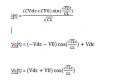
Instead of considering -V0 i have considered V0, i corrected that and the final output equations are as below
1764148553477.png
After some help from the book
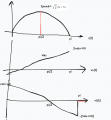
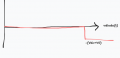
The graphs are as below
1764148587941.png
1764148605490.png
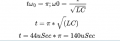
Diode conduction time :
1764149205103.png
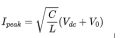
diode peak current = 1764149283218.png
Steady state voltage across capacitor = 2Vdc+V0 = 2* 230 + 50 = 510V
Steady state voltage across diode = -(Vdc+V0) = -230-50 = -280V
All the answers match except the diode conduction time the answer is 44uS instead of 140uS, i assume the textbook has wrong answer.
 

Thread Starter

Vihaan@123

Joined Oct 7, 2025
220
But one question i have is
a. Initially to make the current in the circuit to be 0 the inductor has developed a voltage of +V0 but at the end of the cycle, what was the reason why inductor voltage went to 0 and the remaining voltage dropped across the diode?
 

MrAl

Joined Jun 17, 2014
13,667
Instead of considering -V0 i have considered V0, i corrected that and the final output equations are as below
View attachment 359496
After some help from the book
The graphs are as below
View attachment 359497
View attachment 359498
Diode conduction time :
View attachment 359499
diode peak current = View attachment 359500
Steady state voltage across capacitor = 2Vdc+V0 = 2* 230 + 50 = 510V
Steady state voltage across diode = -(Vdc+V0) = -230-50 = -280V
All the answers match except the diode conduction time the answer is 44uS instead of 140uS, i assume the textbook has wrong answer.
Did you change from starting with the initial cap voltage negative to the cap voltage being positive at t=0?
I'd like to be sure so I can check your results.

It would be nice if you could plot your waveforms a little neater. The cap voltage does not ramp up like a linear ramp.

You might note the time that the inductor current flows. It cannot flow without going through the diode. It is interesting how the inductor voltage flips in order to keep the current flowing.
Thus, your estimate of 140us looks correct. I did not check your other results yet.
 
Top