[Solved]Low side buck converter issue

Thread Starter

entemomoh

Joined Jul 14, 2016
24
Hi all,

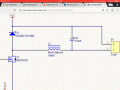
I have built the attached circuit and triple checked my connections. The problem is that when only the slightest amount of PWM is applied, the capacitor(s) charge all the way up to Vcc and stay like that until I give 0% duty cycle. The weird thing is, when I connect my test load(LED) directly from the drain to Vcc the light dimms as expected and the voltage is on the full range. But even if I just connect a Capactor across that LED it has the same zero or hero problem and jumps to Vcc.

Thanks in advance ;)

EDIT: I have also put in a pull down resistor on Gate and Source
Lowsidebuckconverter.gif
 
Last edited:

Thread Starter

entemomoh

Joined Jul 14, 2016
24
I know that from previous experiments, so I tried an LED with 1,2k resistor, a 68 ohm load and a 30 12V light bulb, all the same result.
 

crutschow

Joined Mar 14, 2008
38,503
Okay, I didn't look at it closely. :oops:
But you only gave part of the circuit and information, and I'm not clairvoyant. :rolleyes:.
Where is the MOSFET source connected?
What's the PWM frequency and duty-cycle?
What's driving the gate of the MOSFET and what's the signal amplitude?

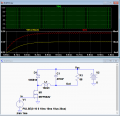
Here's the circuit simulation (as I think it should be connected) with Vcc = 5V, a 50kHz, 50% duty-cycle clock, and a 68 ohm load.
It generates 2.5V across the load [V(Vcc)-V(out)] as expected.

upload_2017-1-29_0-49-48.png
 

Thread Starter

entemomoh

Joined Jul 14, 2016
24
Well the source is grounded as in the LTSpice sim. I have 5-95% aproxx duty cycle. My frequency is currently ca. 10KHz but it can be increased quiet easily. The gate was driven either directly by an op amp output with a 47 ohm resistor with a voltage of 12V from my other PSU. But I also tried to connect the op amp output to a single transistor so that the gate was driven by Vcc(35V)

I dont have a lot of time to make a simulation right now, but I will later.
 

crutschow

Joined Mar 14, 2008
38,503
You don't want to drive the MOSFET gate with an op amp which is likely too slow to give a good square-wave..
You need a digital gate drive circuit.

If you showed the complete circuit we wouldn't have to go through 20 questions. :rolleyes:
 

Thread Starter

entemomoh

Joined Jul 14, 2016
24
You don't want to drive the MOSFET gate with an op amp which is likely too slow to give a good square-wave..
You need a digital gate drive circuit.

If you showed the complete circuit we wouldn't have to go through 20 questions. :rolleyes:
I'm home now and I'm trying gonna have the Spice done shortly :) Just a sec
 

crutschow

Joined Mar 14, 2008
38,503
So now that we have your complete circuit we can determine what's wrong.

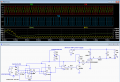
The circuit required significant modifications to get it to work properly, as shown here.

upload_2017-1-29_13-31-59.png

The selected op amps were too slow for the frequencies you want.
I picked some faster devices.

Q1 is not needed so was removed.

Q2 resistor values were too large to properly drive the large MOSFET gate capacitance.

30V exceeds most MOSFET Vgs maximum voltage limits so I connected Q2's collector resistor to you 12V source.

You output L1 and C3 values were way off.

I picked device models for all the parts.
Never use default models for simulations as they can give flaky results.

It would appear that you did very little design analysis of the circuit.
Guessing at part values is highly unlikely to give you the results you want. :rolleyes:
 

Attachments

Thread Starter

entemomoh

Joined Jul 14, 2016
24
Alright Thank you for that improved circuit. I don't think I'm going to change any of the Triangle generator and PWM comparator parts, but I'm going to try to change the resistors of Q2 and change the capacitors. I thought you needed that big of an output cap (whoopsy). But I will modify that tomorrow and let you know about the results, but you think It's going to work like that IRL right? Othwerwise good night (at least for me) and a virtual shoulder patting ;)
 

Thread Starter

entemomoh

Joined Jul 14, 2016
24
Then it's unlikely to work properly at the frequency you want.
Well of course I have different op amps that can handle 700KHz, I hope thats enough op amps are LM358p

Also I cant really measure the inductance on the output, I used an inductor from an old PSU( the yellow toroid ones)
Of course I can play with the cap to remedy that, right?
 

crutschow

Joined Mar 14, 2008
38,503
Well of course I have different op amps that can handle 700KHz, I hope thats enough op amps are LM358p
Not likely.
You need an op amp with probably at least a 10MHz gain-bandwidth to give the sharp square-wave pulses you need.
Alternately you could use an LM339/393 comparator for U1 and U3 to get the fast pulses.
The LM358 should work okay for U2.
Also I cant really measure the inductance on the output, I used an inductor from an old PSU( the yellow toroid ones)
Of course I can play with the cap to remedy that, right?
If you have an oscilloscope to observe what the output is doing.
Otherwise it's guesswork. ;)
 
Last edited:

Thread Starter

entemomoh

Joined Jul 14, 2016
24
Well I can use my scope to fiddle with the values ;)

Also I will only replace the comparators if I see issues, because right know the PWM part works marvelously. Although I will keep it in mind if I see the need for a sharper edge
 

Thread Starter

entemomoh

Joined Jul 14, 2016
24
Alright fine, they're slightly trapezoid(I also had to add a capacitor or two ;) ) but It's my first power supply that is switch mode and how much will it reduce efficiency or increase ripple roughly? I mean I'm okay with a bit of half-assing. The power is roughly 200 max and I have 3 mosfets in parallel as some side info
 

crutschow

Joined Mar 14, 2008
38,503
but It's my first power supply that is switch mode and how much will it reduce efficiency or increase ripple roughly? I mean I'm okay with a bit of half-assing.
Well, then I can understand why you are satisfied. :D

It probably won't change efficiency much but will make the output not as you would predict from the setting of the PWM duty-cycle pot.

For your amusement, here's a simple PWM circuit that uses only two LM339/393 comparators (one IC package).
It doesn't have quite as linear a change of duty-cycle with control voltage as a circuit with an op amp integrator sawtooth generator does, but it's fine for lamp dimming.

The PWM duty-cycle is shown for pot settings of 5% and 95% (0% and 100% give continuous low and high output respectively).

upload_2017-1-29_17-6-10.png
 

Attachments

Last edited:

Thread Starter

entemomoh

Joined Jul 14, 2016
24
So I made the changes and it still won't really work. Capacitor on the output is 1uF now and the resistors are also changed. I filmed the oscilloscope displaying the signal of the gate of the mosfet and the multimeter is set to a range of 25 V and connected across GND of my circuit and "output" , because connecting the multimeter across the 1 uF output cap gave me the same results but inverted. I have connected a 1.8 k resistor across the 1uF cap but also tested it with a resistor across GND and output, same result. It seems as if the range of the PWM is offset and doesn't "cover"the whole 0-30V :mad: Because at 5% duty cycle it shouldn't just be at 12V or so but at 25 or so, right?

I had to upload it to youtube :confused:
 
Last edited:

Thread Starter

entemomoh

Joined Jul 14, 2016
24
This is pretty much my exact schematic(mofets are almost correct value, although they will be replaced with IRFZ44N as soon as they arrive, because their Rdson isn't really the hit)

also the comparators are not the same as you know, but the pwm is nice and square as you can see in the video
 

Attachments

Last edited:
Top