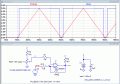
Not repetitive. It's a varying DC voltage which quickly (milliseconds) rises up from zero to max 5v for a few minutes, then fades back to zero over the course of about 20 seconds.
You can lower the thresholds (albeit with increased hysteresis) by biasing the Schmitt input with a resistor to the +ve rail, like this :-
If you want to lower both thresholds and reduce the hysteresis you can make a custom Schmitt trigger from a couple of non-Schmitt inverters as below :-
The ratio of R2/R3 sets the hysteresis amount. Here it's about 1%. R1 pulls the thresholds low.
@danadak Low accuracy in what way? @Alec_t and @ericgibbs fantastic. Both of your solutions seem great, tho's technically Alec's version uses Schmitt's as requested. Alec's version seems to win on low-parts count, tho' i'd like to see how stripped-down the LM393 can get (eliminating parts), while matching functionality.
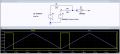
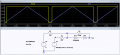
Alec, where's the triangle coming from in yours? Is that the item marked 'pulse'?
The problem using CMOS gates is accuracy of trip points pretty sloppy, even with precision resistors.
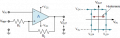
With a comparator or OpAmp its primarily determined by R tolerance. In high precision designs
offsets and G....... will also contribute to error, but your design, using an OpAmp or Comparator,
I think just R precision will determine.
The problem using CMOS gates is accuracy of trip points pretty sloppy,
but your design, using an OpAmp or Comparator, I think just R precision will determine.

 Facebook
 Google
 GitHub
 Linkedin