Solenoid Kick

Thread Starter

KKRS_

Joined Oct 26, 2023
24
Hi,

I am trying to build a circuit to activate a solenoid in one-shot mode.
I have a low-power IoT board powered by 5V via 4 AA batteries.
I would like to activate a solenoid with a nominal voltage of 12V and approximately 0.6/1A.

So I have two problems:
1. I need to raise the voltage from 5V to 12V to activate the solenoid.
2. I need to consume as little power as possible, so I thought of using a one-shot activation. The activation must be such as to release a lock, so I assume that 1s is more than enough.

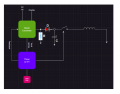
My idea was to use a boost converter to raise the voltage to 12V and a other part of circuit to charge a capacitor that “discharges” the energy into solenoid. Has anyone ever done anything like this? Can it work?
 

Thread Starter

KKRS_

Joined Oct 26, 2023
24
@sghioto

You're right, but...

I have three different power sources: USB/BATTERY/buck converter from 12V to 5V, the latter for powering high loads. Sometimes, for flexibility reasons, a user may not be able to power the motherboard with a 12V source from an external power supply, but I still want to maintain the ability to power the loads I described earlier even with battery power.

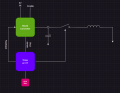
The idea is to include a booster converter with a GPI enable that allows a solenoid to be powered for 1s, and then switches off the converter immediately afterwards.

I don't know if this is the best way...
 

Thread Starter

KKRS_

Joined Oct 26, 2023
24
The idea is this.
My doubts:
1) Based on how the boost converter works, is it always best to include a load resistor in parallel with the capacitor?
2) Is the timer necessary? Can I just use the converter enable, controlling it for the desired time?

1766081871623.png
 

sghioto

Joined Dec 31, 2017
8,634
If the boost requires a minimum load then add resistor R and diode D to the output.
The diode provides a discharge path for the cap through the solenoid only.
Don't know what size cap is required but in this configuration would enable the boost, then short delay for the cap to charge followed by activating the switch and disabling the boost.
Another option is removing D and C, enable boost, short delay then activate switch for 1 second, disable boost.
1766083798817.png
 

Tonyr1084

Joined Sep 24, 2015
9,744
Hello. Here's what I'm seeing: A 5 volt source connected to a Buck/Boost converter. That converter charges a cap. At any moment you want to press a trigger that fires the solenoid. Easy enough. But here's what I'm focusing in on: The buck/boost will be running constantly just to ready the capacitor. You can get around that by adding a PRE-trigger, one that runs the B/B long enough to charge the cap.

There's another way: Press a momentary trigger to turn on the B/B then soon after - you release the trigger. You will probably have to hold it for about a second. When you release the trigger it fires the solenoid. The PROBLEM with that is once you've pressed the trigger - you're committed to firing it. During the charge time and the fire time your aim may be distracted and you could end up firing something in an undesired direction.

What are you firing? You called this a "Solenoid Gun". Are you making a gun of some sorts? This might be a violation of the rules of AAC.

However, I could see an application where I might use something similar. I'm building a rocket launching system for launching Estes rockets. Fully electronic with a 30 second count-down. My oldest two grandchildren, possibly a third, may enjoy rocket launching. However the two youngest may feel left out. So an air bottle charged with 100PSI (certified to 250PSI @ 50˚C) with a sprinkler control valve as the launcher. Set that up to fire a pulse of air from the bottle to the paper rocket. There's more detail to it than that - but I can see a use for such a device. But I wouldn't call it a gun.
 

Thread Starter

KKRS_

Joined Oct 26, 2023
24
@Tonyr1084

Sorry, my English isn't the best.
Maybe it would be better to call it ‘Solenoid Kick’.
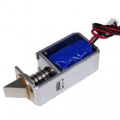
I want to unlock a solenoid of this type:

1766090582539.png

The ‘circuit’ I attached in my previous post actually checks the output voltage of the boost converter and, if it is charged, closes a ‘switch’ for 1 second, which is actually a power MOSFET towards the solenoid.
So what determines the switching of the MOSFET is the output voltage, i.e. when the capacitor is charged.
For simplicity's sake, I didn't mention the diode because I'm working on a conceptual level.
Obviously, the boost topology provides for it.
 

MisterBill2

Joined Jan 23, 2018
27,508
How about a circuit to charge two capacitors in parallel with the 5 volt source, which is simple, and then a switch to discharge two in series with the source, which also has a capacitor across it. That gives a 15 volts pulse for long enough to move the solenoid , but not long enough to overheat it. Just a relay OR even a multi contact push-button switch. No extra electronics to waste any power.
 

crutschow

Joined Mar 14, 2008
38,503
That could require a very large capacitor, depending upon the coil resistance and time required for the pulse.
Do you know its resistance?
 

Sensacell

Joined Jun 19, 2012
3,784
Here is an example of doing this with a Microcontroller to supervise and control the operation.
It's designed to make very efficient use of the battery energy.

This drives a 24 Volt solenoid once-per-minute from 2 D Cells (3Volts)

The system uses a simple boost converter to charge a capacitor, with a voltage sampling circuit that can be disconnected to avoid wasting energy. (residual charge in the capacitor is not drained)
An N-channel MOSFET drives the coil with a pulse every minute.
 

Attachments

MisterBill2

Joined Jan 23, 2018
27,508
The concept I suggested in post#9 is based on using adequate sized wire and a switch capable of a low resistance contact closure. It also demands capacitors with low internal impedance, probably 47mFD. And the current pulse would be short, 50 milliseconds should be totally adequate.
So the scheme can not possibly work if cobbled up on an experimenter's breadboard.
 

Thread Starter

KKRS_

Joined Oct 26, 2023
24
@Sensacell
This seems like a good starting point to me, although my goal would be to control everything with discrete components without an MCU.

@MisterBill2
This is a very interesting solution. It would allow me to avoid introducing a boost converter, starting directly from 5V. The reasoning is similar to a charge pump, am I right? Do you have a diagram of how you implemented everything?
 

MisterBill2

Joined Jan 23, 2018
27,508
It is exactly a MECHANICAL CHARGE PUMP, by the general definition. It would use a push button with two "form C" contacts,
I will need to drag out a pencil and paper to work it out. With the button released both capacitors are in parallel across the 5 volts, but with the button pressed they are all in series, with the third capacitor being always across the 5 volts supply. So now I need to stop and think. (back later)
 

Thread Starter

KKRS_

Joined Oct 26, 2023
24
@MisterBill2

It is exactly a MECHANICAL CHARGE PUMP, by the general definition. It would use a push button with two "form C" contacts,
I will need to drag out a pencil and paper to work it out. With the button released both capacitors are in parallel across the 5 volts, but with the button pressed they are all in series, with the third capacitor being always across the 5 volts supply. So now I need to stop and think. (back later)
Thank you, don't worry, take your time.
 

MisterBill2

Joined Jan 23, 2018
27,508
Hello. Here's what I'm seeing: A 5 volt source connected to a Buck/Boost converter. That converter charges a cap. At any moment you want to press a trigger that fires the solenoid. Easy enough. But here's what I'm focusing in on: The buck/boost will be running constantly just to ready the capacitor. You can get around that by adding a PRE-trigger, one that runs the B/B long enough to charge the cap.

There's another way: Press a momentary trigger to turn on the B/B then soon after - you release the trigger. You will probably have to hold it for about a second. When you release the trigger it fires the solenoid. The PROBLEM with that is once you've pressed the trigger - you're committed to firing it. During the charge time and the fire time your aim may be distracted and you could end up firing something in an undesired direction.

What are you firing? You called this a "Solenoid Gun". Are you making a gun of some sorts? This might be a violation of the rules of AAC.

However, I could see an application where I might use something similar. I'm building a rocket launching system for launching Estes rockets. Fully electronic with a 30 second count-down. My oldest two grandchildren, possibly a third, may enjoy rocket launching. However the two youngest may feel left out. So an air bottle charged with 100PSI (certified to 250PSI @ 50˚C) with a sprinkler control valve as the launcher. Set that up to fire a pulse of air from the bottle to the paper rocket. There's more detail to it than that - but I can see a use for such a device. But I wouldn't call it a gun.
(off the original topic) Many years ago I designed and built for a Cub Scout den a "Water Rocket Bottle Launcher" system. It utilized a plastic pop bottle partly filled with water, pressurized with a tire pump and propelled straight up by the compressed air providing thrust by accellerating the water out of the bottle.
The bottle was held down in pace by a clip that was released by pulling a rope from a distance away. A solenoid could operate a different scheme to release the bottle.
It was quite safe because the operator was at the other end of the rope, with the handle, several feet away. AND when the plastic bottle fell back down, it was empty and light enough to cause no painor injury if it hit them.
 
Top